
Perfect Color Palettes For Stunning Bouquets
When I first started growing cut flowers, I chose a bunch of random flowers in random colors and randomly planted them.
As you can expect… my bouquets looked pretty, well, RANDOM.
Random (adjective)
Definition:
1.a: lacking a definite plan, purpose, or pattern
b: made, done, happening, or chosen without method or conscious decision
Yup, that sounds about right!
No plan, method, pattern or conscious decision.
Now, don’t get me wrong. I do appreciate qualities such as whimsy, spontaneity and “happy accidents” (thank you very much, Bob Ross).
But I quickly realized that while random-looking bouquets were fun to make, I wanted something a little more… professional-looking.
Something that looked like a bit of thought and intention went into it!
The human eye/brain loves order, rhythm and pattern. Without those elements, the design can look cluttered, chaotic and disorganized.
After years of growing, harvesting and crafting thousands of bouquets, I finally figured out how to create pleasing bouquets based on COLOR palettes.
It all starts with being intentional about what COLOR flowers you choose you grow !
I’m here today to help you PLAN AHEAD and choose the best seeds in your favorite color palettes.
Psst… choosing a color palette INTENTIONALLY is what makes your bouquets look more pleasing, appealing, and well… professional!
On our farm, we work with 3 broad color palettes to craft beautiful and coherent bouquet designs that are pleasing to the eye and easy to put together.
While there are ALWAYS going to be variations in each bouquet depending on what’s available (it changes day by day!), most of our bouquets fit into one of the 3 following color palettes.
Warm Sunset tones: Flowers in warm tones, like peach, coral, apricot, salmon, buttery yellow, bronze, strawberry lemonade, sunset, etc (plus white, because white goes with everything!).
Cool Romantic tones: Flowers in cool tones, like pink, lavender, violet, silvery rose, rose, wine, blue, magenta, etc (plus white, because white goes with everything!)
Bright Bold tones: Flowers in bright tones, like red, magenta, violet, carmine, yellow-orange, maroon, orange, yellow, lime green, etc (plus white, because white goes with everything!)
Want a printable guide to help you formulate your color palette strategy?
You’re in luck!
I put together a beautiful resource to help you explore and plan your color palettes.
It’s called “Perfect Color Palettes: Your guide to elevated homegrown bouquets”.
Inside your find:
Example photos of color palettes
Photos of individual flowers, according to their color palettes
A printable list of flowers that fit into each color palette:
Warm Sunset tones
Cool Romantic tones
Bright Bold tones
Get your copy of the guide by filling out the form below. 👇
The guide will be delivered to your inbox. If you don’t see it, be sure to check your promotions or spam folder!
Let’s look at some examples of color palettes so you can see how they work in real life….

Warm tones vs cool tones

Warm tones

Cool tones

Cool tones vs Bright tones

Warm tones vs Cool tones

Warm tones

Bright tones

Bright tones

Cool tones (with a few touches of bright! )
Once you have a color palette in mind, it’s so much easier to choose what seeds to grow.
You can be confident that when it’s time to harvest your blooms, your bouquets will look organized, sophisticated and visually appealing.
Side note: If you love random-looking bouquets, then you should 100% keep making them. You do you, friend!
Enjoy the Perfect Color Palettes Guide. All the flowers featured in the guide are available for purchase on our website.
You can buy seeds from all 3 palettes (there is some overlap!) or make your life super simple and stick to one palette.
Personally, I’m on Team “Warm Sunset Tones”! I can’t get enough! They blend so perfectly with my warm-toned Dahlias in September.
What’s YOUR favorite?

It’s Dahlia Evaluation Time on the Farm!
It’s Dahlia Evaluation Time on the Farm!
Right now is the PERFECT time to do a Dahlia Evaluation before they get hit by frost and the growing season abruptly ends. Dahlia Evaluation time means I’m inspecting each plant, looking to make sure:
It’s properly labeled.
It’s healthy and productive. Any plant that looks suspect or is not producing blooms true to form is immediately culled and destroyed.

MORNING WALKS IN THE DAHLIA FIELD
This time of year, most mornings are spent walking the Dahlia field. While it’s a beautiful way to start the day, it also has purpose. One of my best (and also exhausting) qualities is observation. I notice EVERYTHING. My eyes are evaluating every plant:
Is it healthy?
Is it productive?
Is it true to form?
Is it labeled correctly?
Is it experiencing disease or pest issues?
Most of these answers are cataloged in my brain, where I file away a decade's worth of observation, examination, and scrutiny. As I get older, I become more aware that these thoughts, observations, and awareness need to be recorded or they will be lost forever. So I’m starting to record them.
A UNIQUE PERSPECTIVE ON DAHLIAS
Each Dahlia variety is unique and has different characteristics and qualities. I think of them like people. Even though they are all the same species, the variations are astounding—just like humans. I even find myself talking to them like old friends. When they start blooming, it’s usually been 9-10 months since I’ve last beheld their beautiful faces. It’s so good to see them again, and I tell them how much I’ve missed them. Every morning is a new delight. I’m cherishing these quiet moments, knowing that my time with the Dahlias is limited.
We could have 6 weeks left before frost ❄️… or 2 weeks… or somewhere in between. So I soak it all up, into my body, into my bones… to get me through that 9-10 month absence from my dear friends.
EVALUATING FOR NEXT SEASON
As I make decisions about what to grow next year, I like to keep it simple, growing about 100 different Dahlia varieties each year. This means that if I’m adding 10 new varieties, I must say goodbye to 10 varieties as well.
We are a “Cut Flower Farm,” which means we are growing Dahlias for the purpose of cutting the stems for bunches or bouquets, NOT as a landscape plant. If the Dahlia is beautiful but too short for bouquets or the petals get too damaged in arrangements, then it’s not worth our time or effort to grow it (except in a few cases where we grow them just for fun).
At the end of each season, I take about 3-4 hours and walk the field with my clipboard, making observations and notes about each Dahlia, looking for things like:
Does it grow tall enough to be used as a cut flower? If not, does it have any other redeeming qualities?
What kind of growth habit does it have? Are the stems easy to harvest for cut flowers?
Did this variety have specific issues with disease or pests?
Did I like the color? Was it easy to use in bouquets and bunches?
Are the petals sturdy and able to hold up to handling during harvesting and bunching? If not, does it have any other redeeming qualities?
Is it a good tuber producer? Some Dahlias grow incredible blooms but have consistently poor-quality tubers that make reliable tuber storage difficult. I usually give these varieties three seasons, and if it doesn’t get easier, I will discontinue growing them.
FINAL THOUGHTS ON DAHLIA EVALUATION
If you haven’t done a Dahlia Evaluation yet… you’ve still got time! Grab a notebook, inspect your plants, and start making decisions for next season. Your “Future Self” will thank you!
We have our first chances of frost this week, so if you haven’t done your Dahlia evaluation and inspection, NOW is the time to do it! If we do get frost, I expect it to be very patchy. It won’t kill the plants. It usually takes temperatures below freezing to truly end the Dahlia growing season. We call this our first “Killing Frost” or “Frostmas.” Frostmas is a celebrated holiday on our farm that signals the completion of our growing season, but we never know exactly when the holiday will arrive! It’s usually around October 15, but some years Frostmas arrives weeks before or after that date.

Once the Dahlias are killed by frost, they become completely unrecognizable, so it’s important to do your inspection and evaluation while you can still see what they look like! I walk up and down the rows with my Dahlia Map, ID tags, a Sharpie, and a spade, inspecting every single PLANT that I grow:
Is it labeled correctly? If not, be sure to flag it.
Is it healthy? If not, remove it and dispose of it.
Are the flowers true to form? If not, remove it and dispose of it.
I’m also taking notes on my clipboard about each VARIETY that I grow:
Does it grow tall enough to be used as a cut flower?
Are the stems easy to harvest for cut flowers?
Did this variety have specific issues with disease or pests?
Was the color easy to use in bouquets and bunches?
Are the petals sturdy and able to hold up to handling during harvesting and bunching?

LOOKING AHEAD TO NEXT YEAR
Next year, we are going to divide our Dahlias into two groups and two separate fields:
Dahlias for Cutting/Production: The tried-and-true varieties that perform well as cut flowers in bunches and bouquets.
Garden Dahlias: The varieties that are best enjoyed in the garden. While they still CAN be used as cut flowers, these may be Dahlias with fragile blooms or short stems, which are otherwise better suited for garden decoration.
I'll be sure to share my evaluation this winter!
QUESTIONS?
Ask them here and I’ll get back to you!
Ready for More?
If you’re serious about growing the garden of your dreams this year, register for my online course, “Backyard Cutting Garden 101”. You’ll find everything you need to plan, grow, harvest and arrange your stunning blooms. I can’t WAIT to help you grow! Click on the button below for all the details.

Meet the Dahlia Harvest Cart 1.0
Meet the Dahlia Harvest Cart 1.0
Let me introduce you to the Dahlia Harvest Cart 1.0
It’s a bit of a rough design, but it gets the job done!

Harvesting Dahlias is extremely time consuming and somewhat cumbersome because we sanitize our snips in a 10% bleach water solution between every single plant… which means we have to haul the solution with us up and down the aisles while harvesting.
(This protocol is recommended by the American Dahlia Society to help prevent the spread of virus and other disease from plant to plant. Virus is easily spread via snips, which is why we don’t allow anyone else to harvest our Dahlias. We work hard to keep our Dahlia fields as disease free as possible!)
We used to carry a bucket down the aisles with us, dipping our snips into bleach water between each cut.
However, 3-4 hours of constantly bending over to dip the snips in the bucket was hard on our bodies!
So we started imagining a better system that would allow us to sanitize the snips without bending over.

The Harvest Cart has a caddy that holds our bleach and rinse water jars. The bottom of the cart has a large bucket for holding the cut flowers.
It’s so much easier on our bodies and now we’re not bending over a million times a day!
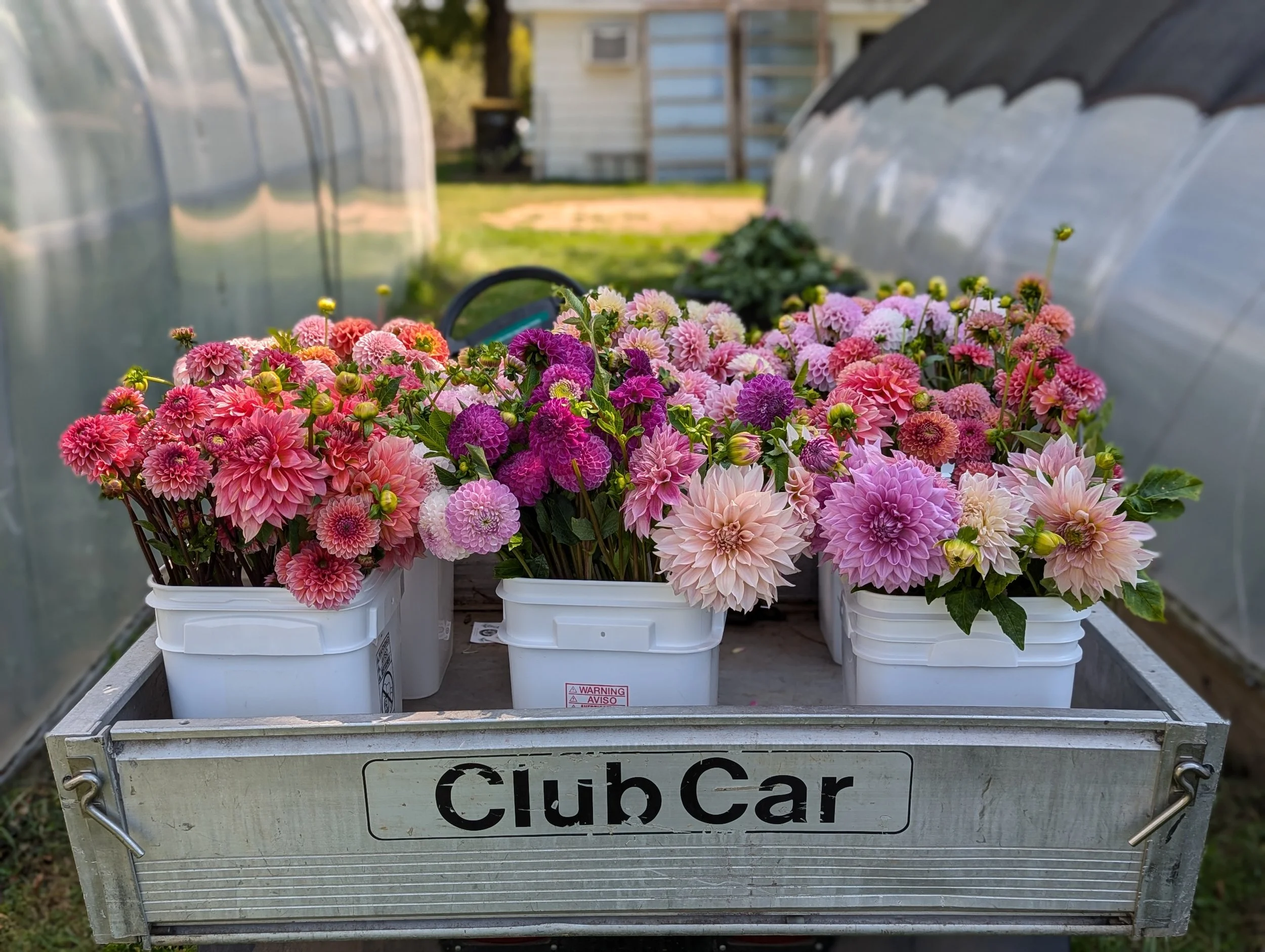
Here’s our workflow for harvesting Dahlias:
Fill clean buckets with cold water and drive them out to the Dahlia field in the golf cart.
Scrub and sharpen snips. Good sanitation practices are important to keep plants healthy!
Fill the jars with bleach solution and wheel the Harvest Cart out to the Dahlia field.
Push the Harvest Cart up and down the Dahlia aisles, cutting stems with freshly sanitized snips between each plant.
Drop cut stems into Harvest Cart bucket (bucket is dry, but stems are only out of water for a few minutes).
When finished with the row of Dahlias, push the Harvest Cart back to the golf cart.
Place cut stems on a table or golf cart seat and begin processing - cutting off foliage and unnecessary side shoots into wheelbarrows.
Before placing in water, recut the stems so they can take up water.
Once buckets are full, place them in a cool, dark place to rehydrate overnight before arranging.
We’ll likely make some modifications in the future, but for now… it works!

QUESTIONS?
Ask them here and I’ll get back to you!
Ready for More?
If you’re serious about growing the garden of your dreams this year, register for my online course, “Backyard Cutting Garden 101”. You’ll find everything you need to plan, grow, harvest and arrange your stunning blooms. I can’t WAIT to help you grow! Click on the button below for all the details.

The Bane of My Existence: Cucumber Beetles
The Bane of My Existence: Cucumber Beetles
Let me introduce you to the bane of my existence this time of year: cucumber beetles. All it takes is one nibble, and the bloom is destined for the compost pile instead of being proudly displayed in a vase.
With the extreme drought we’ve been experiencing on our farm (only about an inch and a half of rain since May… when we usually get about an inch a week) AND the extreme heat, the Dahlias are stressed. Unfortunately, stressed plants are magnets for pests.
It’s a real bummer, but it’s also part of the reality of growing ANY crop, especially one that has to be 100% blemish-free to be acceptable.

EMBRACING THE REALITY OF LOSS
I’ve learned to expect that I’ll lose ⅓ of my blooms to pests, disease, or weather-related issues. While that might sound defeatist, it actually gives me a TON of peace of mind. Instead of:
Freaking out
Getting upset
Fretting and stressing
Beating myself up
Feeling like a failure
…I simply acknowledge the issue, chuck the bloom into the compost pile (where it will turn into AMAZING soil to grow next year’s flowers!), and move on with my life. Since I plan on losing ⅓ of my blooms, I make sure to plant ⅓ MORE than I expect I need.
A PRACTICAL APPROACH TO PEST MANAGEMENT
We could put organza bags over the blooms to prevent cucumber beetle damage, but with over 1,800 plants and multiple blooms per plant, it would require thousands of bags and hundreds of labor hours to cover, uncover, harvest, and recover the blooms. This would mean I’d have to charge an exorbitant price per stem just to break even. Instead, I simply accept that loss goes hand in hand with growing. Nothing has gone wrong—this is real life!
I’m sharing this with you because it’s easy to look at other people on the internet and think they have it all figured out and that you are doing everything wrong. It’s not true. We’re all just out here, stumbling around and figuring things out as we go! The people that “fail” the most are also the people that try the most.
HOLISTIC PEST CONTROL: PARTNERING WITH NATURE
I get lots of questions about what we spray on our flowers to keep the bugs off of them, and many are surprised when I say that we don’t use sprays. There are lots of reasons we don’t spray:
It’s expensive.
It’s time-consuming.
It can be hazardous to the health of humans, animals, and the environment (many insecticides are not safe for use around pollinators). We love knowing our fields and flowers are safe and won’t cause long-term health issues.
Instead, I like to take a more holistic approach. Instead of trying to dominate nature, I like to partner with it.
Instead of trying to control everything and stressing out about a damaged bloom, I accept the reality that there will always be loss in growing.
We plan on loss because loss is normal.
CREATING A BIRD SANCTUARY FOR PEST CONTROL
My dad was a biology teacher, and I grew up spending a lot of time in nature, studying how ecosystems work. I’ve always been fascinated by how all the parts and pieces work together to create a healthy, thriving environment.
So when we started noticing pest damage on our Dahlia blooms about a month ago, I didn’t reach for a bottle to kill all the bugs (if you do decide to use insecticides, PLEASE read the instructions on the bottle very carefully, follow the directions precisely, and make sure you know EXACTLY what pest you are targeting).
Instead, we made a trip to the hardware store and bought several bird feeders. We decided to make our flower fields a bird sanctuary. We set up feeders, created water sources, and made places to perch. We rolled out the red carpet for the birds and invited them in because birds are nature’s #1 ally for pest control.

THE RESULTS OF OUR EXPERIMENT
Do we still have pest damage? Yes. Is it less than the previous years? Yes. Is it because of the birds? Not sure.
It could be that the pests have completed their life cycle, the drier weather has slowed them down, or maybe the birds really have helped to restore the balance.
Either way, it’s an exciting experiment, and hiring the birds to do what they do best has been a lot of fun!
Working in a farm ecosystem that is fully alive with plants, insects, and animals is very rewarding. I encourage you to:
Observe what you see in your ecosystem
Mimic how nature works to solve problems
Partner with nature instead of trying to dominate nature… because spoiler alert - Nature always wins. ;)
QUESTIONS?
Ask them here and I’ll get back to you!
Ready for More?
If you’re serious about growing the garden of your dreams this year, register for my online course, “Backyard Cutting Garden 101”. You’ll find everything you need to plan, grow, harvest and arrange your stunning blooms. I can’t WAIT to help you grow! Click on the button below for all the details.

How to Grow: Bells of Ireland
How to Grow: Bells of Ireland
Bells of Ireland have to be one of my favorite foliages/greenery to grow on the farm.
Not only do they add incredible texture and color to arrangements, they are also long-lasting in the vase... and bonus! They smell delicious! To me, they smell exactly like lime flavored Skittles.
Bells of Ireland are often considered a “Hardy Annual”, which means they prefer cooler weather and have some frost tolerance. This also means they are a late spring/early summer blooming flower (they usually die out by mid/late July, when it gets hot).
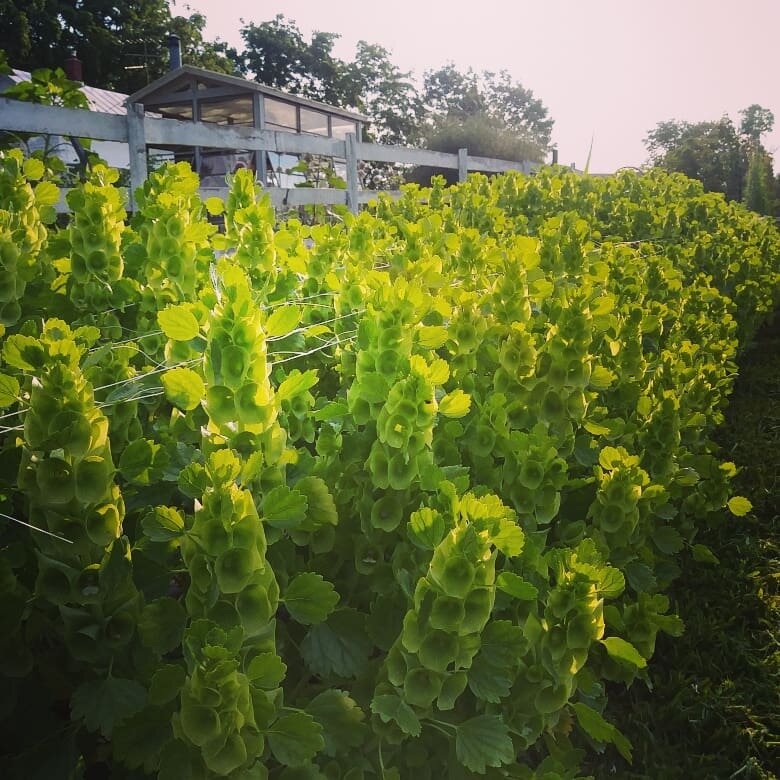
Let’s look at the Pros and Cons of growing Bells of Ireland for cut flower use.
PROS
They last a long time in the vase (in fact, they can even be dried and used as an “Everlasting Flower”).
They are an excellent foliage/greenery for bouquets and compliment nearly every flower type.
They smell good - clean and fresh, with a hint of citrus.
They are beautiful, unique and provide visual interest.

CONS
They can be notoriously tricky to start from seed. If you’re a beginner, maybe put this one on hold until you have more experience.
They need to be supported with netting or they will be flattened in a rain/wind storm.
They develop “spines” that can prick your hands if they are not harvested early enough.
The plants are not particularly long lasting. They are finished on our farm in mid-July. We pull up the plant and put in sunflowers to fill the beds.
They prefer cooler weather and do not handle heat well. For those living in climate with weather extremes, growing Bells of Ireland successfully can be difficult. Here in Michigan, it’s not uncommon in the spring for our temperatures to fluctuate over 60 degrees in a matter of days. Bells of Ireland do not handle these extremes well - they can get stressed and succumb to disease.
CHOOSING SEEDS
Choosing seeds is easy, because there is only one variety of Bells of Ireland (Moluccella laevis) that is generally used for cut flowers.
HOW TO SOW
The most difficult part about growing Bells of Ireland is starting the seeds.
They seem to be quite unpredictable and in all my research, I can’t seem to find a “Fool-Proof” method for germination. Instead, I’ll share some suggestions that may help.
First of all, storing the seeds in the freezer until you are ready to sow them is a smart idea. The freezer mimics the natural cold/dormant period the seeds need to germinate properly.
*Side Note: I store all of my seeds in the freezer, with no ill effects. I figure that if the Svalbard Global Seed Vault, the world’s seed saving experts that are preserving seeds for humanity in case of major global disaster, can store all their seeds in a freezer, so can I. As a bonus, all my hardy annual seeds are always chilled and ready to go.
Another tip is to soak the seeds in water for 24-48 hours before sowing. This helps to soften the tough seed casing.
Here is my method for germinating. It’s a bit of work and seems a little fussy…. But I’ve had good success!
1.Soak seeds in water for about 24 hours. Place seeds in a damp paper towel. Put the paper towel in a plastic bag and set it on a heat mat or in a warm spot (on top of your fridge).

2. In just a few days, the seeds will begin to sprout.

3. Carefully transfer the sprouted seeds into seed trays, tucking the "tail" (root) into the soil.

4. Seedlings can grow the trays for a few weeks until they have 2-3 sets of leaves.
Transplants or Direct Sow?
Transplants should be started indoors 6-8 weeks before the last spring frost.
Some people have better success direct sowing Bells of Ireland and don’t even attempt transplants. If you live in a mild climate, you may be able to sow the seeds in the fall or very early spring. They need a cold/dormant period to germinate properly. The freeze/thaw activity also helps to break open the tough seed casing.
For people living in colder climates, I recommend trying both methods. Start some indoors and also direct sow some seeds outdoors as soon as the soil can be worked.
Bells of Ireland can also be grown using the Winter Sowing method. Find out more about Winter Sowing.
PLANT SPACING
Bells of Ireland should be spaced 12-18” apart.
GROWING on
Bells of Ireland prefer rich soil, with plenty of nutrients and plenty of water.
If you live in a place with cooler summers, the plants may continue to produce for a few weeks. In Michigan, the summers get too hot and the plants stop producing mid-July. Enjoy them while you can!

STAGE OF HARVEST
You’ll know the Bells of Ireland are ready to be harvested when you see the tiny white flowers inside the “bells”.

Cut deep down into the plant to get long stems. You may notice the plants begin to develop “spines” as they mature. Watch out!
Strip off the leaves/bells at the bottom of the stem.

POST HARVEST CARE
Bells of Ireland don’t require any special care after harvest.
Like all flowers, store in a cool, dark place after harvesting and allow stems to rest for a few hours before arranging.
Some people like to remove all the leaves. It’s personal preference whether you do this or not. Sometimes, the leaves will turn brown or spotted, but the bells are still in great shape - in this case, simply remove the leaves.

QUESTIONS?
Ask them here and I’ll get back to you!
Ready for More?
If you’re serious about growing the garden of your dreams this year, register for my online course, “Backyard Cutting Garden 101”. You’ll find everything you need to plan, grow, harvest and arrange your stunning blooms. I can’t WAIT to help you grow! Click on the button below for all the details.