

No-Knead Artisan Bread
A simple, yet mouthwatering, recipe that will delight your taste buds… and your friends and family!
No-Knead Artisan Bread
You, yes you, can make this bread. I promise.
Doesn't it look just like something you would pay $8 for from an upscale artisan bakery? I don't know about you, but I would be willing to pay $8 for this bread.
What if I told you that you could make this bread, all by yourself, for less than $1? You will totally impress your friends and family with this beautiful bread and they will refuse to believe how easy it is!

It's true, my friends. It can be done. And guess what? You don't even have to good at baking. And you don't have to know how to knead bread. And you don't need fancy mixers.
The recipe simply calls for 4 ingredients and a secret weapon - the humble Dutch Oven.
Dutch Oven
What is a Dutch Oven? Well, it's basically a big oven-proof dish with a lid. Most are made from cast iron, but some are ceramic.
When I'm making this bread, I use my enameled cast iron Dutch Oven, but I've also used the Pyrex casserole dishes with lids. If using the small Pyrex dishes, I divide the dough in half to make two loaves, instead of the one large loaf I make in the cast iron Dutch Oven.
Whatever you choose to use, make sure it can handle high heat (450 degrees) and that the lid fits well.

Now, let me be perfectly honest here. I hate it when I see recipes that say "So easy! So fast!" and then I read the instructions only to realize it's NOT easy or fast.
This recipe only requires about 5 minutes of hands-on time and is VERY easy, but there is a lot of planning ahead, waiting and setting timers. This is a bread to bake while you are home for a good chunk of the day, at least 3 hours. Also, the dough needs to be mixed/prepared at least 12 hours ahead of the baking time (24 hours is even better), so you'll have to do some planning ahead... which is not my strong suit.
Ingredients
4 cups of flour (I suggest you start with unbleached white flour. Once you have made the loaf a few times, you can start replacing some white flour with whole wheat flour, if desired)
2 cups of cold water
2 tsp of Kosher salt
1/2 tsp of yeast (not instant yeast)

1. Mix all the ingredients together with a wooden spoon in a large bowl or container. A big glass bowl with a plate as a lid works great too. The lid does not have to be air tight (in fact, it should not be - the gases need to escape during fermentation).
Dough will be wet.
Leave the loosely covered container/bowl of dough on the counter (not the fridge!) for 12-24 hours. Go on with your business of living while the dough works it's magic.


2. After 12-24 hours, pick a time when you'll be around the house for about 3 hours. Got it? Ok, now sprinkle some flour on a work surface. I just use my counter as my work surface.

3. Dump the dough out of the bowl onto the floured surface. It will be a wet, sticky mess. Sprinkle the dough with a little more flour and attempt to fold the dough in half a couple times, working the dough no more than about 10 seconds. I like to use this plastic scraper I got at the dollar store to help me turn it over and get the sticky bits off the counter.
After folding it, cover the dough with a tea towel or flour sack towel and let it rest for 15 minutes. Go putter around for a while.

4. When the 15 minutes is up, take off the towel and lay it on the counter.
Coat the same tea towel with flour or cornmeal (my preferred choice) to keep the dough from sticking. Use more than you think you should.
Now gently gather up the dough in your hands and try to shape it into a ball. Sprinkle with more flour if needed. This should take no more than 10 seconds or so. Don't overwork the dough. You'll end up with a ball with a smooth top, but wrinkly seam on the bottom. Perfect.
5. Now place the ball seam side down on the cornmeal coated towel. Sprinkle more cornmeal or flour on top of the dough.

6. Gently cover the dough with the flaps of the tea towel and let it take a nap for 2 hours. Maybe you could take a nap too...
7. About 30 minutes before the 2 hour "nap" is over, you'll need to start preheating your oven to 450 degrees with the Dutch Oven inside it! It is very important that both the oven and the Dutch Oven are hot.
When the 2 hour rest time is over, put on your oven mitts and pull out the extremely hot Dutch Oven and remove the lid.
Now comes the hardest part. You will need to open the towel, carefully pick up the dough, still in the towel and flip it into the steaming hot Dutch Oven so the seam side is now facing up.
Do it quickly and confidently (even if you don't feel confident). Even if it looks like a mess when you dump it it, it will still turn out delicious.
8. Place the lid back on (with your oven mitts on!!!) and slide the Dutch Oven back into the oven. Bake for 30 minutes. After the 30 minutes is up, remove the lid and continue baking for 15 minutes.

9. Ta-da! Your bread is done. Pull the Dutch Oven out and remove the loaf. Allow the loaf to cool on a wire rack before slicing (yeah right... I can never resist cutting off a little piece and slathering it with butter while it's still piping hot).

10. Admire your lovely loaf of bread and be amazed that you, yes YOU!, baked such a wonder. Now go share it with your friends and teach THEM how to bake this bread! Spread the love.

BUT WAIT! There’s more!
I discovered that this recipe actually makes INCREDIBLE pizza dough. Over the years, I’ve come up with this pizza recipe and our family LOVES it.
In fact, my son is very reluctant for me to share our “secret recipe” because he thinks it’s the best pizza in the world and we should sell it. Ha!
I don’t plan on opening a pizza shop anytime soon, so here you go ;)

Cast Iron Deep Dish Pizza
2 cast iron pans
1 batch of No-Knead Artisan Bread Dough
16 oz bag of shredded Mozzarella cheese/Pizza cheese. Feel free to use less cheese if desired.
Pizza Sauce, about 3-4 oz. I often divide a 14oz jar into 4ths and freeze the remaining sauce in small jam jars.
Desired toppings: Pepperoni, cooked sausage, ham, black olive, onion, peppers… the sky is the limit!
Olive oil
Salt
Pizza Seasoning
Garlic Powder
Method
Preheat oven to 450 degrees F.
Follow the directions for making the bread, but STOP before you get to Step 7 (when you transfer the dough to the Dutch Oven).
Grease 2 cast iron pans liberally, using about 1-2 tbsp of olive oil. Divide the dough in half and press it into greased cast iron pans.
Pour a bit more olive oil on top of the dough in the pan and keep pressing the dough gently to the sides of the pan. It make take a little time for the dough to “release” and stay put. By this time, the dough will be liberally greased on the top and bottom.
Sprinkle the crust with a bit of salt, garlic powder and pizza seasoning.
Spread out the sauce, then top with cheese and desired pizza toppings.
Sprinkle with more salt, garlic powder and pizza seasoning, if desired.
Bake the pizzas in the cast iron pans at 450 degrees for about 12-18 minutes… or until they are golden and bubbly.
Remove pizzas from the oven and allow them to cool for about 10 minutes before serving.
Let me know if you try the recipe! It’s a real crowd pleaser and if you’re new at making bread, I think you’ll love how easy and simple this recipe is.
Enjoy!

Chocolate Crinkles Recipe: Our Favorite Christmas Cookie!
Our favorite Christmas cookie recipe. I think you’ll love them as much as we do!
Chocolate Crinkle Cookie Recipe
These cookies.
They fly off the plate so fast I’ve never had a chance to photograph them until now. And you better believe I had to beat off a lot of snitching hands trying to sneak a few, just to get these shots. Ha!
I found this recipe in a magazine over a decade ago and they quickly became my “go-to” Christmas cookie. They look beautiful and taste even better than they look.
It’s like a combination of a cookie, brownie and donut. Be still my heart.

BEFORE YOU BEGIN: Please note that the dough needs to rest in the fridge for 2+ hours before baking. Make sure you take this into account! Sometimes, I make the dough a day ahead of time and let it sit in the fridge overnight.
INGREDIENTS
3/4 cup butter, melted
1/2 cup unsweetened cocoa powder
1 cup sugar
2 eggs
2 tsp vanilla extract
2 cups flour
1 tsp baking powder
1 tsp baking soda
1/2 tsp salt
6 ounces of semisweet chocolate chips (about 3/4 cup)
3/4 cup confectioner’s sugar
METHOD
In large bowl, combine the melted butter, cocoa powder and sugar.
Whisk in the eggs and vanilla.
In medium sized bowl, combine the flour, baking powder, baking soda and salt.
Use a spoon or rubber spatula to add the dry ingredients to the wet ingredients.
Stir in chocolate chips.
Refrigerate dough for at least 2 hours (or overnight).
When ready to bake, heat oven to 350 F.
Pour confectioner’s sugar into a small bowl.
Roll the dough into balls about the size of a ping pong ball. Place dough balls in the bowl of confectioner’s sugar, and roll them around until evenly coated.
Place dough balls on a cookie sheet (I always use parchment paper) and bake for 10-11 minutes. Cookies will be very soft and gooey.
Allow cookies to cool on a wire rack for about 5 minutes (I simply slide the parchment paper with cookies off the baking sheet onto the wire rack).
Dust cookies with remaining confectioner’s sugar. I put a few tablespoons of confectioner’s sugar in a small sieve and lightly tap the sieve over the cookies.
Allow cookies to cool completely before handling.

Step 9: Roll dough into balls and coat with confectioner’s sugar.

Step 10: Place dough on cookie sheet.

Finished!
I hope you enjoy these cookies as much as we do!
Do you have a favorite Christmas cookie? Please share in the comments below!
-Lori

Grandma Hamm's Peanut Butter Cookies
A very special recipe to honor the woman who loved and lived in this home before me.
Grandma Hamm’s Peanut Butter Cookies
We bought this farmhouse in 2010 from a family who lived here since the 1945.
They raised 4 kids here. They raised countless farm animals. They grew a huge garden. They canned and preserved. They baked and baked and baked some more.
When we moved here, our neighbors would share stories about “Grandma Hamm” and all the delicious baked goods she would make for them.
One of the daughters who grew up here stopped by our farm to introduce herself. I begged her to share some of the family recipes.
She sent me this recipe in the mail: “Grandma Hamm's Peanut Butter Cookies”. I made them... and I swear the house sighed in contentment. "Oh yes, I remember this smell! It's been a while!"
Isn't it funny how certain smells can take us back in time and bring back memories?
I cannot tell you how delighted I am to fill this house with the scents of Grandma Hamm's legacy of love.
Now you can try them yourself. I think you’ll enjoy them as much as we do!
-Lori


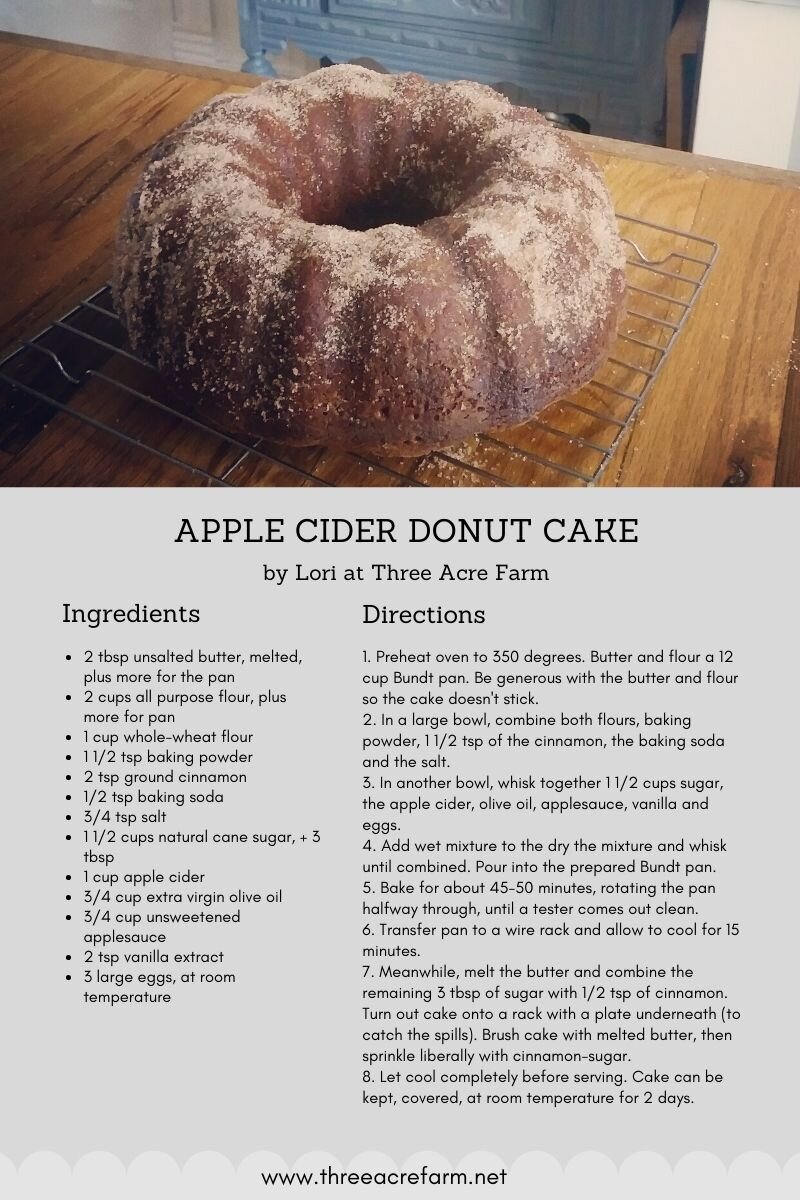
Apple Cider Doughnut Cake
Yeah, you read that right. A DOUGHNUT CAKE. And yeah, you're going to want to make this.
Apple Cider Doughnut Cake Recipe
Friend, stop what you are doing right now and go buy some apple cider so you can make this cake. You won’t regret it.
The first time I shared a photo of this cake on social media 7 years ago, I was immediately inundated with requests for the recipe... so here you go!
Now you can stop drooling and make it yourself. ;)
Oh, and while you’re at it… freeze a couple cups of apple cider in 1 cup portions, so you can make this mid winter, when apple cider is out of season. You’re going to feel like a GENIUS. Trust me.
![IMG_20171208_160758_099[1].jpg](https://images.squarespace-cdn.com/content/v1/582b872529687fd6acb7423d/1512769806951-CTDZ2V1LGK589SVJGHBO/IMG_20171208_160758_099%5B1%5D.jpg)
Apple Cider Doughnut Cake
* Adapted from "A New Way to Bake" by the Editors of Martha Stewart Living
2 tbsp unsalted butter, melted, plus more for the pan
2 cups all purpose flour, plus more for pan
1 cup whole-wheat flour
1 1/2 tsp baking powder
2 tsp ground cinnamon
1/2 tsp baking soda
3/4 tsp salt
1 1/2 cups natural cane sugar, + 3 tbsp
1 cup apple cider
3/4 cup extra virgin olive oil (you can try using a different oil, if desired)
3/4 cup unsweetened applesauce
2 tsp vanilla extract
3 large eggs, at room temperature
Method
1. Preheat oven to 350 degrees. Butter and flour a 12 cup Bundt pan. Be generous with the butter and flour so the cake doesn't stick.
2. In a large bowl, combine both flours, baking powder, 1 1/2 tsp of the cinnamon, the baking soda and the salt.
3. In another bowl, whisk together 1 1/2 cups sugar, the apple cider, olive oil, applesauce, vanilla and eggs.
4. Add wet mixture to the dry the mixture and whisk until combined. Pour into the prepared Bundt pan.
5. Bake for about 45-50 minutes, rotating the pan halfway through, until a tester comes out clean.
6. Transfer pan to a wire rack and allow to cool for 15 minutes.
7. Meanwhile, melt the butter (if you haven't already) and combine the remaining 3 tbsp of sugar with 1/2 tsp of cinnamon. Turn out cake onto a rack with a plate underneath (to catch the spills). Brush cake with melted butter, then sprinkle liberally with cinnamon-sugar.
8. Let cool completely before serving (yeah right!!!). Cake can be kept, covered, at room temperature for 2 days.
Did you try it?
Let me know what you think! I kind of have a thing for Apple Cider Doughnuts... Of course, this is not quite the same as deep fried doughnut, but my family agrees it's a pretty good substitute.
Enjoy!
How to Dig and Store Your Dahlia Tubers
Not sure how to dig, divide and store your dahlias? Relax! Here’s everything you need to know to successfully overwinter your dahlia tubers!
How to Dig and Store Your Dahlia Tubers
This time of year, I receive countless questions about digging and storing dahlia tubers. There is so much conflicting advice and uncertainly. Some people start to panic!
I get it. Tubers are a big investment and of course, you want to do everything you can to ensure your tubers survive over the winter.
I’m going to walk you through the process we use for digging and storing our dahlia tubers. After reading and watching the videos, you should feel more confident and ready to try it on your own!
Before we dive in, I want you to know 2 things:
1. There are several different methods that can be used to store dahlia tubers. When you hear “seemingly contradicting” advice, just know that different methods work for different storage situations. The way WE store them might not be best for YOU, since we don’t have the exact same storage spots.
2. If you are new to storing dahlia tubers, I highly recommend you try a few different storage methods and locations. This will help you discover the ideal methods for YOU. It’s never a great idea to “put all your eggs in one basket”. This way, if one method is a flop, you have a back up supply of tubers.
Got it? Good.
So, first… here’s a quick video that shows you what dahlia tubers clumps should look like AFTER you dig them up. Notice the big clump of tubers and the short stem.
Ok, now that you know what you’re going for and what the tubers look like, let’s get digging!
Digging and Storing Your Dahlia Tubers.
Step 1: Wait for Your First Frost
Dahlias are very sensitive to frost. You’ll know you’ve had a frost because one day your plants will look beautiful… and the next day they will be black and dead (see before and after photos below). Flower farmers call the First Killing Frost of the Season “Frostmas”. ;)
Feel free to go out by your dead dahlias and cry a little bit. No judgement here. Goodbye, my loves…
Frost covered dahlias are gorgeous, but they only look pretty for about an hour and then they turn to mush. Get out there and take photos! It only happens once a year!
You don’t HAVE to wait for the frost to kill the Dahlias in order to dig them up. However, it’s best to allow them to grow for at least 135 days (four and half months)… which naturally coincides with many grower’s frost dates, which is why frost is usually the signal to start digging!

Happy Frostmas! “Black Satin” after the first frost.

BEFORE: Dahlia field the day before the 1st frost.

AFTER: Dahlia field the day after the 1st frost. These photos were taken within 24 hours of each other!
Step 2: Cut Back the Plants… and Wait
Once the frost has killed the plants, go through with a heavy clippers or loppers and cut back the main stem and all the foliage, leaving a “stem handle” sticking up out of the ground about 4-6” long.
Once you have cut back the plants, it’s time to WAIT. You can relax for a week or two. Simply leave the tuber clumps in the ground, undisturbed.
Cutting back like this signals the tubers below the ground to set “eye” (sprouts) on the tubers. This is helpful because you need to be able to see the eyes if you plan on dividing your tuber clumps right away.
Cutting back also signals the tubers to cure and toughen up, which helps them store better over the winter.
Don’t have to time to leave them in the ground? Sometimes the weather or your life commitments are not conducive to waiting. No problem, friend. You can cut and dig on the same day. It just might be a little trickier to see the eyes when you dig them up.
If you have not received a killing frost by November 1, you can start cutting back plants anyway. You want to leave yourself enough time to get them out of the ground before the ground freezes. Yup, I’ve been out there digging the last of the tubers out in the snow in December. ;)

We made “Cut Back the Plants” day into a work party and cut back the whole field in 1 hour!
Step 3: Time to Dig!
After 1 -2 weeks of curing in the ground (or less, if you need to dig right away), you can begin digging.
Using a pitchfork, CAREFULLY loosen the soil on all sides of the tuber clump. Take care to NOT break the tubers. They are EXTREMELY fragile.
Do NOT yank up the tuber clump by the “stem handle.” Instead, place one hand on the handle and use the other hand to pry up the clump with the pitchfork.
Gently remove excess soil from around the tubers with a pencil, stick or paint brush. Clip off “root hairs” and any broken tubers.
Using a loppers or heavy clippers, cut off the “stem handle” near the base of the clump, leaving about 1-2 inches. Do NOT cut too low or you will cut off the “eyes”!
Place the clump in a bag or crate with the dahlia variety name clearly marked on it.
Bring the bags/crates to a cool, dry location out of direct sunlight (like a garage or covered porch) and allow them to dry to the touch. This may take a few hours or a few days, depending on weather conditions and temperature. BUT MAKE SURE THEY DO NOT FREEZE DURING THIS TIME!!! Unfortunately, we know this from experience. :(
Do NOT set tubers directly on concrete to dry. It will dry them out. Place them on tables, counters, pallets, crates, etc.

A nice looking dahlia tuber clump!
Step 4: To Divide… Or Not to Divide
Once your tubers have dried for about a week, you need to decide:
Will you divide your clumps now or in the spring?
We usually divide in the spring (we simply don’t have time to deal with them in the fall!), so we store our tubers in clumps. We feel keeping the clumps whole as long as possible helps the tubers to store better… but obviously, it takes up waaaaaay more room than storing individual tubers.
If you do decide to divide in the fall, you will need to do a little more babysitting over the winter.
*Please note: We HIGHLY recommend you sanitize your snips/knife/tools between tuber to clumps to prevent the possible spread of disease between plants.
IF YOU DIVIDE IN THE FALL:
Wash clumps and allow them to dry overnight… or simply brush off excess dirt with a paintbrush (this works best for light sandy soil. If you grow in heavy clay, you will need to wash them).
Divide the clumps into individual tubers (watch the video below to learn how). Allow cut ends on tubers to dry and cure, about 1-2 days. Remember: ONLY tubers with “eyes” are viable!
Store tubers in bins/boxes filled with vermiculite, peat moss, or wood shavings. Be sure that they are not touching each other! Fill the bin with about 1-2 inches of storage material and carefully place the tubers so they are not touching. Sprinkle another 2 inches of storage material on top and add another layer of tubers, and so on. They can also be wrapped in newspaper to prevent touching.
Store at 40-45 degrees Fahrenheit, with about 80-90% humidity.

“Eyes” on a tuber.
IF YOU ARE LEAVING THE CLUMPS WHOLE:
Leave clumps unwashed. Brush off as much dirt as possible.
Store in boxes/plastic or paper bags/crates at 40-45 degrees Fahrenheit, with about 80-90% humidity. If you are storing in a dry place, plastic bags may work best. If you are storing in a damp place, paper bags may work best.

Tubers in a paper bag ready for winter storage.
Step 5: Long Term Storage
THIS IS THE TRICKIEST PART OF GROWING DAHLIAS. Dahlias are relatively easy to grow, but proper winter storage can be a struggle!
Here are a few tips for storing your tubers over the winter, regardless if they are divided or not.
Store at 40-45 degrees Fahrenheit. If the tubers freeze, they will turn to mush when they thaw. If they get too warm, they could rot.
Humidity at about 80-90%. Ensure that the tubers are not too dry (they will shrivel) and not too wet (they will rot). If your space is dry, you can control this by storing in plastic bins/bags and occasionally spritzing with water. If your space is damp, try storing in paper bags/cardboard boxes that will help absorb moisture. Peat moss, wood shavings and vermiculite will also help regulate humidity. You may need to run a dehumidifier OR a humidifier, depending on your needs.
Check on your tubers every few weeks. Remove any rotted, mushy tubers. Mush is no good. If the tubers looks shriveled and dry, don’t toss them - move them to a more humid location. I’ve seen the most terrible dead-looking tubers come back to life in the spring.
Sometimes the tubers develop small amount of mold. Don’t panic. It means your spot is too humid. Move them to a drier spot and simply brush off or wipe off the mold.
FOR BEST RESULTS, we recommend trying a few different storage methods and locations. Keep notes and make observations. Until you discover what works for you, it’s wise to not “put your eggs in one basket.”
People are always asking me:
“How do you store YOUR Dahlia tubers?”
I’m reluctant to talk about our storage method, because it’s nearly impossible to replicate our method. If you want to see how we do it, you can read about it HERE.
BOTTOM LINE: You will have to do your own experimenting/trialing to figure out the best place and method for YOU to store YOUR Dahlias tubers. What works for someone else could be disastrous for you.
I wish there was a “one-size-fits-all” solution. I really do!!! But there isn’t, because every single Dahlia grower in the world has a slightly different storage solution. Nobody has the exact same storage area or conditions.
After talking to hundreds of people about their storage methods, here are a few we’ve heard of:
Filling a cooler with vermiculite and nestling the tubers in there. Then place the cooler in an unheated garage, pushed up against a wall of the house that IS heated, and cover the cooler with a blanket (stays cool, but hopefully does not freeze - cross your fingers!).
Stored in vermiculite in bags in a hall closet that has an exterior wall (to keep the closet cool).
Bury a trash can in the ground, stuff it full of straw, place the tubers in there, then cover with the lid and heaps of straw or leaves to insulate it.
A good old-fashioned root cellar.
A crawl space
Cold corner of the basement, stored in peat moss (if the basement is dry) or pine shavings (if the basement is damp).
A wine refrigerator.
Concluding Remarks
Thanks for taking the time to read this. I know, it’s a lot of overwhelming information and some of you are wondering if it’s worth all the time and effort. And maybe now you understand why dahlia blooms cost more than most other flowers! They are a real labor of love!
You don’t HAVE to dig up your tubers every fall. Some people simply decide to purchase new tubers every spring and that is fine! If you are on our email list, you’ll be the first to know when we have dahlia tubers available in the late winter/early spring.
You also can try experimenting with “overwintering” you tubers in the ground, depending on where you live. Here in Zone 5b in the Great White North (Michigan), dahlias will not survive over the winter, but… let me tell you what happened to us last year!
We had several “Blizzard” variety dahlias that we did not need to dig up (because each plant produces about 20+ new tubers!) so we left them in the ground. Our neighbors gave us huge loads of maple leaves and they ended up in a giant heap (2-3 feet deep) over the dahlias. We meant to move them but didn’t get around to it before the snow came.
Come spring, I lifted up that thick layer of leaves… and found a dozen healthy dahlia plants sprouting! We transplanted them and they did GREAT this season. So, it IS possible to overwinter them, but it might have been a fluke.
It’s worth experimenting with though, if you have large amounts of leaves you can mulch with…
That’s it, folks.
Have fun digging your tubers!
-Lori