Top 10 Fall Flower Farm/Garden Tasks to Start Today
Finish strong! Fall is the best time to accomplish these important farm/garden tasks.
Top 10 Fall Flower Farm/Garden Tasks to Start Today
Fall may be here but there’s still lots of work to be done in the field and garden!
In fact, fall is the most labor intensive season on the farm. After a long growing season, we’re bone deep tired. My husband and I often yell out to each other “Finish strong!” as we stumble our way toward the finish line (Thanksgiving is unofficial “end date” for field work). Ha!
Here’s my list of some of the most important “Fall Tasks” to tackle before the snow arrives.
1. Take Notes and Make Evaluations
Over the growing season, I take a farm walk each Sunday morning and write notes to my Future Self to help me make better growing decisions in the future. It takes me about 10 minutes, but it’s incredibly valuable.
At the end of the season, I allow myself a couple hours to do a longer farm walk and reflect on the entire year as a whole.
What worked? What didn’t? What did I love? What have I outgrown? What felt right? What do I actually want to grow?
It’s a simple notebook and it’s literally just scribbled notes like:
“Don’t grow as much Amaranth next year”
“Snow Maiden Scabiosa is a pain in the butt to harvest. I don’t ever want to do this again.”
“Plant 4 successions of Tender Annuals next year instead of 3”
When I start making my crop plans and seed order lists in the winter, I pull out these notes and thank my Past Self for being so honest and truthful. Because let’s face it, in the winter we all want to grow ALL THE THINGS… but my Past Self reminds me of what I actually need to grow. ;) Stick with the plan!
2. Submit a soil test
Fall is the best time to take and submit a soil test. Any soil test at any time of year is better than no soil test… but fall is ideal.
When taking and submitting a soil test, be sure to follow the instructions on the test EXACTLY.
Once your soil test has been mailed in and analyzed, you’ll receive recommendations on what you can do to improve your soil.
I suggest adding the soil amendments in the fall, rather than the spring. Why? Soil amending is a slow process and the sooner you can start, the better. Adding the amendments in the fall allows them to slowly incorporate into the soil over the winter, so that your soil is ready to go in the spring.
Do not skip this task. I know it can feel confusing, but HEALTHY SOIL = HEALTHY PLANTS. Improving the health of your soil is the absolute best thing you can do to reduce pest/disease issues and increase the productivity of your plants.
3. Cut back summer crops and repare your planting beds/areas for early spring planting.
If you want to plant “Hardy Annuals”, you’ll need to prepare your beds in the fall. Hardy Annuals are cool weather crops that grow best in the fall or spring. In order to grow them properly, you’ll likely need to plant them or sow the seeds in the fall, late winter or early spring.
If you live in a cold climate like mine, the soil is frozen most of the winter. As soon as the top inch of soil thaws out in early spring (March), it’s time to plant Hardy Annuals. Trust me - you don’t want to be trying to prepare beds in cold, muddy March.
Prepare your beds now and your March self will be so grateful.

4. Shop for and plant Perennials
Early Fall is the BEST time to plant Perennials, shrubs and trees. The cooler weather and increased rainfall is perfect for establishing these deeper rooted plants (instead of planting in the spring when the heat and drought of summer can stunt new plantings). Be sure to water them in well and apply a nice thick layer of mulch at the base to protect them from temperature extremes.
This is also when we plant bare root Peonies. The first season, we mulch them well to prevent frost heaving, but in subsequent years they don’t need mulch.
Many plant nurseries will still have a great selection of Perennials in the fall, so get out there and give your local plant nursery some love. Help them end their season strong!

5. Divide Perennials
If you already have lots of Perennials and they need to be split or divided, now is the time to do it. Here are some of my favorite Perennials for cut flower use.
6. Plant Spring blooming bulbs
As soon as the weather and the soil begins to cool down, it’s time to begin planting spring bulbs, like Tulips, Daffodils, Alliums, etc. Here in Michigan (Zone 5), we usually plant our Tulips in October or early November. Want to learn how we plant our Tulips that we grow for cut flowers? Learn more in this blog post.

7. Dig Dahlia tubers
In our climate, it’s too cold to overwinter Dahlias, so we must cut back the plants, dig up the tubers and store them over the winter to be replanted the following spring.
To learn more about digging and storing Dahlia tubers, read this blog post.

8. Preserve the harvest
As we cut back all the flowers (we cut each plant at the ground and leave the roots in the soil to increase organic matter), we reserve any blooms that can be dried for making dried flower arrangements. These dried flowers allow us to have “farm fresh, locally grown” flowers in our house all year long. Learn more about dried flowers in this blog post.

9. Wash and sanitize seed trays
If you grow your own seedlings, it’s ideal to wash everything at the end of the season so you have clean trays ready for next spring. A warm fall day is great for this.
Bring your supplies outside, turn on the hose and scrub your trays with soapy water. After rinsing the trays, spray them with equal parts vinegar and water. Allow to sit for about 10 minutes, then rinse. Allow the trays to dry in the sun before stacking them.
Doing this outdoors in the fall is much easier than trying to wash all your trays in the bathtub in January. Ask me how I know this ;)
10. Collect fallen leaves
Leaf compost is a wonderful soil amendment, full of nutrients and beneficial bacteria. Best of all, it’s free!
We collect as many leaves as we can and create a giant leaf pile. We allow the leaves to break down for about a year, turning them occasionally to help them break down into small pieces. This massive pile eventually turns into a small pile of soft, crumbly, earthy smelling compost that plants love.
You can use this compost to top dress your planting beds or Perennials.
NOTE: Do not use Black Walnut tree leaves, as they contain a compound called juglone that can stunt the growth of other plants. Thankfully, Black Walnuts lose their leaves earlier than most other trees, so it’s easy to avoid mixing them with other leaves.
There you have it. Finish strong, friend!

Crisp Cucumber Salsa Recipe
A delicious way to use up fresh produce from the garden!
Crisp Cucumber Salsa Recipe
When August rolls around, it seems like the garden explodes overnight. Every day, I bring in loads of tomatoes, peppers, cucumbers, herbs and more.
I feel rich and wealthy beyond measure! There is something deeply satisfying about growing and eating your own food - your labors of love coming to fruition!
In August, I'm always looking for ways to use up our produce.
My friend Alicia shared this AMAZING recipe that takes advantage of all the good things growing in the garden in mid summer.
I think you'll like this recipe as much as we do! I went ahead and doubled the original recipe for you... because, trust me. You'll want a double batch.

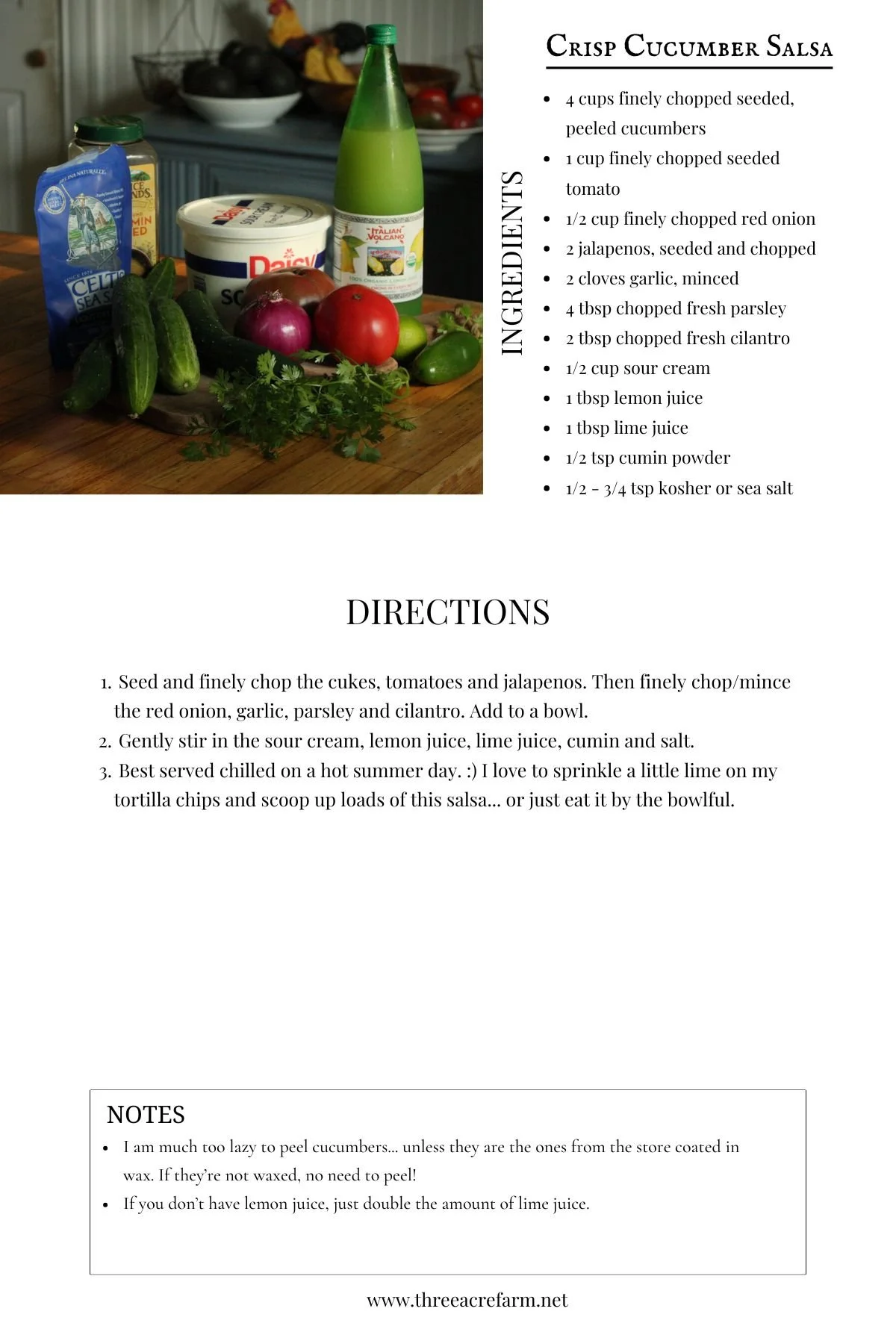
Crisp Cucumber Salsa
Ingredients
4 cups finely chopped seeded, peeled cucumbers (Note: I'm much too lazy to peel cukes... so I don't and it still tastes/looks great)
1 cup finely chopped seeded tomato
1/2 cup finely chopped red onion
2 jalapenos, seeded and finely chopped
2 cloves garlic, minced
4 tbsp finely chopped fresh parsley
2 tbsp finely chopped fresh cilantro
1/2 cup sour cream
1 tbsp lemon juice
1 tbsp lime juice
1/2 tsp cumin powder
1/2 - 3/4 tsp kosher or sea salt

Method:
1. Seed and finely chop the cukes, tomatos and jalapenos. Then finely chop/mince the red onion, garlic, parsley and cilantro. Add to a bowl.
2. Gently stir in the sour cream, lemon juice, lime juice, cumin and salt.
3. Best served chilled on a hot summer day. :) I love to sprinkle a little lime on my tortilla chips and scoop up loads of this salsa... or just eat it by the bowlful.

What are your favorite summer time recipes for using up your garden fresh produce? I'd love to hear them!
-Lori
Simple Tips for Beautiful Bouquets
These 3 simple tips will set you up for success
“What are your best tips for making a beautiful bouquet? Mine never look as good as I imagine them in my head!”
I hear this question all the time!
You’re in luck - I have some simple, actionable tips that will help.
Over the past 10 years, I’ve crafted thousands of bouquets using seasonal blooms from our farm. When I first started, I’ll admit my bouquets were less-than-stellar (that's a nice way of saying it!) because I was trying to do too many things at once.
As is true with so many things in life… Simplify, simplify, simplify!
Choose a Color Scheme
Remember sitting in Art class learning about the Color Wheel and rolling your eyes thinking “This is so boring. Why do I need to know this? When will I ever use this?”
You’re gonna use it now, friend. ;)
The Color Wheel is a tool that helps you determine which colors look good together, depending on the “feel” or “look” you’re going for.
Sticking to a recognized Color Scheme, instead of mixing colors together willy nilly, will create a cohesive, pleasing design.
Of course, rules are meant to be broken, but if you’re looking for some guidelines to keep you on track, stick with a Color Scheme.
Color Theory can be complex, so here are a few Color Schemes that are simple and easy to use:
Complementary Colors: Colors directly across from each other on the color wheel. (Ex. Violet and Yellow)
Color Triads: Colors that form a perfect triangle on the color wheel. (Ex. Violet, Green and Orange)
Monochromatic: Multiple shades and tones of one color. (Ex. Varying shades and tones of pink)
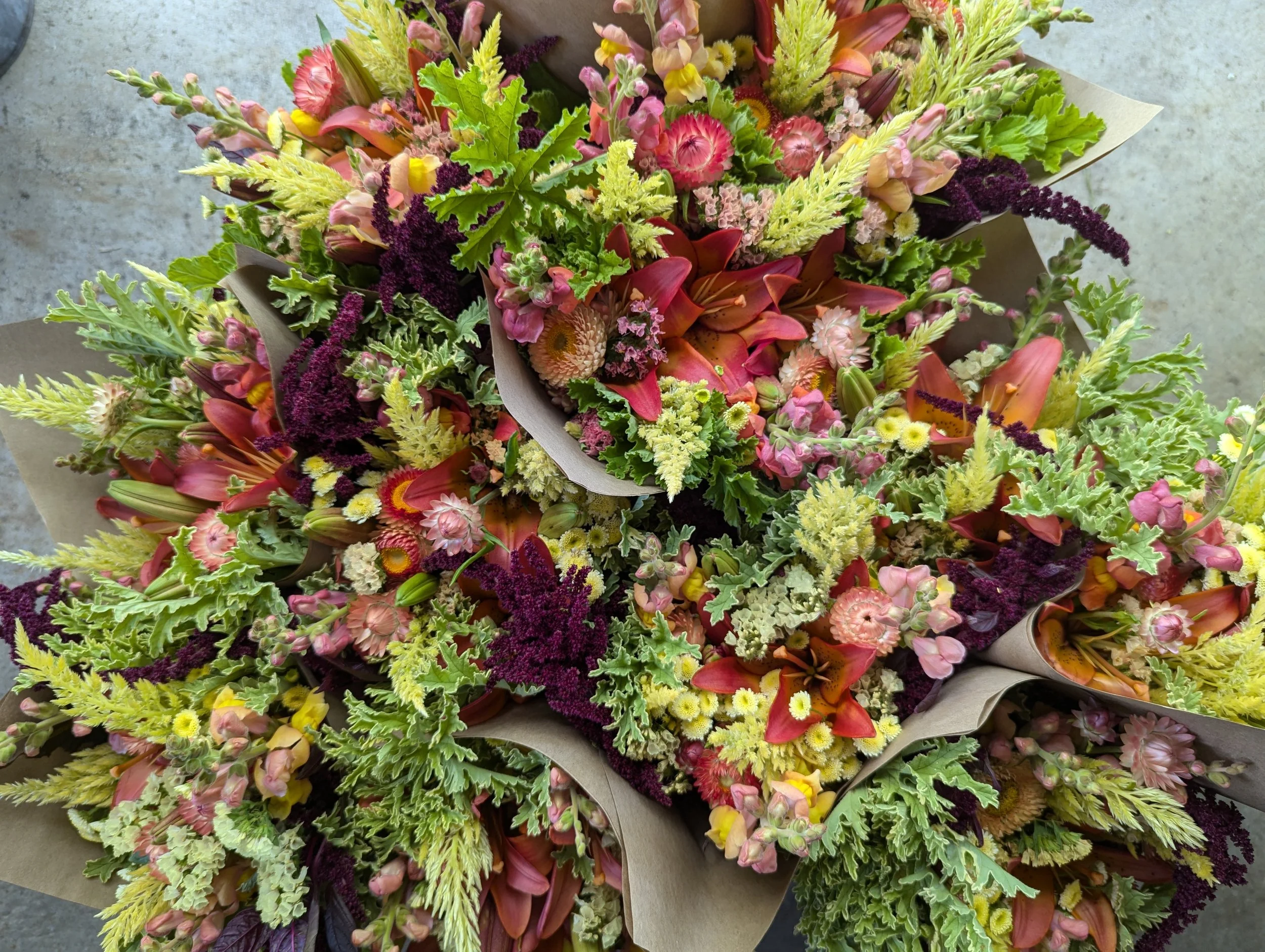
Warm Colors: Reds, Oranges, Yellows
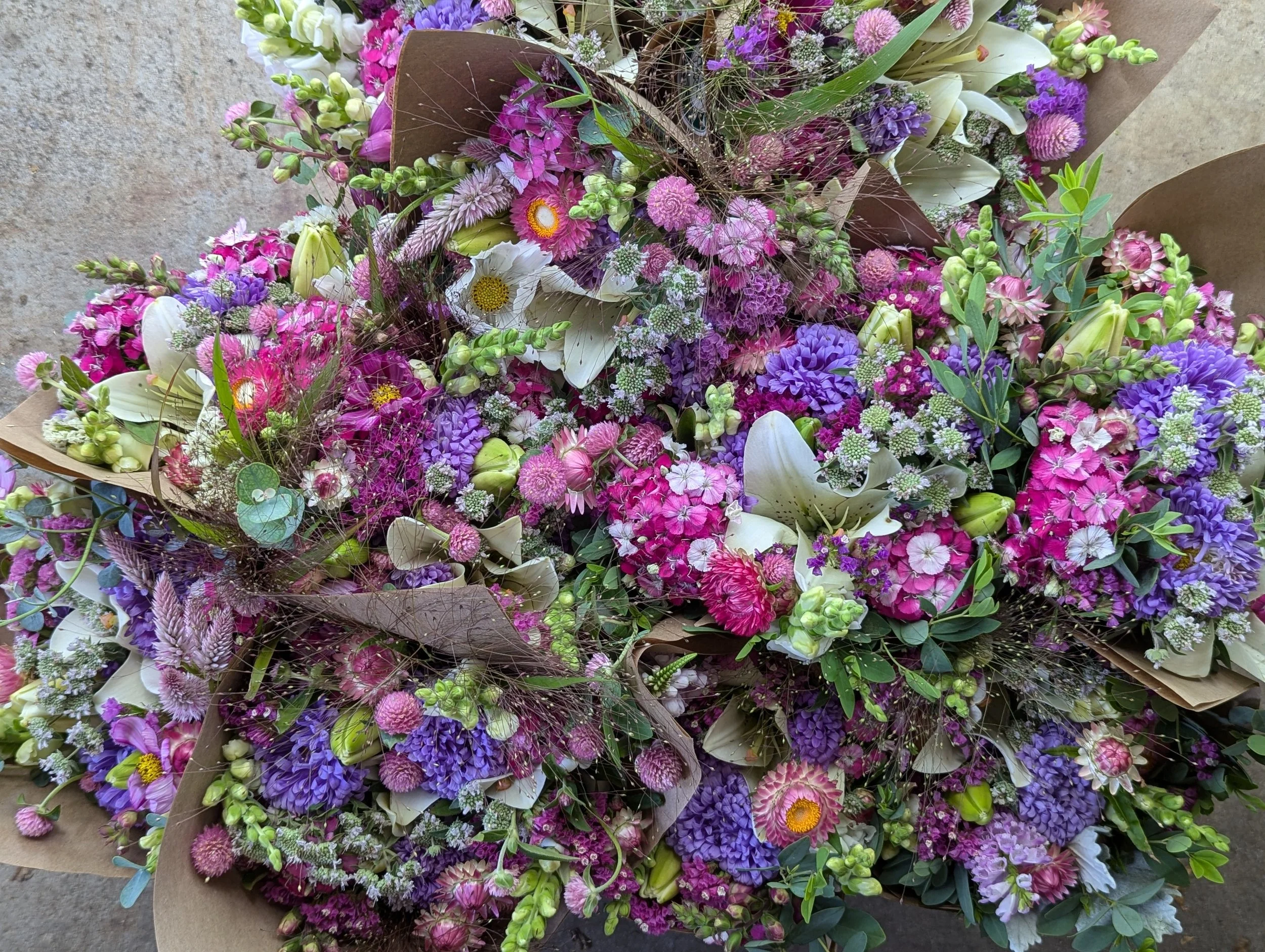
Cool Colors: Greens, Blues, Violets
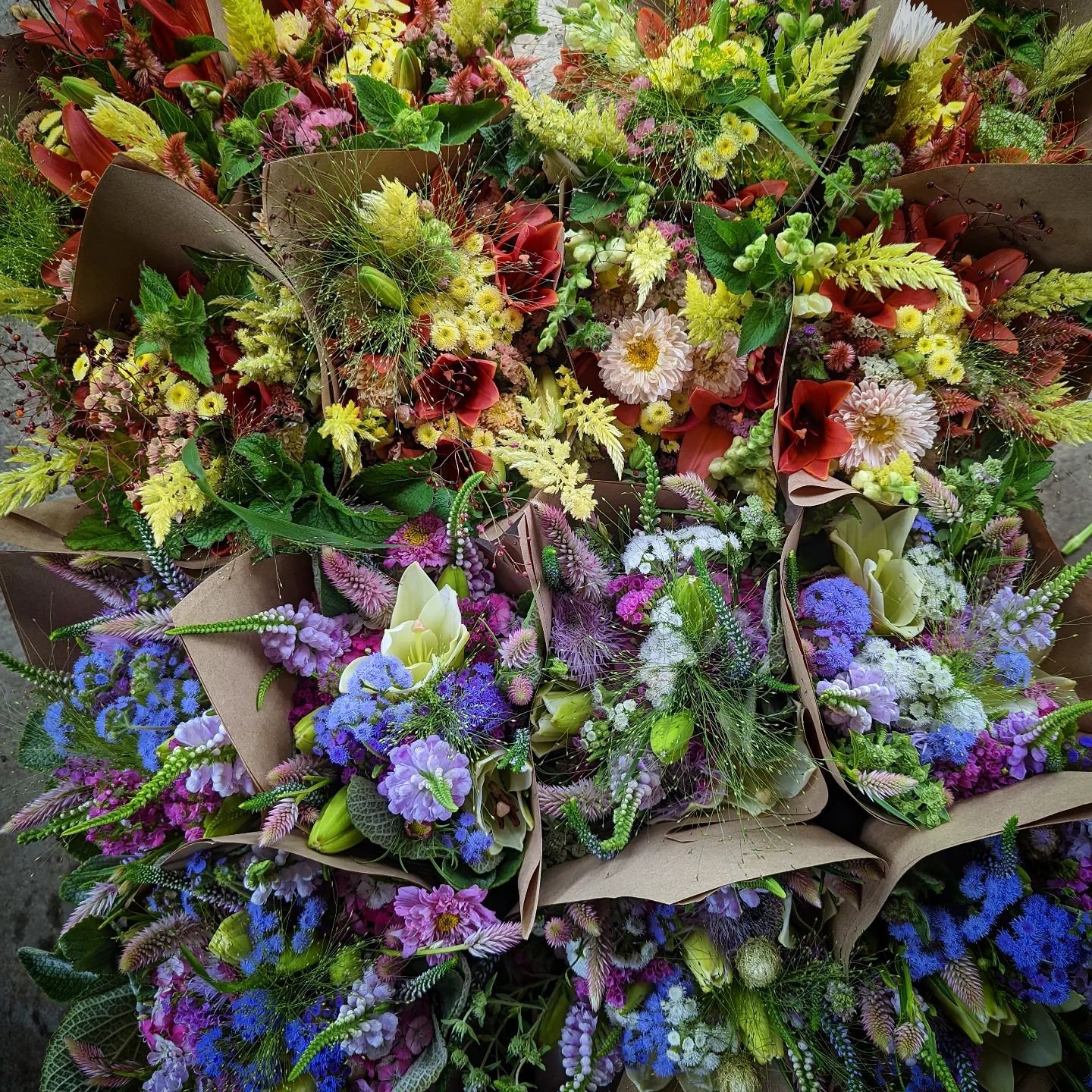
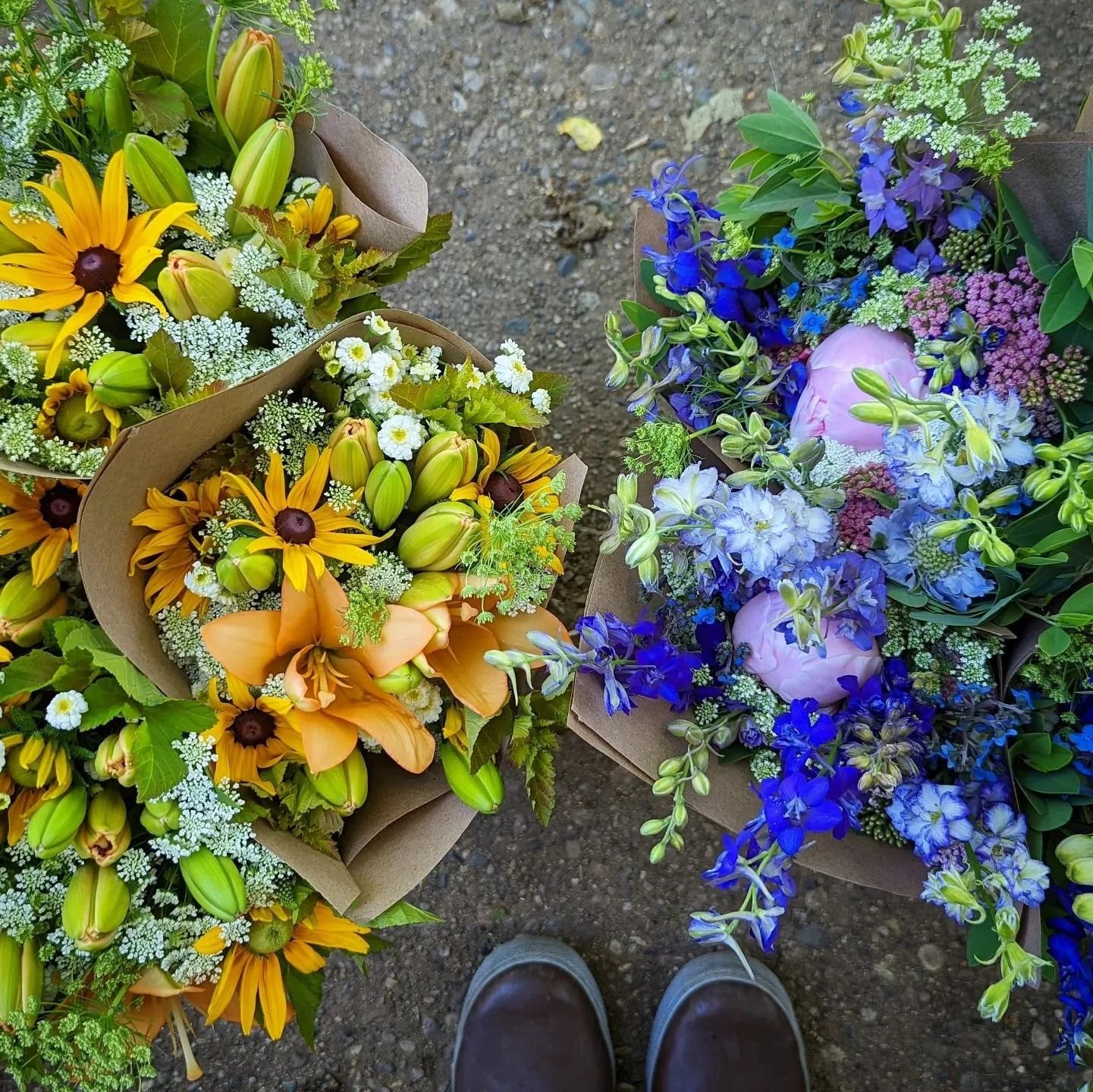
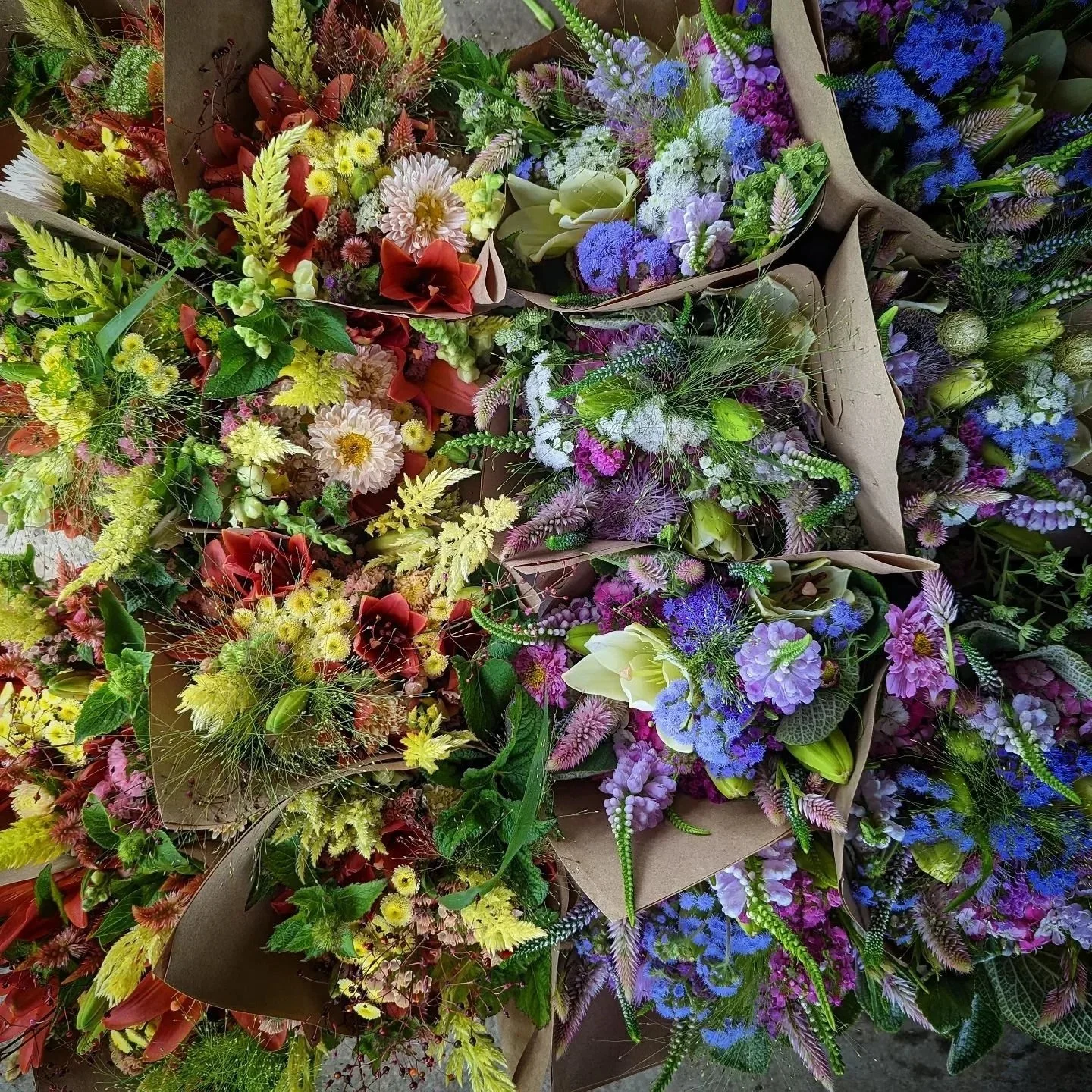
As you can see in the sample photos below, I love to work with “Warm” and “Cool” Color Schemes.
When we make our bouquets, we pull out all the “ingredients” (flowers/foliage) we have to work with, then divide them into “warm” or “cool”.
Then we lay out the “cool” color ingredients on the table assembly line style and make all the cool bouquets. After we’re done, we switch to the “warm” color ingredients and make all the warm bouquets.

Warm vs Cool
Warm vs Cool
Warm vs Cool
Warm
Cool
2. FOCAL, FILLER, FOLIAGE
To simplify the bouquet-making process, on our farm we assign every bouquet ingredient to one of these 3 categories:
Focal: The main flowers that capture the most attention.
Filler: The other flowers that complement the Focal flowers (the vast majority of the bouquet is made of these ingredients).
Foliage: The greenery that creates the foundation for the Focal and Filler flowers
To learn even more about Focal, Filler, and Foliage,read this Blog Post.
We like to divide a bouquet into roughly ⅓’s so that the overall mass of the bouquet is:
⅓ Focal Flowers
⅓ Filler Flowers
⅓ Foliage
We find this simple loose formula, along with a well-defined color scheme, leads to a well-balanced, pleasing bouquet.

Focal: Dahlias
Filler: China Aster, Veronica, Celosia, Snapdragon, Strawflower, Lisianthus, Gypsophila, Statice
Foliage: Eucalyptus, Plectranthus
3. LIMIT THE “INGREDIENTS” in your “recipe”
It’s very easy to succumb to the temptation to add “a little bit of this, a little bit of that” to a bouquet… until you’re left with a cluttered, mish-mash bouquet that has no distinctive “flavor”.
The secret here is CONSTRAINT.
Instead of choosing 30 different flowers/foliage, CONSTRAIN YOURSELF and choose 5-10 flowers/foliage, and use them in multiples of 3-7 stems.
Why? The human eye loves pattern and repetition. Repeated shapes, colors, textures… all of these are pleasing to the eye and our brain can make sense of them. If a bouquet has no pattern or repetition, it looks chaotic and our brain doesn’t know how to process it.
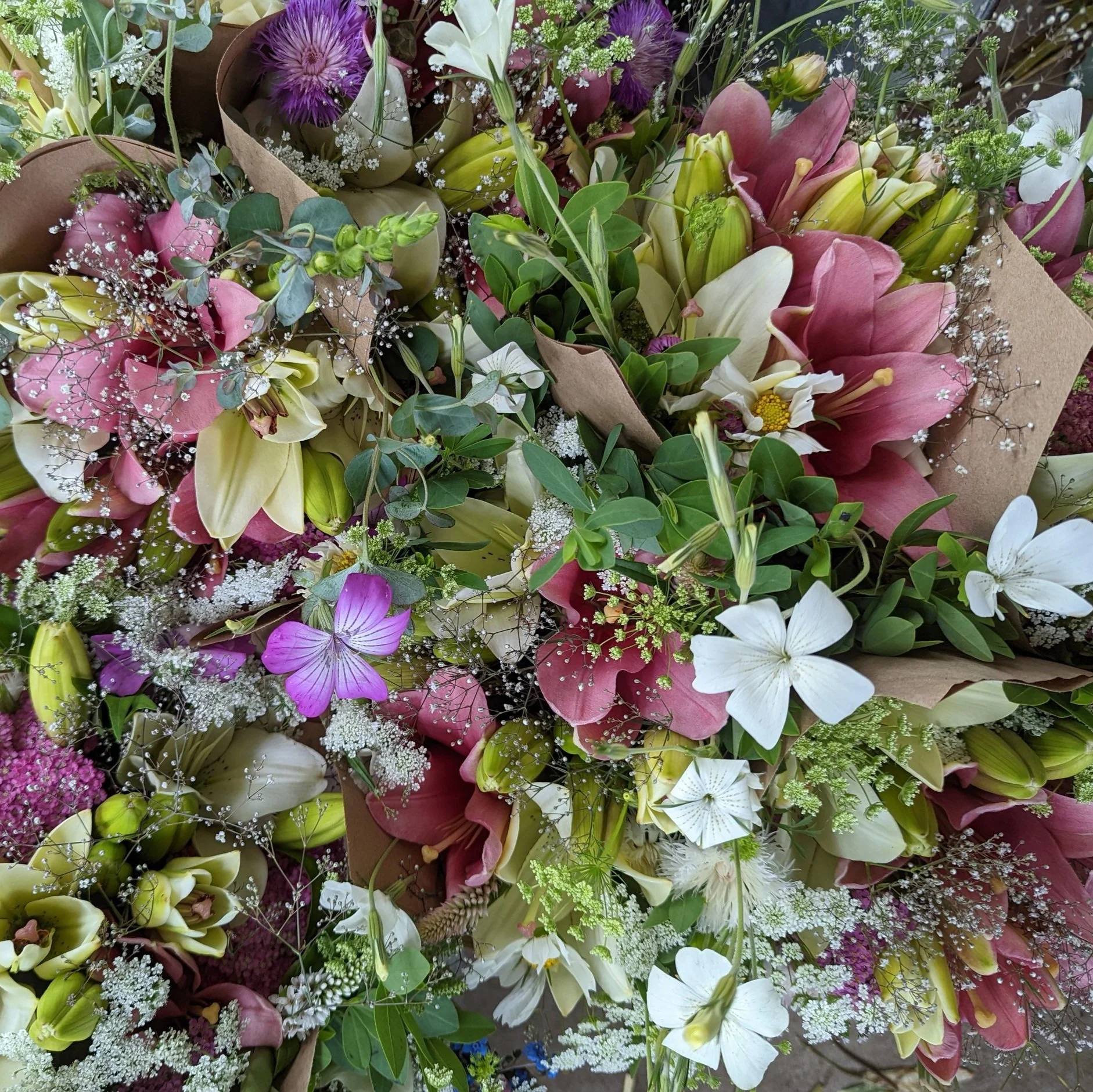
Here’s a sample bouquet “Recipe”:
Focal - 1 Lily stem
Filler - 3 Snapdragon stems, 5 Yarrow, 3 Ammi (False Queen Anne’s Lace) stems, 5 Agrostemma stems
Foliage -3 Baptisa stems
There are countless more bouquet tips, but again I want to emphasize:
Simplify, simplify, SIMPLIFY.
Once you master these 3 simple tips, you’ll be crafting your own beautiful bouquets in no time!

How to Support Your Cut Flowers in the Garden to Prevent Ruined Blooms
Outsmart those damaging summer storms by proactively supporting your plants!
How to Support Your Cut Flowers in the Garden to Prevent Ruined Blooms
Maybe you’ve been there…
Your cut flowers are at their peak production and looking AMAZING!!! The stems are tall and straight and you’re days away from harvesting buckets and buckets of blooms!
And then… a summer storm whips through with 50+ mph winds. In just 30 seconds, your MONTHS of hard work is ruined as the plants topple over and smash into the mud.
*Sigh*
Can you tell this has happened to us more than a few times on the farm? ;)
Ok, here are a few things I know for sure:
There WILL be summer storms with damaging winds. This is not a surprise or a shocking event. In fact, it is to be EXPECTED.
Cut flowers plants that are not supported WILL crash during these storms… unless they are supported.
Thank goodness there are ways to prevent this from happening.
Today, I will discuss a few different methods you can use in your garden to support your cut flower plants.
If I’m being honest, I will tell you that I don’t like supporting my cut flower plants. No matter what type of support you use, it will slow you down when you’re harvesting… and quite frankly, some plants are a nightmare to harvest through supports and can become a tangled mess (I’m lookin’ at you, Scabiosa and Cosmos…). But it’s better than losing entire beds of plants to a storm.
Netting
Hortonova Trellis netting is a popular option for many growers. The netting can be used vertically for climbing plants or horizontally stretched over planting beds.
Pro Tip: Place the netting over the beds when you direct sow the seeds or plant the seedlings. I usually stretch the netting so it’s hovering about 18” over the ground. As the plants get bigger, they will grow up through the netting.
I recommend securing the netting with sturdy rebar stakes or t-posts. When we started the farm, we couldn’t afford t-posts and instead used plastic stakes… and they simply are not sturdy enough and the netted plants topple over.
UPDATE: After a scary incident where my cat got tangled up in Hortonova netting and nearly strangled herself, I no longer feel comfortable using this support method on my farm. We are slowly transitioning to only Cattle Panel supports (see below).


Cattle Panel Support
While Hortonova netting has saved my butt many times, I’ve got no love for it. At the end of the season, it’s a tangled mess. We reuse it for as many years as possible, but eventually it will have to go in the trash.
One day, I saw a photo on Instagram posted by Cathy of “Miss Effie’s Flower Farm” in Iowa. Cathy’s husband, Cliff, created a brilliant solution for supporting her plants using metal cattle panel fencing from the farm store.
My husband thought Cliff was a genius and he started fashioning our own version of cattle panel plant supports.
The supports can be customized to fit your beds/growing area. Below is a video of how my husband bent the panels.
These supports are MUCH sturdier than Hortonova netting and I don’t find myself cursing as much when I’m harvesting Cosmos and Scabiosa. Ha!
But the real beauty of these supports is that they can “live” in the garden forever and don’t have to be “put away” at the end of the season. When I’m ready to clear out the beds, I just lift up the panel, remove the plants and put the panel back in place.
They are also very useful for early spring plantings. If you see that frost is coming, you can simply throw a sheet over the panel and protect your tender seedlings.
The only downside is the cost of the panels. We eventually want to phase out Hortonova netting completely and only use the cattle panel supports, but it will take us a few year to achieve that goal. In the meantime, we make more supports each year as our budget allows.


Corralling
For our Dahlias, we use a support method called “Corralling”.
There are lots of different ways to grow and support Dahlias, but this is what works for us.
We grow the plants in single rows that are about 12” wide. We then place t-posts at the corners of the long bed and then about every 12 feet down the length of the bed. We use polypropylene string stretched tightly around the t-posts to effectively “corral” the plants into the 12” wide bed. The string keeps the plants from toppling over into the aisle.
Most of the Dahlias we grow reach 3-4 feet tall, so we run a string line at about 12-18” and another at about 30-36”. Some Dahlias will reach over 6 feet tall, so those plants get a third string line to help them behave.
We plant over 1,000 Dahlias each season and find this to be the most efficient method for us. You can certainly use Hortonova netting for Dahlias, but I hated harvesting through the netting so much (it was very time consuming!) that we switched to corralling.


Tomato Cages
If you are growing a smaller number of plants and want to support them individually, tomato cages are an excellent option!
Here’s a photo of a Dahlia I’m growing in my vegetable garden. Eventually, the plants will hide the tomato cage, but the cage will keep doing it job.
Be sure to set up the tomato cage right away when you plant the tuber/seedling, so that you don’t damage roots/tubers installing it later in the season.

To support or not to support….
Many people ask me ”Do I HAVE to support all my plants? Is there anything I can skip netting?
Well, it really depends on where you live. If you’re growing in an open field, yes, you will likely need to net/support everything. Nearly all cut flower plants need support of some kind. Just do it. You’ll be so glad you did when those storm roll through.
However, if you are growing in a protected area that is sheltered from wind, you might be able to get away with only netting some of your plants.
On our farm, we net/support pretty much everything except:
Sunflowers
Statice
Zinnias
Most perennials


My Favorite Seed Sources for the Home Gardener
Confused about where to buy seeds? I've got you covered!
My Favorite Seed Sources for the Home Gardener
One of the #1 questions I field on a regular basis is:
"Where do you buy your seeds?"
The Short Answer? EVERYWHERE.
Seriously, it seems like every store I enter, I'm drawn like a moth to a flame to the seed section. Do you know how many stores carry seeds in the spring?!? It's crazy. My family sometimes has to physically drag me away from those enticing displays.
I can't help it!!! I buy seeds where ever I go - dollar store, grocery store, hardware store, Target... they are everywhere!
The Long Answer? EVERYWHERE. ;)
Ok, fine, so I'll try to narrow it down... a bit.
![20180105_143903[1].jpg](https://images.squarespace-cdn.com/content/v1/582b872529687fd6acb7423d/1515181587806-6HFZOJLH8YE8MXDA9I8Q/20180105_143903%5B1%5D.jpg)
Here are few suggestions I usually make before I give Seed Source advice:
1. Seek out seed companies that are located in a similar growing environment to yours. This not completely necessary, but it makes sense that if a plant variety does well in their trial gardens, it will probably thrive in YOUR garden.
So if you live in the Pacific NorthWest, choose companies in the PNW. If you live in the NorthEast Coast, go for seed companies in the NEC. If you live in the deep South, go with companies in the deep south. You get it.
2. Are you interested in saving your own seeds to use next year? Then you will want to seek out companies that specialize in "Heirloom" or "Open Pollinated (OP)" varieties. These seeds will save "true to type".
You should NOT try saving seeds from Hybrid varieties. You will know it's a Hybrid if you see the term "F1" on the seed description. Hybrid is not a "bad" trait - it simply means it's a specifically pollinated cross of 2 different plant varieties and the seeds saved from the resulting fruit/veggie/flower will NOT be "true to type".
3. Are you going to grow your garden with only Organic methods? If so, you may want to lean toward purchasing certified Organic seed. Most Organic plant varieties are bred specifically to thrive without the use of synthetic fertilizers, pesticides and fungicides. But don't feel like you have to limit yourself to only certified Organic seeds.
Given the choice, I will purchase Organic, but I'm not a stickler for ONLY Organic.
My Favorite Seed and Gardening Sources
Your Local Garden Center
In our neck of the woods (near Grand Rapids, MI), my favorite place to shop for seeds is Fruitbasket Flowerland (I hit up the location on 28th St., near US 131). They have a HUGE selection of flower and vegetable seeds, seed potatoes, onion sets, tubers, bulbs, etc. As a bonus, they have a highly knowledgeable and helpful staff. I look forward to my annual spring shopping trip.
High Mowing Organic Seeds
Located in Vermont, this seed company has been my trusted go-to source for vegetable seeds.
Great selection, appropriate for home gardens, homesteads and farms.
They offer a good mix of Open Pollinated and Hybrid seed varieties.
Ordering online is super easy.
100% Certified Organic
Non-GMO Project Verified
Johnny's Selected Seeds
This Maine based company has a stellar selection. Johnny's not only offers great seeds, but also their website is chock full of valuable growing information. This is where I order the majority of my flower seeds, since they offer flowers varieties that are suitable as cut flowers (only some flowers are good for cutting/bouquets!).
Wide vegetable selection makes them the trusted source for many small farms, but also appropriate for the home gardener.
Offer Hybrid, Open Pollinated and Organic choices.
Fantastic selection of Herbs and Cut Flowers.
Well known for their high quality growing supplies, such as seed trays, heat mats, plastic mulch, etc.
Territorial Seed Company
Located in Oregon, this company offers a selection similar to Johnny's Select Seeds. I often find a few unique varieties that are not available anywhere else, like their "Yum Yum Gold" mini sweet bell peppers, which are AH-MAZING and some super fun tomato varieties.
Excellent selection of Hybrid, Open Pollinated and Organic seeds.
Lots of unique cut flowers, peppers and tomatoes.
100% Non-GMO
Easy on-line ordering
Baker Creek Heirloom Seeds
Ah, Baker Creek... their seed catalog is the stuff of dreams. *Swoon!* If you are looking for fun, unique or rare varieties, look no further. Jere and Emilee Gettle, the founders of the company, and their employees quite literally scour the globe as seed explorers, searching for new (or perhaps we should say ancient!), endangered and rare seed varieties. You must check them out! They are located in Missouri, but also have stores in Connecticut and California.
You get a free pack of seeds with every order. It's a fun surprise!
GMO free seeds
Supporter of heritage and heirloom seeds
All seeds are Open Pollinated (so you can become a seed saver, or course!)
Rare, exotic seeds that you won't find anywhere else, along with some familiar faces
Seed Savers Exchange
If you are really geeked out about seed saving, consider a membership to the Seed Savers Exchange, one of the nations largest "seed banks". Their mission is to preserve our diverse agricultural heritage. They are located in Iowa.
All seeds are Open Pollinated (obviously!)
Non- GMO
Many certified Organic options
Offer "Certified Heirloom Varieties", which means they have been saved and shared by home gardeners for generations.
Great selection of Heirloom tomatoes and peppers!
Grow Organic/Peaceful Valley Farm and Garden Supply
Located in California, Peaceful Valley Farm and Garden Supply is a homesteader's dream come true. They offer everything from seeds to gardening tools/equipment to cheese-making supplies to composters to dehydrators to beekeeping supplies! I could go on and on. Be sure to sign up for the email subscription service, as they regularly offer flash sales and discounts to their subscribers.
100% GMO free seeds
Certified Organic seeds
HUGE selection of farming, gardening and homesteading supplies. Watch out! You're going to put EVERYTHING on your wish list!!! Ha!
Good source for Organic garden fertilizer and compost
Prairie Road Organic Seed
In full disclosure, I have not YET purchased seeds from this company… but I got to know the owners over the winter and I love what they doing! They can expect as seed order from me soon ;)
My farming friend down the road purchased from them and was very pleased with the quality of the seed.
Theresa does a great job maintaining their helpful, easy to navigate website. It’s full of tasty recipes and tips to help you on your growing journey.
Certified Organic seeds.
Excellent customer service. You get to talk to the people who actually grow the seed!
Botanical Interests
Ok, I must confess one of the reasons I love this company is because of their great artwork/illustrations. Everything about their seed pack and products are beautiful and sure to make you feel joyful and inspired! If you live in the Grand Rapids area, be sure to visit Fruitbasket Flowerland, since they carry this brand in the store. Otherwise, their online ordering is simple.
Non- GMO seed
Great selection of Heirloom and Organic vegetable choices (and the occasional hybrid, but most are OP).
Varieties are selected for home garden use.
Large selection of flowers, many that make good cut flowers
Nature and Nurture Seeds
This Michigan based seed company offers a delightful selection of veggies, herbs and flowers. Some of my favorite tomato varieties, such as “Growing in Place” cherry tomato and “Early Detroit” slicer are sold here.
Non-GMO
Organic and Heirloom seeds
Great for Midwest growers
Select Seeds
This seed company is 100% pure delight. Select Seeds specializes in flower seeds, with many unique and hard to find species. Their catalog is one of my favorites to explore!
They sometimes offer free shipping on orders over $50 for early bird buyers.
Shop by types, such as “Fragrant”, “Heirloom”, “Cottage Garden”, etc
Old House Gardens
This small company is located in my home state of Michigan (Ann Arbor). They specialize in rare, endangered and Heirloom Bulbs/Tubers. Their customer service is top-notch and their catalog/website is so fun to explore. A great source for hard to find:
Daffodills
Peonies
Lillies
Tulips
Daylillies
Irises
Dahlias and more...

Your Turn!
What are your favorite sources for seeds and supplies? I would LOVE to hear about them.
Have fun searching for seeds and dreaming about spring!
-Lori