
2024 Potager Garden Report
We built a Potager Garden! Read about it here!
This past summer, we created a Potager Garden at Three Acre Farm.
Over the growing season, I posted loads of photos and updates on my Instagram Stories, with the promise that I would eventually share a detailed Blog post illustrating the process of creating, building and planting the Potager Garden.
Ready to learn about the Potager Garden?
Let’s begin!
Warning: This is a LOOOOOOOOOONG post with lots of photos. ;)

August 17, 2024
WHY WE BUILT A POTAGER GARDEN
Before we started Three Acre Farm in 2017, we were homesteaders.
Homesteading has many definitions, but for us, it meant growing as much of our own food as possible. I trained as a Master Gardener and learned how to grow dozens of different fruits and vegetables. It was a full-time job managing my garden during the growing season!!!

Half of my original vegetable garden back in 2015 before I started Three Acre Farm
When I started flowering farming in 2017, working for Three Acre Farm became my full-time job… and I could no longer homestead and manage my giant vegetable garden. After years of neglect, we abandoned my old vegetable garden. It was just too much work.

Neglected vegetable garden. So sad! This is the space we transformed into the Potager Garden.
But I couldn't imagine life without a vegetable garden. Just like many of you, gardening is my hobby.
After a long day of farming, I look forward to spending time relaxing in my garden!
So we begin to reimagine what a “hobby” vegetable garden could look like for me…
I wanted it to be smaller, more manageable and most importantly, I wanted it to be BEAUTIFUL.
I wanted it to be a space of refuge and relaxation to help me unwind from the stress of farming.
I wanted it to be a place to nourish my body, mind and soul.
WHAT IS A POTAGER GARDEN?
I began researching different types of gardens and came across the concept of the “Potager Garden”.
“Potager” is a French word that literally means “for the soup pot”. It’s pronounced po-ta-jé.
These types of gardens are sometimes called “Kitchen Gardens”, since they are:
often planted close to the kitchen, almost as an extension of the home
full of veggies, fruits, herbs and flowers for the kitchen table
Another distinguishing feature is the emphasis on symmetrical design, a tradition that goes back to Medival times. Not only do these gardens value “function” (producing food), but they also value “form” (design, layout, aesthetics, beauty, etc). In other words, the perfect intersection of function and form, which is the ultimate goal in design.
I purchased the book “Designing The New Kitchen Garden” by Jennifer R. Bartley and I was absolutely mesmerized by the history, design concepts and functionality of the Potager Garden (I believe this book is out of print, so check your local library).

Fantastic book that includes the history of Potager Gardens
DRAWING THE PLANS
It took me about 2 years of sketching, dreaming and scheming to finally come up with the final plan for my new Potager Garden.
In the end, I went with a design that focuses on a central element (the fountain), 4 smaller beds and 4 larger beds.

Original Sketch, complete with coffee stains and dirty finger prints ;)
The inner smaller beds are 4’x4’.
The outer “L”-shaped beds are also 4’ wide but we adjusted the length on some of them to accommodate the grape arbor that would be installed at the entrance of the garden.
The entire garden is roughly 40’ x 40’.
We had a list of “must-have” elements to consider:
Proximity to the house. Ideally, I’d be able to walk out to the garden and harvest herbs and produce while cooking dinner.
Full sun and fertile soil
Spacious layout (we made sure we could easily navigate wheelbarrows around all the beds)
Raised beds made from long-lasting materials (we chose Oak beams. My husband found someone on Facebook Marketplace selling rough-sawn beams)
Central water source
Vertical elements, such as arches and obelisks to create a “garden room” space that would feel 3 dimensional
A fountain. It’s so soothing and relaxing to listen to the fountain while working in the garden!
BREAKING GROUND & BUILDING DREAMS
In Michigan, where I live, most people plant their vegetable gardens in mid May.
Springtime on a flower farm is absolutely INSANE and we knew there was no way we’d be able to get the Potager Garden built in time for May planting.
So we decided to wait until AFTER the majority of the farm planting was done to begin working on the Potager Garden.
This means that construction started around late May and planting began in mid-June, about a month late.

1st Bed being constructed on May 27, 2024

2nd Bed construction on May 30, 2024
My birthday is in May. All I wanted for my birthday was a fountain for my garden… but they are quite expensive! My husband, the “King of Facebook Marketplace Finds”, found this used fountain for me for my birthday. It doesn’t look like much when it’s in pieces but it’s beautiful when it’s arranged!
Sorry, I can’t tell you where to buy a fountain. You’ll likely have to look locally, as they would be incredibly expensive to ship.

The fountain!
As soon as John finished the outer beds, he began filling the beds for me so I could get plants in the ground ASAP. I was chomping at the bit to get my tomatoes and peppers planted!
He filled the raised beds “lasagna style” with a mix of the following ingredients:
Sand - for drainage. We used sand from our property, since our farm’s “soil” is pretty much like sand box sand ;)
Old leaves - we keep a gigantic pile of old leaves for planting and mulching, because leaves are INCREDIBLE organic matter
Native Soil - when we took apart the old vegetable garden, we set the soil aside to create the new Potager Garden beds
Goat & Chicken Compost - we keep goats and chickens on the farm. Their manure and bedding is composted for about 2-3 seasons before we use it. This stuff is BLACK GOLD and plants love it.
Leaf Mulch - we keep separate piles of old leaves. After 2-3 seasons, it breaks down into beautiful light airy mulch, full of beneficial bacteria, minerals and organic matter
Woodchip Mulch - our local arborist/tree trimmer drops off loads of chipped leaves, branches, trees

Filling beds on June 8, 2024

Putting Tomatoes and Peppers in on June 12, 2024.
The woodchip mulch on top serves 3 purposes:
Conserves moisture. They help keep the soil from drying out in the hot sun.
Weed deterrent. Bare soil WILL grow weeds, so always keep the soil covered with some sort of mulch
Soil Improvement. As the chipped twigs, leaves and woodchips slowly break down over the years, they add fertility to the soil and improve the soil structure.
Once I finished planting the outer beds in mid June, we started working on the inner beds and the bed for the fountain. During this time, we did a lot of walking around the garden, feeling it out, to make sure we left enough space between beds for wheelbarrows, benches for sitting, etc.
It looks like we could have made the pathways smaller, but by the time the garden was fully mature, I was SO GLAD we’d left more space!

Setting up the inner beds on June 20, 2024

The inner beds on August 26, 2024. Good thing we left enough space between the beds!
By June 27, we finally had most of the plants in the garden beds. It was finally time to start making the garden look pretty. We spent a lot of time weeding the pathways, then putting down a thick layer of mulch.
Some people may choose to lay down stone or pea gravel, but I prefer the look and feel of woodchips. We may add stepping stone or brick paver pathways some day… but for now, woodchips fit the budget ;)

Mulching the pathways on June 27, 2024
Even though we planted this garden 4-6 weeks late, we were SHOCKED at how quickly it grew. I was always worried about getting my garden in too late, but now I know better. Planting a few weeks before the Summer Solstice is fine! The long sunny days help the plants grow fast!
VERTICAL ELEMENTS IN THE GARDEN
Since this new Potager Garden was much smaller than my previous gardens, I wanted to make use of all available space to grow… so that meant growing UP! Instead of OUT.
I made use of vertical elements in a couple different ways:
Cattle Panel “walls” - I’ve been using this method for growing cherry tomatoes for years. We purchase “cattle panel” fence panels from our local Tractor Supply Co and secure them to rebar stakes driven into the ground. This trellis system creates a “wall “ of tomatoes.
Obelisks - these metal trellis structures are great for climbing plants.
Cattle Panel Arches - We used the 16’ long cattle panels from TSC and bent them into arches between the beds. We simply zip-tied or wired them to rebar stakes.
CATTLE PANEL “WALLS”

Cattle Panel “walls” on June 25, 2024. Cattle panel secured to rebar or t-posts using Velcro or wire. Cherry tomato plants are trained to grow on the wall using clips.

“Wall” of tomatoes in the outer beds by August 3, 2024.
GARDEN OBELISKS

Garden obelisk on July 10, 2024

Same garden obelisk on August 26, 2024
CATTLE PANEL ARCHES

Cattle Panel arches on July 2, 2024

Cattle Panel arches on July 17, 2024. Look at how much the plants grew in 2 weeks!

Tomatoes growing on cattle panel arches
PLANTS FOR THE POTAGER GARDEN
As a Master Gardener and flower farmer, I’m well aware of the rules about “plant spacing”. This refers to how much space should be left between plants.
Well, in the case of the Potager Garden, I completely ignored proper plant spacing and stuffed as many plants as I could in the beds. Ha!
I wanted to garden to feel lush, overflowing and abundant.
And it certainly did! It also led to a few issues, such as shorter planting being crowded out by taller plants and my tall plants getting SO big that their supports collapsed under the weight of them. Oh well!
Since I’m no longer homesteading and trying to grow our own food, I could be a little more discriminating in what I decided to grow. This garden is for feeding the body, the mind and soul… not just the body.
Mostly, I wanted to grow the ingredients for my favorite summer food, this AMAZING Cucumber Salsa. So naturally, I grew a lot of cucumbers, tomatoes, peppers and herbs.
Just for fun, I planted a wide variety of vegetables, herbs and flowers in the Potager Garden.
Basil
Tomatoes
Jalapeno Pepper
Lettuce
Mouse Melons (Cukamelons)
Nasturtium
Nicotiana
Parsley
Poblano Peppers
Pole Beans
Scarlet Runner Beans
Sorrel
Swiss Chard
Thyme
Verbena
Verbena
Here are some of the notable standouts, in no particular order.
Swiss Chard - When I designed the garden, I envisioned beds with colorful Swiss Chard spilling out of them. The reality exceeded my fantasy! Even when the rest of the garden died after the frost in mid-October, it still looked amazing. Swiss Chard is gorgeous, productive, tasty, cold-hardy, heat-tolerant and long-lasting. I harvested it from June - December. What’s not to love?!?
Cucumbers - I’ve been growing the Japanese variety called “Shintokiwa” for a few years now and I’m convinced it may be the BEST cucumber ever. I harvested for over 3 months from the same 6 plants. You can find the seeds at Nature & Nurture Seeds in Dexter, MI.
Nicotiana - This beautiful blooming plant was super popular with the hummingbirds. I love coming out to the garden each morning to watch the hummingbirds feed.
Lettuce - Marvel of the Four Seasons. This delicious lettuce is more heat tolerant than most types of lettuce. It’s great for spring, summer, fall or winter growing. It truly IS a marvel!
Verbena - These violet blooms are loved by pollinators.
Tomatoes - I’ve tried dozens of tomatoes over the last 20 years and here are my favorites: The Bumblebee Cherry Series (Pink, Purple and Sunrise), Growing in Place (currant type from Nature & Nurture Seeds), Early Detroit (from Nature & Nurture Seeds) and Cherokee Purple.
Nasturtium - I planted these along the edges of the beds so they would spill out. They added so much whimsy and playfulness to the garden!

Gorgeous Swiss Chard

Nicotiana, Verbena and Zinnias… a pollinator’s paradise!

An eclectic mix of flowers, herbs and vegetables

“Growing in Place” tomato plants. Only 2 plants were grown on this arch! They are prolific!
A GARDEN FOR ALL FOUR SEASONS
What I love most about the Potager Garden is the structural elements.
Unlike a tilled-up patch in the dirt that looks nice for just a few months (a traditional garden), a Potager Garden has year-round appeal.
Because the beds are permanent, the Potager Garden can become a home for perennial herbs, flowers and vegetables.
The structure of the garden is pleasing to the eye, no matter what season or what is growing (or not growing) in the garden.

Spring in the Potager Garden

Summer in the Potager Garden

Fall in the Potager Garden

Winter in the Potager Garden
WHAT’S NEXT
We still have quite a bit of work to do to “complete” the Potager Garden project, including:
Fencing it in so my chickens don’t eat all my tomatoes ;)
The glass greenhouse featured in so many of these photos needed to be removed. We built a new garden shed and that will need to be incorporated into the Potager Garden.
Adding a few more small beds to the west for perennial herbs (in front of the new garden shed).
Rebuilding the grape arbor and training the grapes to grow on the Potager Garden fence.
Adding more vertical elements, such as a cable system suspended over the garden to encourage birds to linger in the garden (and eat all the pests that try to eat my veggies!).
But that’s the joy of gardens… they are always a work in progress, never fully complete.
They are full of endless opportunities for change and growth!
I hope you enjoyed this report on the Potager Garden.
I’m sure I’ll be adding more updates in the future!
-Lori
Winter Sowing
Dreaming about spring? It’s time to start planting your “cold hardy” annuals!
Winter Sowing
[Note: This post introduction was written on January 22, 2019]
When I woke up on Monday morning, it was -9 degrees Fahrenheit.
Yup. -9.
And guess what? I planted seeds on Sunday. In the middle of the winter.
No, we don’t have a heated greenhouse and no, I’m not growing the seeds indoors with grow lights.
Instead, I’m using a seed-starting method called “Winter Sowing”.
What is Winter Sowing?
Winter Sowing is a method of starting seeds in the winter that does not involve a greenhouse, heat mats or grow lights. This is a fantastic method for people who are tight on space and don’t have room to start seeds indoors.
Winter Sowing is just like it sounds - sowing seeds in the winter! As a general rule, you can begin Winter Sowing around the Winter Solstice (Dec 21) up until early March, depending on where you live.
Here is the basic concept:
1. Choose seeds from plants that are “cold hardy” (I’ll provide a list below). These are often plants that fall into the category of “Hardy Annual”, “Biennial” or “Perennial”.
2. Find a plastic container, such as milk jugs, soda bottles, lettuce “clamshell” containers, vinegar jugs, deep foil pans with clear lids, etc. Tall containers will need to be cut into 2 pieces, so you can access the bottom.
3. Poke drainage holes in the bottom of the container.
4. Fill the container with potting soil and sprinkle seeds on the potting soil.
5. Put the lid/top back on and secure it with duct tape. Make sure there are vents for air to escape and rain/snow to enter.
6. Place the containers in your backyard… and wait until spring!

Dara (Chocolate Lace Flower) is a great winter sown cut flower.
Why Winter Sow?
Depending on where you live, cold hardy annuals are planted either in the fall (climates with mild winters) or the spring (climates with harsh winters).
Hardy annuals are best grown as spring or fall flowers. They do NOT like heat and start to decline and die when temperatures rise in the summer.
In my climate (Zone 5b), it’s too cold to plant some hardy annuals in the fall.
If I wait until spring (March 21 - June 21) to plant the seeds, there isn’t enough time for the plants to grow and bloom before the heat of summer is upon them! Here in Michigan, it’s not unusual for the weather to fluctuate 60 degrees in a matter of weeks (or days!).
By Winter Sowing the hardy annuals, it means I have sturdy seedlings ready to go in the ground in early spring… which means I can get the plants to bloom BEFORE the sweltering heat of summer.
Winter Sowing is also a great way to use up “questionable seeds”, the ones you’ve had lying around for a few years and wonder if they are still good. You really don’t have much to lose… and lots to gain if they DO germinate!
IMPORTANT NOTE: Many people contact me in the middle of winter and ask why their winter-sown seeds are not germinating yet. Please note that winter sowing allows the seed to germinate, on its own, at the RIGHT TIME. The main point of winter sowing is tapping into the freeze/thaw cycles that help to break open the casing on the seeds.
Trust the process. The seeds know when conditions are right. You’ll likely notice the seeds begin to germinate when spring bulbs (daffodils, crocus, tulips, etc) begin to emerge.

“Green Mist” Ammi (False Queen Anne’s Lace)
“Cold Hardy” Plants
Not all flowers are a good candidate for Winter Sowing. Generally, it’s best to skip the heat-loving Annuals, like Sunflowers, Zinnias, Celosia, etc. and start those from seed when the weather warms up.
Be sure to look for clues on the seed pack, words like:
"hardy"
"direct sown as soon as the soil can be worked"
"direct sow in early spring"
"chill seeds before sowing"
"can withstand frost"
These are often plants that fall into the category of “Hardy Annual”, “Biennial” or “Perennial”.
Below is a list of “cold hardy annuals” that are good candidates for Winter Sowing. This list is by no means exhaustive!
If you notice certain flowers in your garden tend to “reseed” themselves or “self-sow” year after year, that is a clue that they might be good for Winter Sowing.

Corn Cockle (Agrostemma) performs best when winter sown.


Love-in-a-Mist (Nigella) is a great spring cut flower
Keys to Success
Basically, the containers are “mini-greenhouses” that will provide your seeds with the right conditions for germination.
There are a few keys to success here:
Drainage holes in the bottom
Clear or opaque plastic that allows light to enter
Vented top/lid to allow HOT air to escape and allow rain/snow inside. On a sunny day, your “greenhouses” will heat up quickly. Overheating/lack of adequate venting is the #1 reason why winter sown plants die - they can fry in hours, unless properly vented. Use a knife to poke holes or cut out vents. If using milk jugs, vinegar jugs, soda bottles, etc., simply remove the cap.
Adequate potting soil to retain moisture. You’ll need about 3-4” of soil in each container. Too little soil, and you risk the seedlings drying out quickly on a hot day.

Yarrow is a lovely addition to the cutting garden

“Mystery Rose” Chinese-Forget-Me-Not (Cynoglossum) is a beautiful spring flower
Preparing for Winter Sowing
Here is what you need to get started:
Cold hardy annual seeds
Winter Sowing Containers (milk jugs, vinegar jugs, soda bottles, salad clamshell containers, etc.)
Potting Soil (You should be able to find “Seed Starting Mix” at your hardware store)
Scissors or X-acto Knife
Screwdriver or nail for poking holes in bottom
Sharpie marker or labeling marker
Labels (Popsicle sticks, plastic plant markers, etc.)
Duct Tape
![20200115_100517[1].jpg](https://images.squarespace-cdn.com/content/v1/582b872529687fd6acb7423d/1579104698078-YOW1FO1PR4H56IV4E86X/20200115_100517%5B1%5D.jpg)
Here is how to prepare a milk jug Winter Sowing Container:
1. Poke holes in the bottom of the jug for drainage.

2. Cut the container open, leaving a small section intact, so the two halves are still attached, but you can open up the jug.

3. Fill the bottom half of the jug with 2-4 inches of damp potting soil. Gently tamp it in place.

4. Sprinkle your cold hardy seeds on top of the potting soil. For small seeds, simply press the seeds into the potting soil to ensure good contact. For larger seeds (like sweet peas), sprinkle some additional soil on top of the seeds and press gently.
5. Put the two halves of the milk jug back together and duct tape the halves in place.
6. REMOVE THE CAP from the milk jug. This is the vent that allows hot air to escape and rain/snow to enter
Use the same method for others jugs/bottles. For clam shell containers (pictured below), simply poke drainage holes in the bottom and cut vents in the lid.

Getting ready to Winter Sow some Bells of Ireland seeds!
Put Those Babies Outside!
Once you’ve planted your seeds in your Winter Sowing containers, now comes the easy part!
1. Place the milk jug outside in a place sheltered from the wind (so the jug doesn’t blow away) that receives sunlight.
2. Avoid placing the containers next to the house or under eaves, where rain could pour down and damage or flood the containers.
3. Check on your containers periodically. You want to make sure the containers do not dry out. If the soil is dry, drip a bit of water in the container or heap some snow on it.

Bells of Ireland seeds outside
4. Waiting is the hardest part! You may think your experiment has failed, but trust that those seedlings will emerge at just the right time. The constant “freeze/thaw” activity helps the seed casing to break down and allows the seed to germinate. You may find seedlings popping up around the same time you notice tulips and daffodils coming to life.

5. As the seedlings grow and temperatures rise, you may need to add more ventilation. Frying your seedlings is the biggest threat at this point. They need to stay cool. Those mini greenhouses get hot!
5. Once your seedlings are sturdy and have 2-3 sets of leaves, AND your soil is thawed enough to work with, you can begin transplanting your babies out into the big wide world! By this point, they should be properly “hardened off” (acclimated to outdoor conditions) and ready to go!
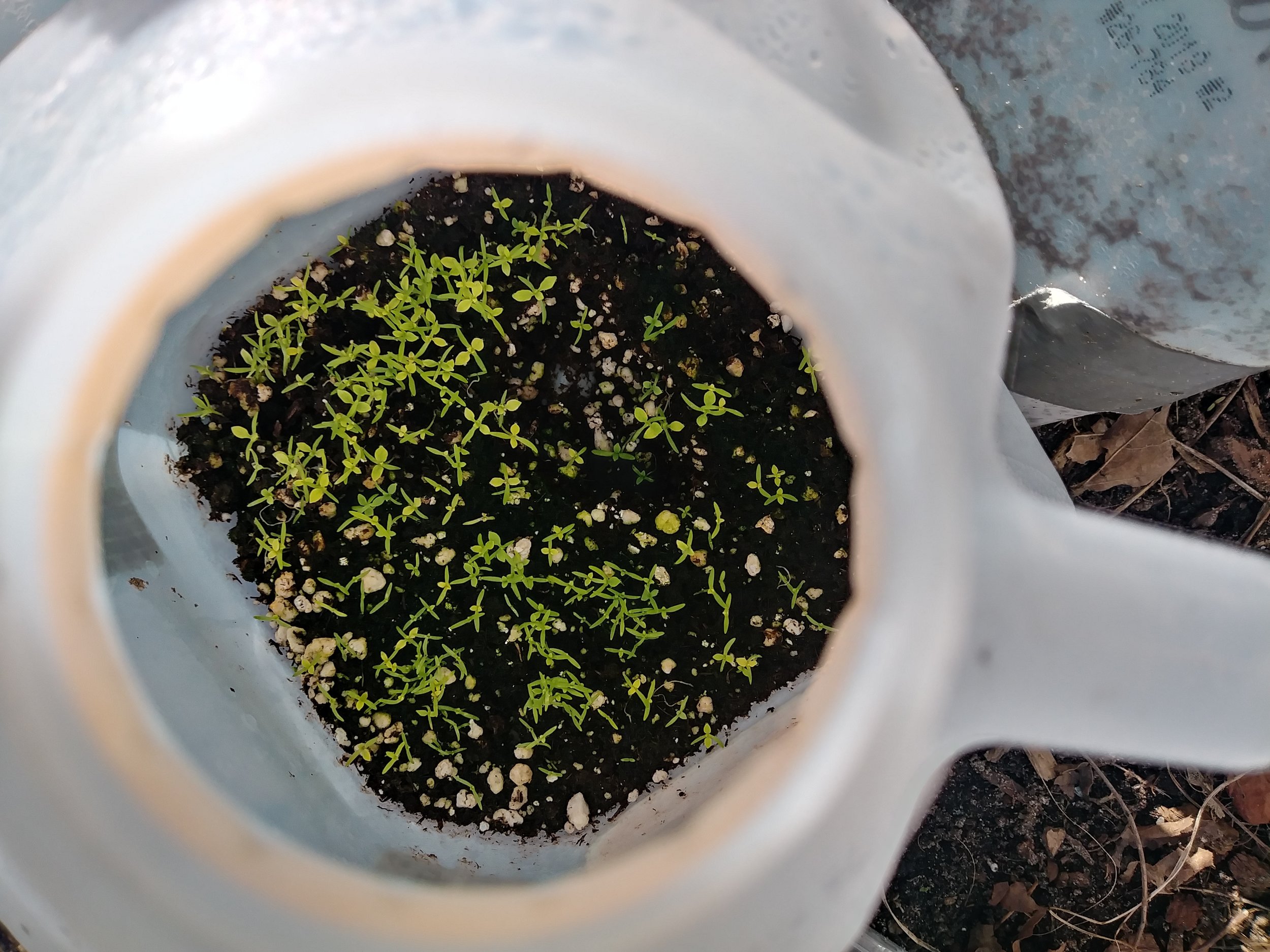
6. If you sowed your seeds thin, you can “prick” out the individual plants and transplant them. If you sowed your seeds thick, you may end up with a “clump” of seedlings (often happens with tiny seeds, like these poppy seedlings). No worries. I use a clippers to cut the clump into “hunks o’ seedlings” and plant an entire hunk.

I cut this clump into small hunks and planted a hunk in each hole.

Within a month or two, the seedling grow and look like this!

Hope this was helpful! Happy Winter Sowing!
Ready for More?
If you’re serious about growing the garden of your dreams this year, register for my online course, “Backyard Cutting Garden 101”. You’ll find everything you need to plan, grow, harvest and arrange your stunning blooms. I can’t WAIT to help you grow! Click on the button below for all the details.
How to Grow: Ageratum
How to Grow: Ageratum
Pronunciation: ah-jer-rah-tm
Ageratum is a wonderful addition to the cutting garden. While it never steals the show like other flowers, I like to think of it as a “supporting character”. It’s reliable, dependable and always shows up when you need it.
The blooms are cheery, adorable and delightful in bouquets. With multiple blooms per stem, they quickly add mass, texture and visual interest to your arrangements.

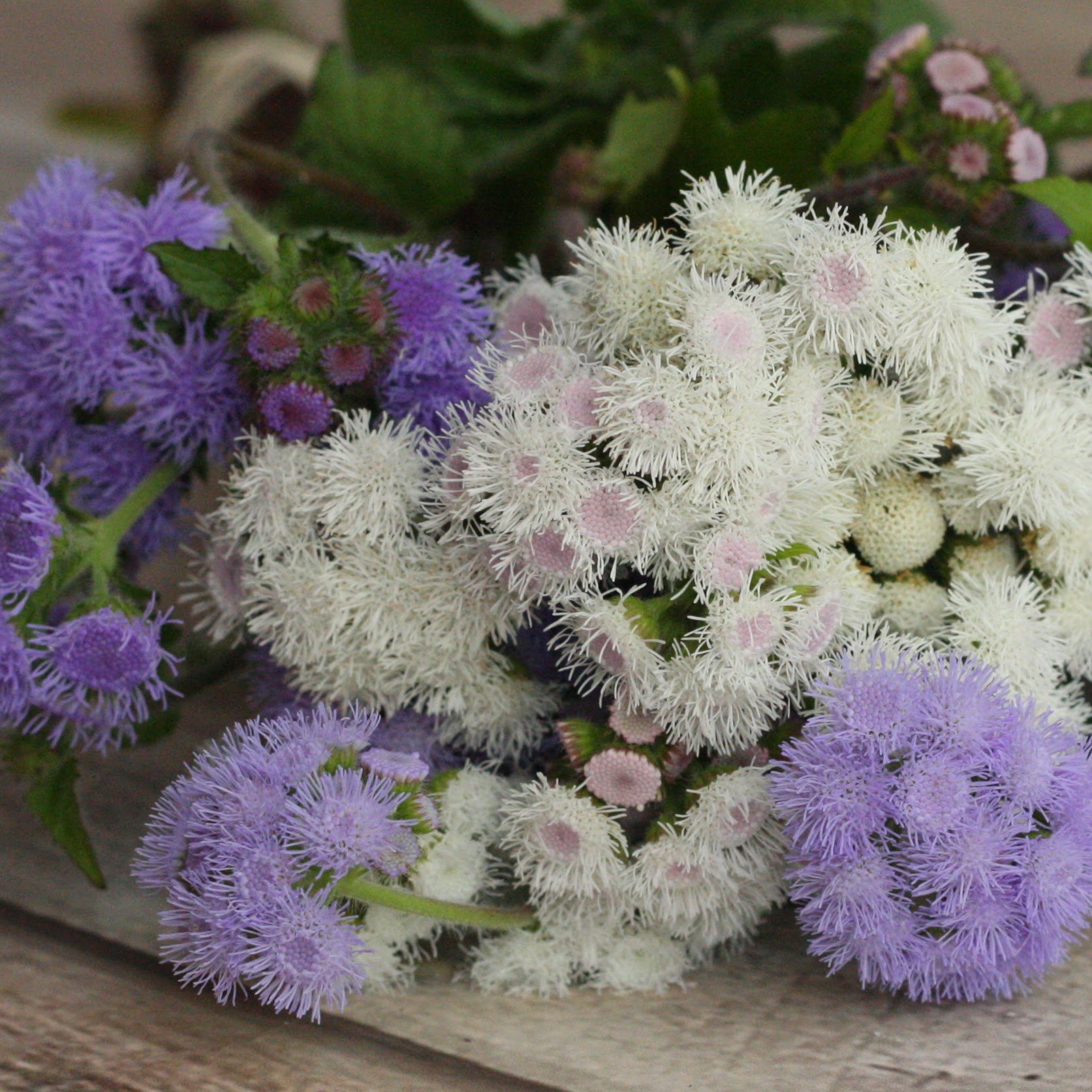
Ageratum "Timeless Mix"
Many varieties of Ageratum are bred as short “bedding plants” used in landscaping. You’ll want to avoid these varieties for the cutting garden and choose varieties bred for cut flower use instead (varieties that grow at least 24 inches tall).
A few years ago, I heard another flower farmer mention she grows Ageratum almost exclusively for its beautiful, prolific foliage.

Ageratum Foliage
In the photo below, you can see that we used Ageratum foliage as our primary foliage for these beautiful bouquets!

Ageratum foliage used as our primary foliage in these beautiful bouquets!
If you’ve ever grown a cutting garden, you know that finding good Annual type foliage sources is quite difficult! Lack of good foliage options seems to be a nearly universal problem for cut flower growers. Ageratum is a perfect solution to this problem. The more you harvest from the plants, the more they will grow.
Since Ageratum is a “dual-purpose” plant (flowers AND foliage), it earns a place of honor in every cutting garden.
Ageratum is sometimes called “Floss Flower”, which I assume refers to the fact that the flowers are thread-like and resemble embroidery floss… but I could be wrong. ;)
Let’s look at the Pros and Cons of growing Ageratum for cut flower use.
PROS
They are easy to grow from seed. In fact, Ageratum self-sows so well on my farm that I don’t even sow seeds in trays anymore. I simply go look for “volunteer” seedlings coming up each spring, dig them up and transplant them where I want them.
They are one of the best cut-and-come-again plants that will continue blooming for a long period of time if harvested regularly. The more you harvest, the more they will keep growing flowers and foliage.
They are very heat tolerant and perform well in hot climates.
They add wonderful texture and interest to bouquets.
They are easy to harvest and long-lasting in the vase.
They have little to no pest or disease issues. If you’re looking for a carefree, no-fuss flower, Ageratum fits the bill!
CONS
They come in a limited color palette (mostly cool colors such as white, purple, blue, violet and pink).
They will stop producing flowers if you stop harvesting them (which is true for most cut flowers).
They are not the most exciting flower. If your space is very limited, you may want to choose a flower with impact.
CHOOSING SEEDS
Here are a few of my favorite Ageratum to grow for cut flower use:
“Tall Blue Planet”
‘White Bouquet” (particularly useful as a white flower. White goes with everything!)
HOW TO SOW
Ageratum is a heat-loving, summer-blooming flower. It’s best to plant them outdoors after the threat of frost has passed.
Transplants or Direct Sow?
Ageratum can be started in seed trays and transplanted or direct sown in late spring. Transplanting is the preferred method, as the seeds are very tiny and difficult to direct sow.

Sow seeds in trays about 6-8 weeks before your Average Last Spring Frost Date. Keep them in a warm place while they are growing.
Transplant the seedlings outdoors after your Average Last Spring Frost Date.
Seeds are tiny and I recommend sowing them using the “toothpick method.” Pour the seeds into a container, lick the end of a toothpick and use the toothpick to remove seeds one at a time. Sow 1-2 seeds per cell. Barely over the seeds with a sprinkle of potting soil or vermiculite.
Like many Annuals, I recommend sowing 2-3 successions of Ageratum, 2-3 weeks apart to ensure you have a steady supply of blooms over the season.
PLANT SPACING
Grow Ageratum at 9-12 inch spacing for best results.

GROWING ON
Ageratum is quite carefree and easy to grow. Like most cut flowers, they appreciate consistent feeding and watering.
Plants should be netted or supported to prevent them from falling over.
Pinching is not required but can be useful as it causes the plants to branch more abundantly. I usually pinch half of the plants and leave the other plants as is. This helps to stagger the blooming time, so I don’t have all the plants in bloom at the same time.
STAGE OF HARVEST
Harvest when the flowers are ¾ of the way open, not in “bud” form. Be sure to cut low into the plant to encourage future growth.
If harvesting for foliage, cut stems before the flower buds form. Cut deep into the plant to encourage branching and more growth.

POST-HARVEST CARE
Ageratum does not require any special post-harvest care.
Like most cut flowers, always harvest in the cool of the day and allow the flowers to rehydrate in water in a cool location overnight before arranging.
QUESTIONS?
Ask them here and I’ll get back to you!
Ready for More?
If you’re serious about growing the garden of your dreams this year, register for my online course, “Backyard Cutting Garden 101”. You’ll find everything you need to plan, grow, harvest and arrange your stunning blooms. I can’t WAIT to help you grow! Click on the button below for all the details.

How to Grow: Amaranth
How to Grow: Amaranth
Pronunciation: am-ah-ranth
Amaranth is a beautiful and unique flower to add to your cutting garden. Their velvety flowers are elegant looking in the vase and add some real drama to your cut flower arrangements.
It’s also fun and easy to grow. Amaranth plants can tower in the garden and some even make great ornamental plants, if you decide you’d rather enjoy them in the garden rather than the vase.

“Coral Fountain” Amaranth
Another bonus of Amaranth is it makes a great dried flower. I dried Amaranth two seasons ago for fall decor arrangements and it still looks great!
You may have heard of Amaranth before or even seen it’s seeds in the grocery store! Yes, there are several different species of Amaranth and they can be used for food, foliage or flowers. Amaranth seeds are tiny and often cooked/prepared like quinoa (another “ancient grain” that is popular today).
Let’s look at the Pros and Cons of growing Amaranth for cut flower use.
PROS
They are easy to grow.
They are very unique and fun to look at.
The plants are productive for a long period of time.
They add elegance and drama to arrangements. No other flower has the same draping, trailing quality.
They have a good vase life of 7-10 days, with proper harvest and care.
CONS
They can shed their seeds on your table if harvested too late.
They can sometimes grow so large that they can be unwieldy and difficult to use in arrangements (more about how to prevent that later…).
CHOOSING SEEDS
There are 2 main types of Amaranth grown for cut flower use.
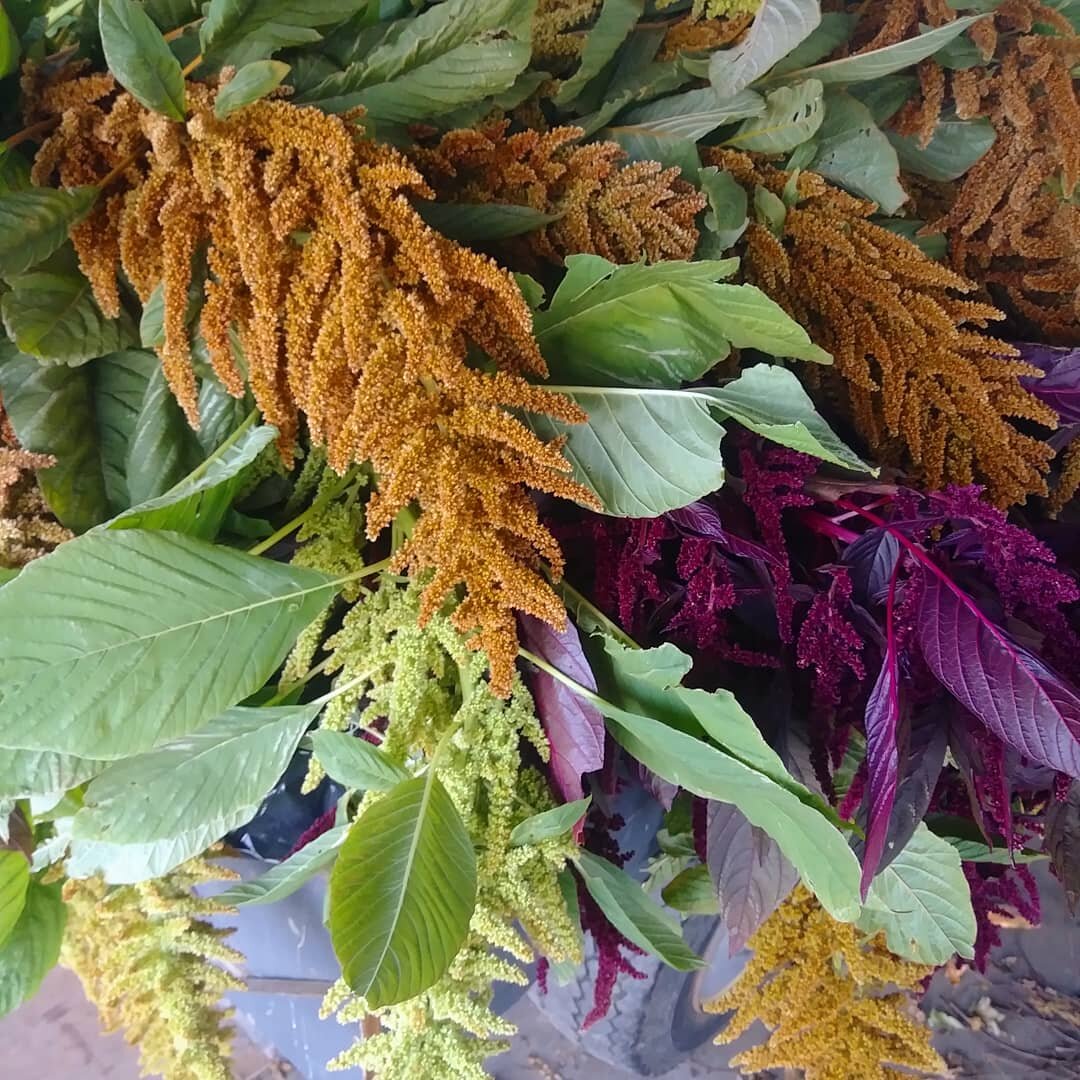
“Spike” type Amaranth has an upright growing habit and the plants produce “spikes” or “plumes” that add height and drama to arrangements.
“Trailing” type Amaranth has a draping growth habit and the plants produce “ropes” that hang and drape in arrangements.
Both types are useful and worth growing. Here are a few of my favorite Amaranth to grow for cut flower use:
“Love-Lies-Bleeding” (trailing)
“Green Cascade” (trailing)
“Red Spike” (spike)
“Hopi Red Dye” (spike)
HOW TO SOW
Amaranth loves heat. They do not like cold temperatures and can’t handle frost, so don’t plant them too early. Don’t worry - they grow quickly when the soil warms up. They will begin to bloom in mid/late July and bloom until the fall frost.
Transplants or Direct Sow?
Amaranth is versatile and can be transplanted or direct sown.
The seeds are tiny, so you may need to use the “toothpick method” for planting seeds. Pour the seeds into a small bowl, wet the toothpick with your tongue, then dip it in the seeds to pick up 1-2 seeds on the toothpick. Transfer seeds to your trays or desired planting spot.
Transplants should be started indoors about 4-6 weeks before the last spring frost. They love heat, so be sure to keep them warm while they are growing indoors.
Direct sowing is another option (my preferred method!), as the plants grow very quickly. Direct sow in warm soil, after the threat of frost is passed. Sprinkle a couple seeds in spots spaced about a foot apart. You can thin the plants later (pluck out the unneeded seedlings).

PLANT SPACING
Amaranth plants can get quite large, so they should be spaced at about 12-15” apart.
GROWING ON
It is wise to provide support or netting to keep the plants from falling over. If you are growing just a few plants, large tomato cages may be sufficient. If you are growing a block or row of them, netting or metal supports would be best (like our “cattle panel supports” featured below).

“Coral Fountain” Amaranth
For best results and more manageable blooms, it’s advisable to “pinch” the plants. If they are not pinched, they tend to grow very large (over 6 foot tall!) and have thick stems that are much too big to use in most floral arrangements (below, you will see an example of Amaranth plants I forgot to pinch! Whoops).
To pinch Amaranth, cut back the center bud/stem when plants are about knee high. This will signal the plant to produce multiple stems that are smaller and easier to use.
If flowers are harvested and spent blooms are “deadheaded” (removed and not allowed to go to seed), the plants will continue to send up blooms until frost arrives.
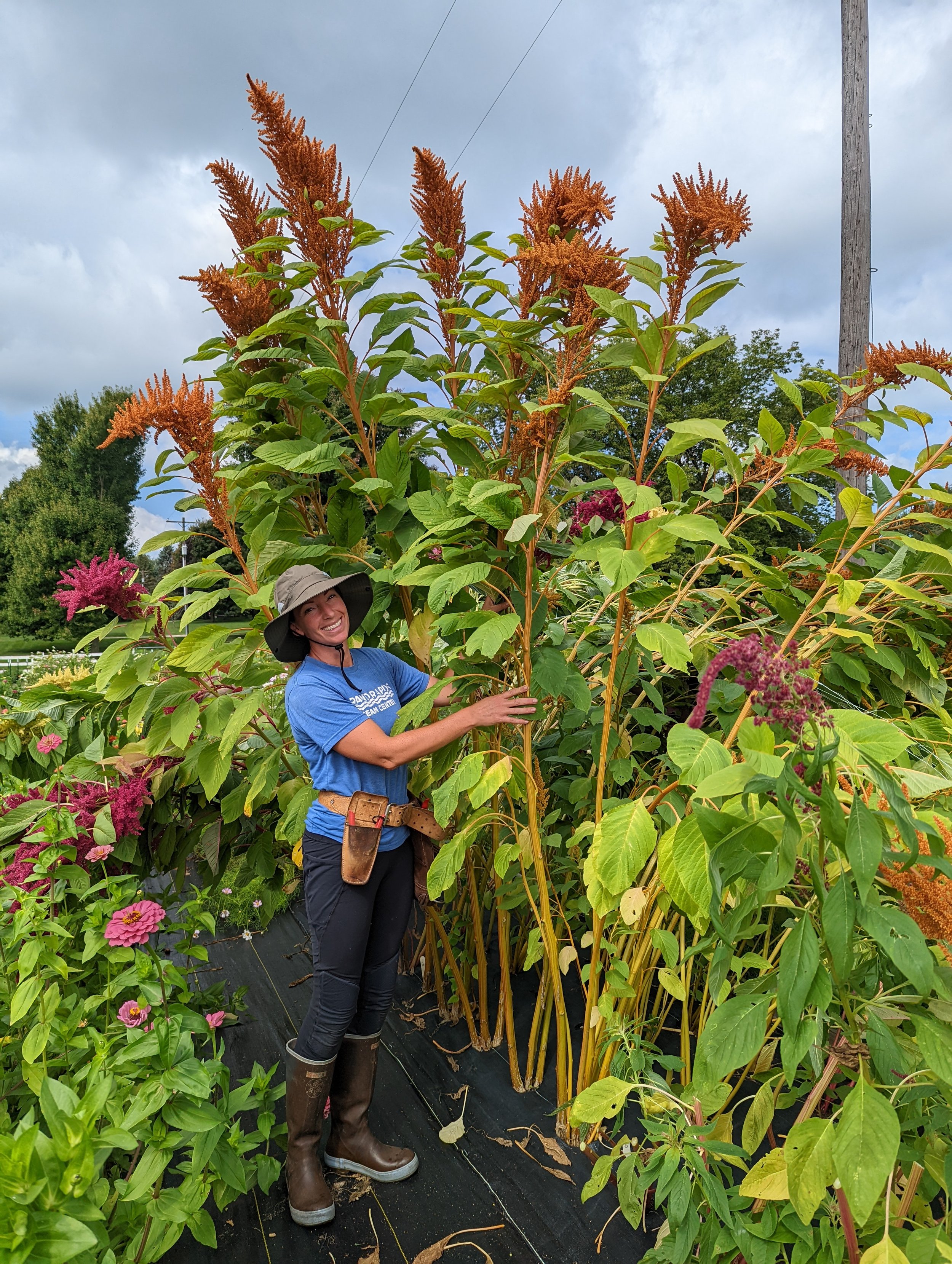
“Chinese Giant Orange” Amaranth
STAGE OF HARVEST
Amaranth can be harvested after the color forms on the spikes or tassels, when about ¾ of the tiny little flowers are open. The spikes or tassels will continue to grow in size as they mature and they have a long harvest window.
However, be sure to harvest before they are too mature or they will drop their seeds all over your table!

“Fercita” Amaranth
Amaranth can be used fresh in arrangements or you can dry it to be used as an “Everlasting” flower.
To dry, simply place them in a bucket in a warm, dry place out of direct sunlight, and let them drape naturally… or hang them upside down. They should dry in about 2 weeks.

POST HARVEST CARE
After harvesting, remove most of the leaves to help the stems re-hydrate more quickly. This also allows the flowers to be more visible.
Amaranth requires no other special care.
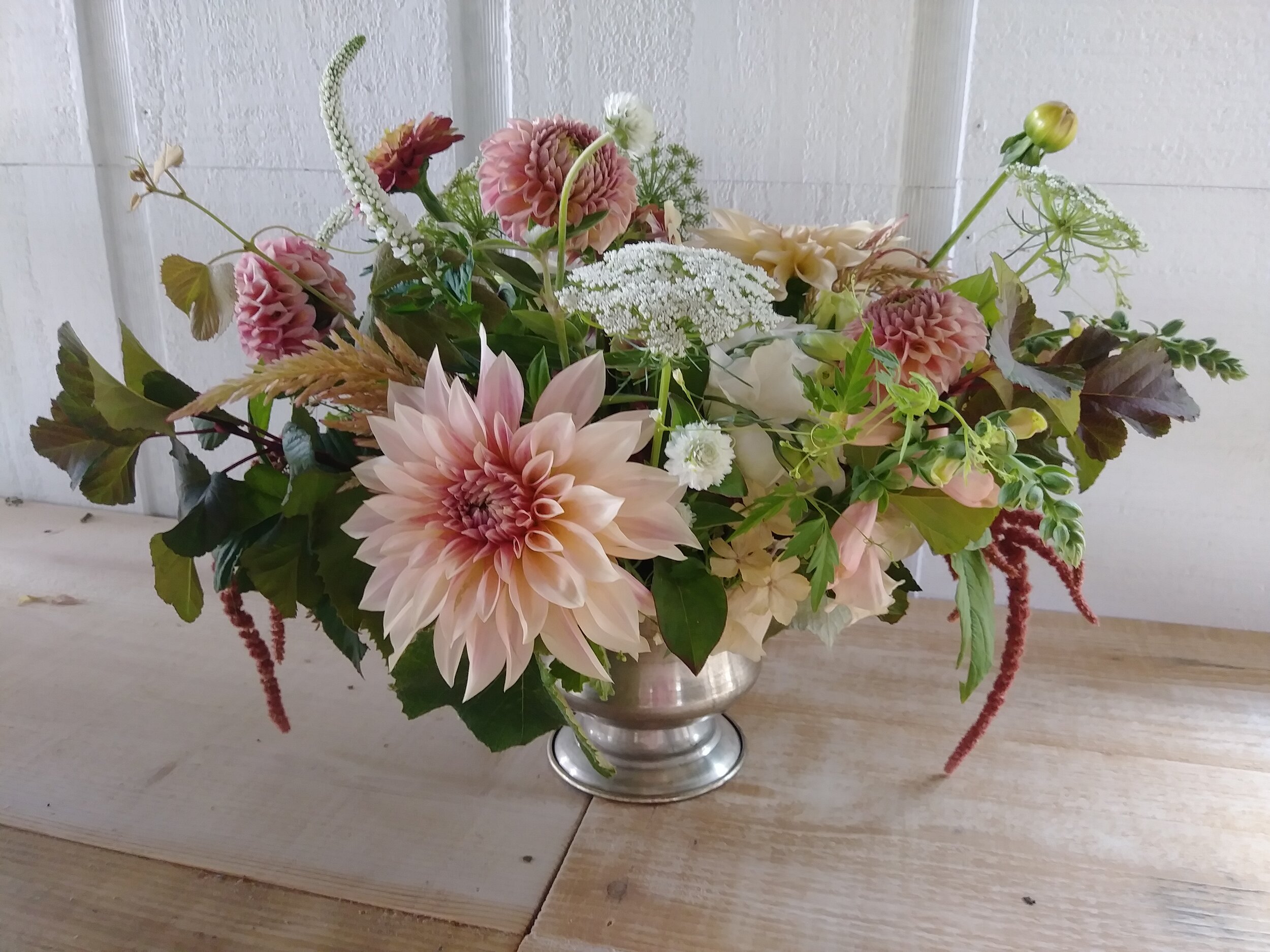
“Coral Fountain” Amaranth in a wedding arrangement
QUESTIONS?
Ask them here and I’ll get back to you!
Ready for More?
If you’re serious about growing the garden of your dreams this year, register for my online course, “Backyard Cutting Garden 101”. You’ll find everything you need to plan, grow, harvest and arrange your stunning blooms. I can’t WAIT to help you grow! Click on the button below for all the details.

How to Grow: Ammi (False Queen Anne's Lace)
The perfect filler for all your arrangements!
How to Grow: Ammi (False Queen Anne’s Lace)
Pronunciation: am-ee
One of the biggest “newbie” flower gardening mistakes I see is not growing enough “filler” type flowers for bouquets.
I know, I know… it’s easy to get starry eyed over all those big blooming “focal” flowers, like Sunflowers, Zinnias and Dahlias… but a bouquet made with only big focal flowers can easily look a tad gaudy and overpowering.
In order to have well balanced bouquets and arrangements with visual interest, it’s important to grow some flowers whose soul purpose is to complement and enhance the focal flowers.
Ammi (False Queen Anne’s Lace) does this beautifully. It looks great with almost any type of flower and adds some much needed volume, texture and whimsy.

You may have noticed the wild Queen Anne’s Lace (Daucus carota) growing in meadows and roadsides. Another name for this plant is Wild Carrot, and yes, if you pull up the root, you’ll see and smell that it is indeed a white carrot!
Queen Anne’s Lace grows wild in our area. In fact, the field that is currently our U-Pick Flower Garden was an entire field of Queen Anne’s Lace when we moved to farm nearly a decade ago. It certainly was beautiful!

Gah! My kids were just babies. Now my son has a mustache and is taller than me… and my daughter is the same size as me. People, how does this happen?!? Excuse me while I have a moment…

For floral use, though, most people prefer to grow the more sophisticated and cultivated varieties of Ammi, which are related to wild Queen Anne’s Lace.
Let’s look at the Pros and Cons of growing Ammi for cut flower use.
PROS
They are fairly easy to grow.
They are versatile in bouquets and arrangements.
They attract pollinators.
They will reseed themselves, if you allow them to.
CONS
They are not the longest blooming flower. You’ll need to plant them a few times over the spring/summer to have a continual harvest.
They should be netted to keep them from falling over.
They have irritating sap that can cause contact dermatitis when harvested on a sunny day (more about this later!).

CHOOSING SEEDS
There are 3 main categories of Ammi that are used for floral work.
1. Ammi majus: This type most closely resembles wild Queen Anne’s Lace - light, airy and delicate. On our farm, this type does best in the spring/early summer.
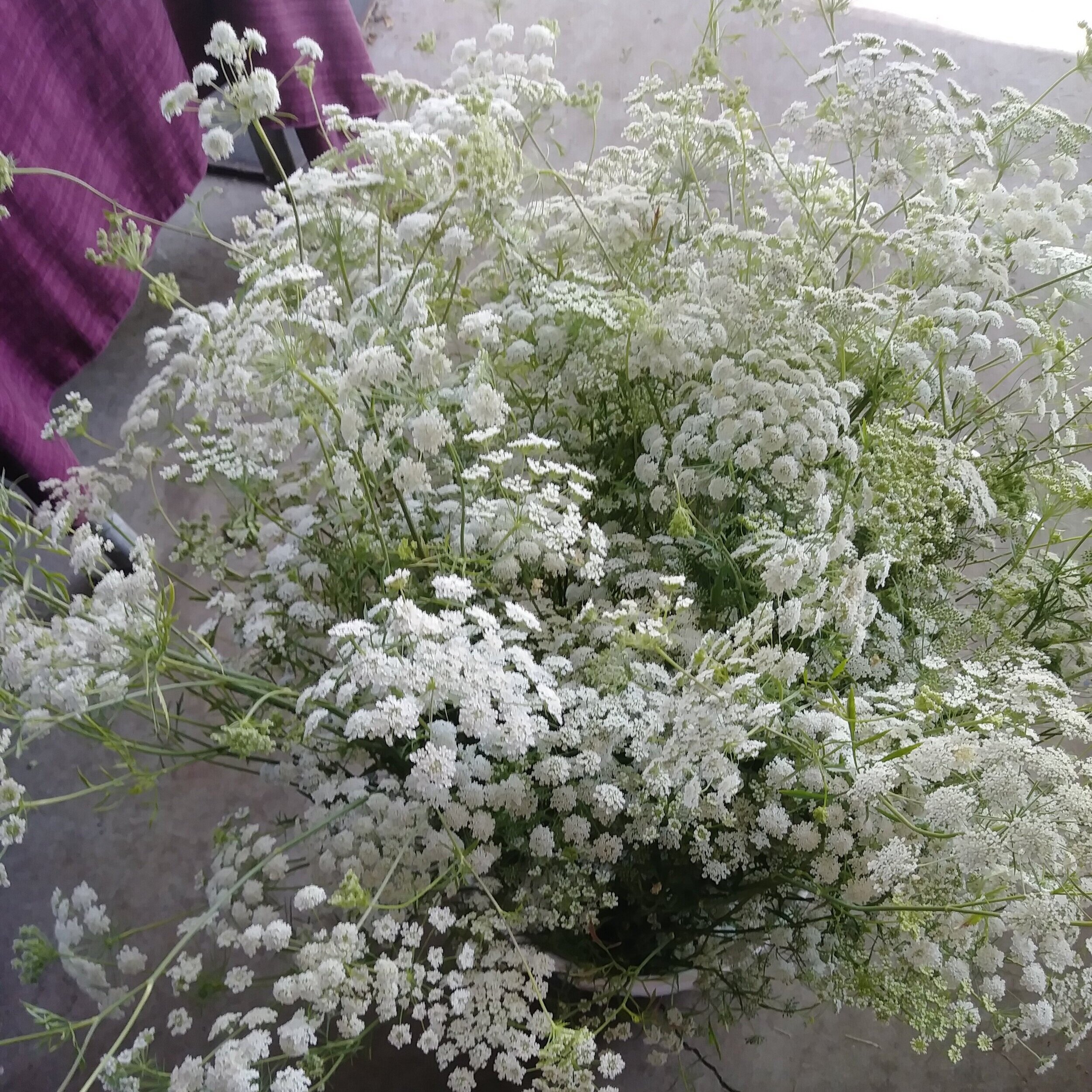
2. Ammi visnaga: This type is much more robust and fuller than Ammi majus. It also tends to be more green than white. This type is sturdy and adds lots of structure to bouquets. Unfortunately, it also has a distinct smell that some people don’t like. On our farm, this type blooms well even in the heat of summer and into fall.
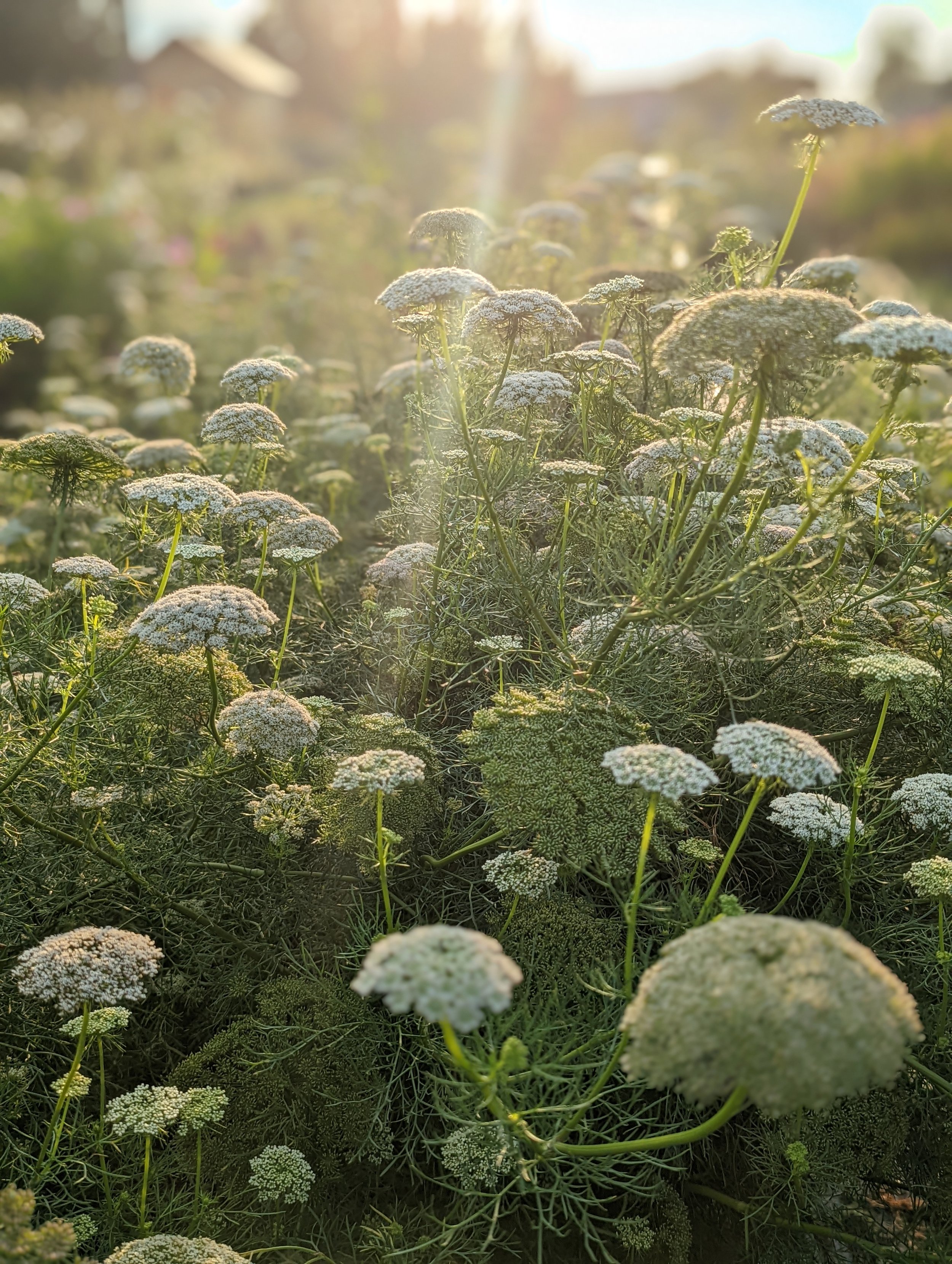
3. Dara/Daucus carota: Technically not “Ammi”, you’ll often find this in seed catalogs under the Ammi category. This type is a unique variety of wild carrot. The blooms come in a range of pink, purple and white. I’ve seen all sorts of names for this flower (no one seems to know exactly what to call it!), so search for “Dara”, “Ammi dara”, “Daucus”, “Daucus carota”, “False Queen Anne’s Lace”, “Chocolate Queen Anne’s Lace”, “Ornamental Carrot”, “Chocolate Flower” and even “Chocolate Lace Flower”!

Here are a few of my favorite Ammi to grow for cut flower use:
“White Dill” (Ammi majus)
“Graceland” (Ammi majus)
“Green Mist” (Ammi visnaga)
“Dara” (Daucus carota)

HOW TO SOW
Ammi generally prefers cooler weather and really shines in the spring/early summer. While it can handle warm days, it wants cool nights.
The plants are quite cold hardy and can handle some frost.
If you live in a warm climate, sow the seeds in the fall and they will take off early next spring. If you live in a cold climate, sow the seeds as early as you can in the spring (when the soil has thawed).
Transplants or Direct Sow?
Ammi can be transplanted or direct sown.
Transplants should be sown indoors 4-6 weeks before you plant them out. Keep the seeds in the fridge or freezer for 2 weeks before sowing (this mimics winter weather).
Remember, they want cold nights, so if you are using heat mats for your seedlings, be sure to turn off the heat at night or remove the tray at night. They can be transplanted out BEFORE the threat of frost is over, since they are cold hardy.
If you don’t want to mess around with moving trays every day (I don’t!!!), then simply direct sow when you want them to grow as early in the spring as possible.
Ammi prefers to be direct sown, so this method is the simplest and easiest. You might as well save yourself some time and growing space, and simply direct sow the seeds!
If you want to try Winter Sowing, Ammi is a great candidate for this method.
Ammi is a “self-sowing” hardy annual, which means if you leave a few seed heads to mature on the plants, new plants will pop up the following spring. Bonus!
PLANT SPACING
Ammi can be grown at 3-12” spacing… so if you direct sowed and your plants are crowded, don’t fret.
I find Dara needs the least amount of spacing (grows very upright), Ammi majus needs about 6-9” spacing, and Ammi vignaga does better at 12” spacing (widely branching plants).
Netting is helpful, as plants will grow 36” or more. We use Hortonova trellis netting stretched tight over the bed with stakes.
Yup. It’s a real pain harvesting those stems in the netting… But it’s better than having the plants falling over! Hint: Pull the stem down through the netting, not up.

Update: Recently, we switched to using “cattle panel support” pictured below for growing Ammi and Dara… and it is a GAME CHANGER. You can learn how we make the “cattle panel supports” in this blog post.

GROWING ON
Ammi is not a particularly long lasting flower in the field. Don’t expect it to bloom all summer long.
In order to harvest Ammi longer, I like to plant 2 successions of Ammi majus (spring/early summer blooming) 2-3 weeks apart, followed by 2 successions of Ammi visnaga (summer/fall blooming) 2-3 weeks apart.
Dara seems to do better as a spring/early summer blooming plant, but occasionally I can get some to bloom into the fall.

STAGE OF HARVEST
Recognizing the correct stage of harvest for Ammi can be a little tricky.
Harvest too early, and they will droop over and never recover.
It’s better to err on the side of too mature than too early. Fortunately, even if you harvest them too mature, they still look beautiful with their seed pods.
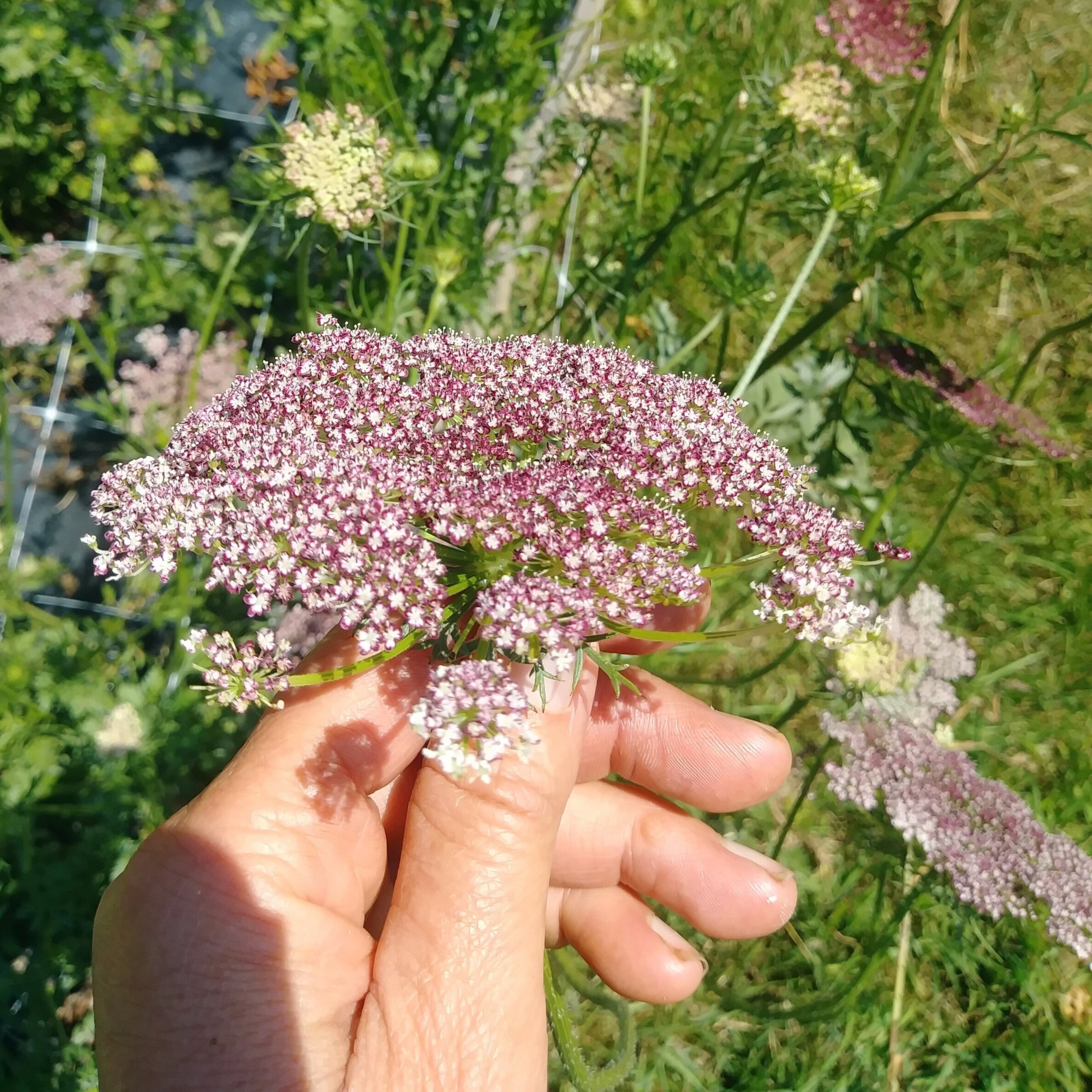
Take a look at the bloom. If it is flat or concave (sides higher than center), it is not ready.
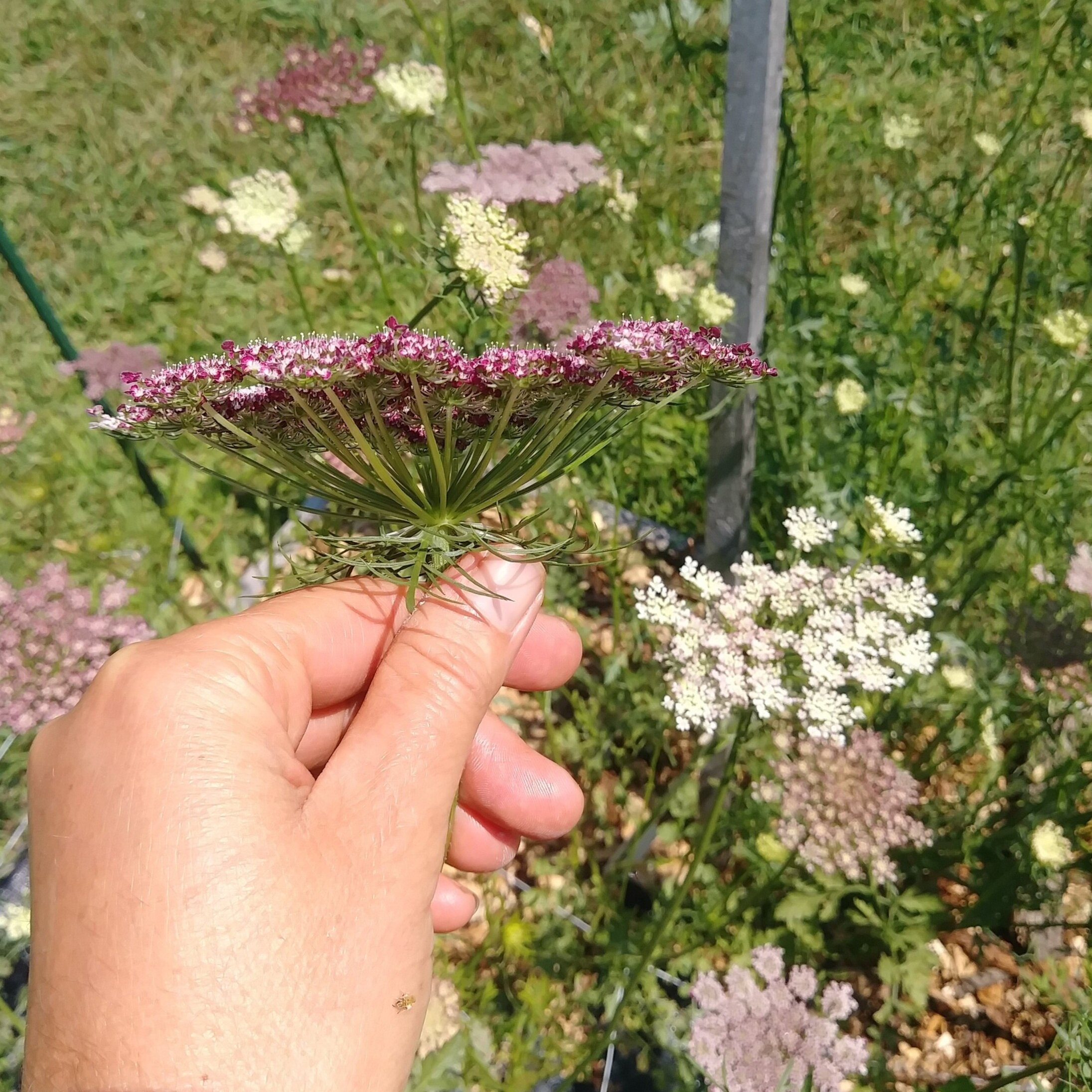
If the bloom is domed or convex (sides lower than center), then it’s ready!
SPECIAL NOTE:
When you cut a stem of Ammi, sap will come out of the cut end. Do NOT allow this sap to come into contact with your skin, especially on a sunny day. Ammi can cause contact dermatitis on some people, called Phytophotodermatitis, a reaction caused by contact with a plant sap/substance that reacts to sunlight.
When the sap gets on your skin and is exposed to the sun, it can cause burns and blisters. While usually not painful, it can cause scarring that lasts for months. Ask me how I know this.
Usually, I wear long pants, long sleeves and gloves when harvesting (AND harvest it before sunrise or after sunset), but on this one day, we had to harvest it 9am and it was 90+ degrees. I learned a hard lesson to always wear long pants/sleeves, even when it’s suffocating (and this is exactly why farm workers wear long pants/sleeves when harvesting carrots, celery and other plants).
The blisters were not painful, but I had scars/dark patches on my legs/forearms for about 3 months.

POST HARVEST CARE
Immediately upon harvest, allow the Ammi to rest in a bucket of water in a cool, dark place.
After resting overnight, stems should be ready for arranging!

QUESTIONS?
Ask them here and I’ll get back to you!
READY FOR MORE?
If you’re serious about growing the garden of your dreams this year, register for my online course, “Backyard Cutting Garden 101”. You’ll find everything you need to plan, grow, harvest and arrange your stunning blooms. I can’t WAIT to help you grow! Click on the button below for all the details.