How to Protect Tulips from Voles
A full report on my “No-Till Tulips” experiment.
How to Protect Tulips from Voles
If you’ve been following along for a while, you know that voles (small little mammals, similar to mice) are a huge problem on our farm. Voles love to eat all sorts of vegetations, but bulbs are their favorite food.
My first season on the farm, I planted 125 Tulips bulbs… and the voles ate 123 of them.
My second season, I planted about 500 bulbs… and the voles 2/3 of them.
I realized this was a SERIOUS problem and I would have to find ways to outsmart the voles.
In November of 2019, my husband and I drove all the way from Michigan to Philadelphia so I could spend a day learning from Jennie Love, of Love ‘n Fresh Flowers.
I’m grateful for Jennie’s wisdom, generosity and enthusiasm. She is an inspiration to me and I love learning from her, whether it’s in person, through one of her online courses or listening to her podcast, “The No-Till Flowers Podcast”.

When I saw her “No Till Tulips” planting method in person, I was fascinated and wanted to try it myself.
The method is brilliant. Instead of digging individual holes for each bulb or a giant trench, she creates a temporary raised bed on the surface of the soil. This makes harvesting the Tulips much faster and creating the beds is so simple.
On Jennie’s farm, they don’t get a lot of snow cover, so her two fierce barn cats can hunt all winter and keep the vole/critter population at a manageable level (side note: barn cats are MUST on any farm!).
In Michigan, we often have deep snow cover over the winter. The voles make their tunnels deep below the snow and our barn cats can’t catch them… so the voles basically have free run of the entire farm and can do massive amounts of damage.
I decided to try Jennie’s “No Till Tulips” planting method, but with a twist. I would line the BOTTOM and the TOP of the bed with wire mesh hardware cloth and staple it the sides of the beds.
Below, I’m going to walk you step by step though the process of how I did it. There are LOTS of photos, because I suspect you are a visual learner like me.
1. Rake planting area smooth and lay out the boards for the beds. These boards are 6” tall. I wish they were 8-12” but we worked with what free materials we had on hand.
This bed is 3’ x 50’ and I fit 4,200 Tulips bulbs in here.

2. Roll out wire mesh hardware cloth. I bought this from Home Depot and it’s the 1/4” mesh. 1/2” is too big - voles can fit through 1/2” spacing. I pinned it in place with landscape staples.

3. I started creating the sides of the beds. The boards are simply held in place with rebar stakes on either side of the boards.

4. I bent the wire mesh so it cradled the boards. Then I used a staple gun to staple the mesh to the boards.

5. I started filling the beds with about 2 inches of compost and a sprinkle of Bone Meal.

6. My farm hand, Kathryn, helped me plant the bulbs. This part goes really fast. We were able to plant over 4,200 bulbs in a couple hours.
We placed about 25-30 bulbs per square foot. They are nestled close together, like eggs in a crate.

7. After the bulbs were placed, we filled the beds all the way to the top with more compost.

8. Just for refence, this is what 100 Tulips bulbs looks like. They hardly take up any space at all.

9. After the bed was filled, I rolled out another layer of wire mesh hardware cloth over the top of the bed and stapled it to the boards. Now the Tulips bulbs were in a “cage”, completely encased in wood and wire mesh.

10. Over the winter, whenever there was a thaw, I’d see lots of vole tunnels all around the Tulip bed…

11. In March, I visited the Tulip bed every day to look for growth. As soon as they started poking up, I removed the wire mesh top.
By this time, most of the snow as gone and the barn cats were able to hunt again.

12. In April, the Tulips started to wake up.

13. Our spring was extremely cold and cloudy, which delayed Tulip growth. We hoped they would be ready in time for Mother’s Day, but alas, most were not.
We even tried covering the bed with hoops and plastic to warm them up faster, but it didn’t really work since it was so cloudy and windy in April (if you try this, be sure to keep the sides vented. When the sun comes out, it can heat up REALLY fast and cook the Tulips to death).

14. By the first week of May, a couple of the varieties were ALMOST ready to harvest.

15. When we harvest Tulips for cut flower use, we pull the entire plant, including the bulb. With the bulb still attached, they can be stored in a cooler for up to 4 weeks.

16. We harvest when the buds swell and begin to show their color. This allows the bud to open up in the vase and the customer get the best and longest vase life.

17. Tulips are harvested into crates or buckets and stored dry in the cooler. They don’t need to be in water.

18. After a cold cloudy spring, the temperatures soared (literally doubled in 2 days), the sun came out and all the Tulips were ready for harvest in a 3 day period, instead of a 3 week period.
We harvested up to 5 times a day to make sure we caught them before they opened. We had to scramble like crazy to harvest everything in time AND mash them all into our walk-in cooler.
19. After the harvest was over, I disassembled the raised bed. I pulled the sides off and raked the compost into the beds nearby to use for a new planting area.

20. And look what I found under the wire mesh! There are so many voles tunnels under the mesh.
I rejoiced that the mesh did it’s job and we didn’t lose a SINGLE BULB to those awful voles. Take THAT, voles!

I hope you enjoyed this step-by-step explanation of how I finally outsmarted the voles. If you struggle with voles too, use this as inspiration to find a solution that works for you!

READY FOR MORE?
If you’re serious about growing the garden of your dreams this year, join my online course and community, “Backyard Cutting Garden 101”. You’ll find everything you need to plan, grow, harvest and arrange your stunning blooms. I can’t WAIT to help you grow! Click on the button below for all the details.

Best Perennials for the Cut Flower Garden
Perennials are a great choice to fill the awkward space between Spring Blooming bulbs and Summer Blooming Annuals!
When we started our flower farm, we grew mostly Summer Blooming Annual flowers like Cosmos, Sunflowers and Zinnias. The seed is inexpensive and they grow quickly when planted from seed after the Average Last Spring Frost Date.
However, we soon noticed that we struggled with what I call “Awkward Gap Season”, which is the 6-8 weeks between when the Spring blooming bulbs die off (Daffodils, Tulips, etc) in mid May and the Summer Blooming Annuals begin in mid July.
What could we use to fill that “dead” space between mid-May to mid-July?
Perennials to the rescue!
Many types of Perennials bloom during the dreaded “Awkward Gap Season”.
I can’t tell you how much I’ve learned to love and appreciate our Perennials. Even though many Perennials are only in flower for about 2-6 weeks out of the year, many of them bloom right when I need them, when nothing else on the farm is in bloom!
Perennials do take a few years to establish before they are vigorous enough to harvest from, so I recommend planting as many as you can, as soon as you can.
While they may not bloom for a long length of time (many Perennials bloom for about 2-6 weeks out of the year), they are hardy, reliable and generally more drought tolerant than annual plants.
Some Perennials will give you a flush of blooms in early summer, then a second flush in late summer/early fall if cut back after the first blooming.
Fall is the BEST time to plant Perennials (about 4-6 weeks before your Average First Fall Frost), but they can also be planted in the spring.
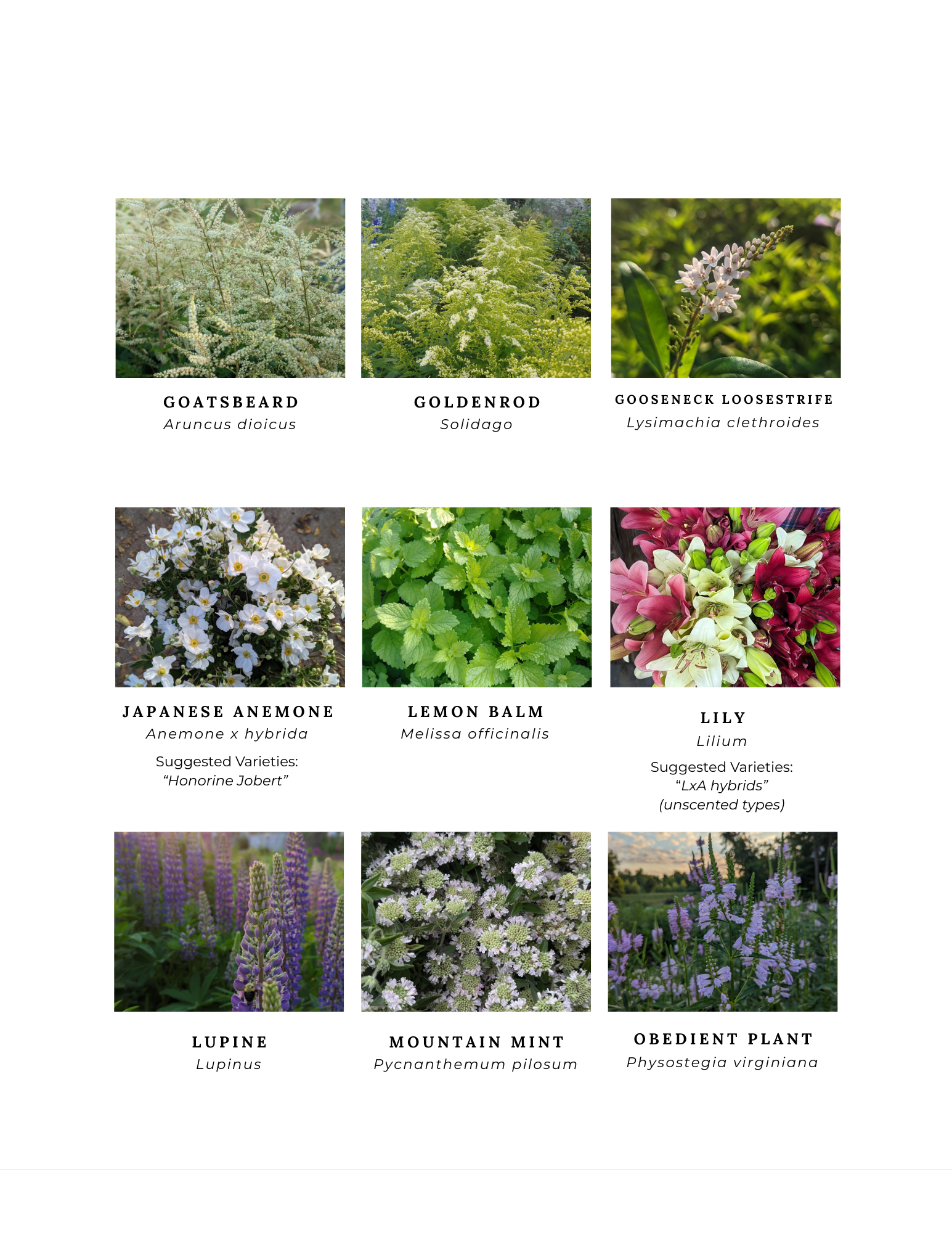
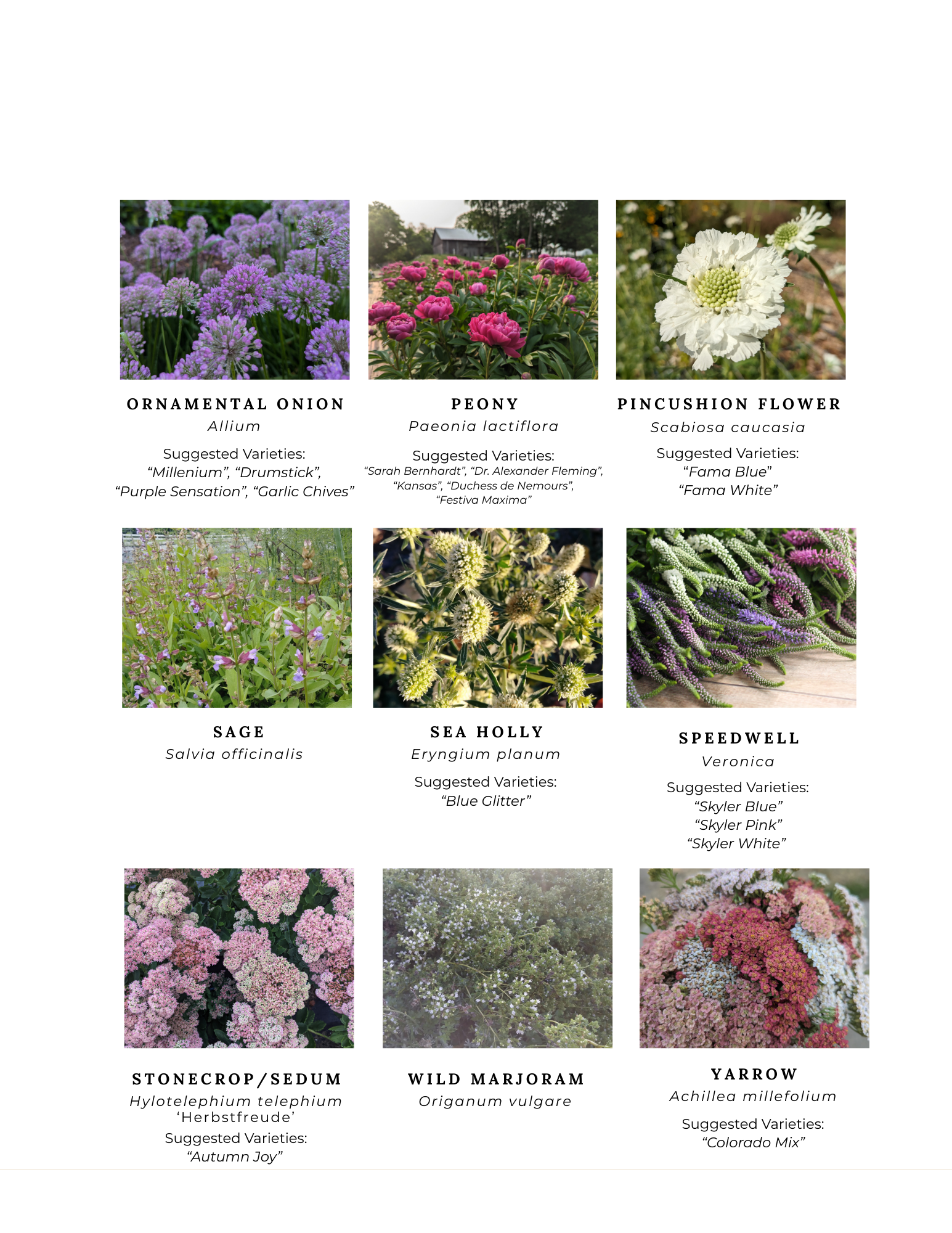
Here is a list of a Few of my favorite Perennials on our farm
Not all of these Perennials bloom in the spring/early summer… but many do!
* Please note that some crops we grow may be considered “invasive” in your area. Be sure to do your own research before planting!
Achillea millefolium - Yarrow “Colorado Mix”
Allium - Ornamental Onion “Millennium”, “Purple Sensation”, “Drumstick”, “Garlic Chives”
Anemone x hybrida - Japanese Anemone “Honorine Jobert”
Aruncus dioicus - Goatsbeard
Baptisia hybrid - False Indigo “Decadence® Deluxe Pink Truffles”
Echinops bannaticus - Globe Thistle “Blue Glow”
Eryngium planum - Sea Holly “Blue Glitter”
Geum - Avens “Totally Tangerine”, “Tempo Rose”, “Pretticoats Peach”
Gypsophila - Baby's Breath “Million Star II”
Hylotelephium telephium 'Herbstfreude' - Stonecrop/Sedum “Autumn Joy”
Lilium Lily (prefer the LxA hybrid types, as they are unscented)
Lupinus - Lupine
Lysimachia clethroides - Gooseneck Loosestrife
Melissa officinalis - Lemon Balm
Nepeta mussinii - Catmint
Origanum vulgare - Wild Marjoram
Paeonia lactiflora - Peony “Sarah Berhardt”, “Kansas”, “Dr. Alexander Fleming”, Duchess de Nemours”, “Festiva Maxima”, etc
Phlox paniculata - Garden Phlox “David”
Physostegia virginiana - Obedient Plant
Pycnanthemum pilosum - Mountain Mint
Rudbeckia hirta - Black-Eyed Susan “Irish Spring”, “Moroccan Sun”
Rudbeckia Triloba - Brown-Eyed Susan “Filou”
Salvia officinalis - Sage
Scabiosa caucasia - Pincushion Flower “Fama Blue”, “Fama White”
Solidago - Goldenrod
Tanacetum parthenium - Feverfew/Matricaria “Magic Single”, “Magic Lime Green”, “Tetra White”
Veronica - Speedwell “Skyler Blue”, “Skyler Pink”, “Skyler White”

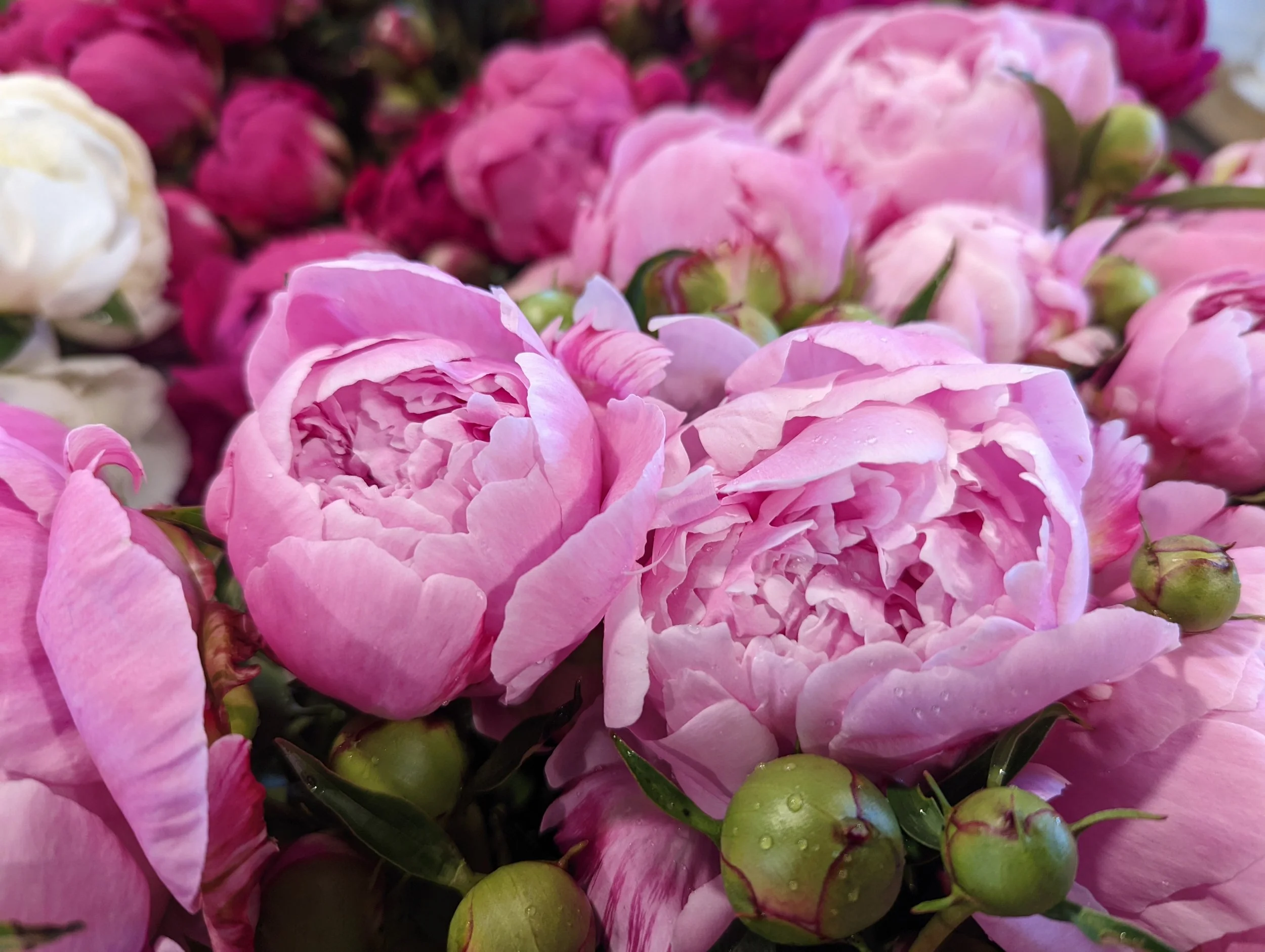
Show-Stopping Peonies for Cut Flowers
Imagine massive, ruffled blooms the size of dinner plates. Petals so lush and layered they seem almost too beautiful to be real. The air is thick with the intoxicating fragrance—a heady mix of rose and citrus that makes you close your eyes and breathe deeper.
Welcome to Peony season, friend.
But here's the bittersweet reality about Peonies: their incredible beauty is brief. Peonies remind us that the most treasured things in life are fleeting… which makes them even more precious.
Peonies for Extraordinary Cut Flowers
Not all Peonies are created equal when it comes to gracing your dining room table. The varieties that truly shine as cut flowers possess three qualities:
Stems that are strong enough to support those heavyweight blooms.
Robust plants that grow vigorously.
Blooms that look stunning in your vase for at least five days.
After nine years of trial and triumph (and lots of spectacular failures!) testing over 30 varieties on my Zone 6 Michigan farm, I've discovered which Peonies are the true champions of the cutting garden.
Growing Peonies with Patience
Here's where most growers get it wrong: they expect instant gratification from Peonies. But Peonies operate on their own timeline, and trust me, they are worth the wait.
The Foundation Years (Years 1-3)
Start with bare-root divisions planted in fall. We plant in November or even December, as long as the ground is not frozen.
Then comes the hardest part: for the following three growing seasons, you are going to remove/pinch off the buds. Yes, you read that right. Pinch them all off.
I know, I know. It feels like a cruel joke.
But here's why it’s important: Plants, much like overambitious humans (ahem, like me!), are terrible multitaskers. Ask a young Peony to produce those showstopping blooms and develop a robust root system simultaneously, and it'll do both jobs poorly. You end up with a mediocre plant with mediocre blooms.
Instead, be kind and loving to your Peony plant. Give it permission to focus solely on building strong roots, and I promise, you'll be rewarded with a plant that becomes incredibly productive in the future.
Pro tip from a trusted Peony farmer: Keep one bud per plant during those first seasons—just enough to confirm you actually planted what you thought you planted, AND to get a preview of the beauty to come.
Year 4: The Grand Reveal
By the fourth season, your Peonies will have transformed into strong plants with a robust root system. Now it's time to let them loose and harvest to your heart's content!

My 3 favorite Peony varieties! “Dr. Alexander Fleming” (pink), “Festiva Maxima” (white), and “Kansas” (magenta).
Choosing Varieties to Extend the Harvest
Peony season is short (usually less than 2 weeks), so to make it last as long as possible, we plant an assortment of “Early”, “Mid”, and “Late” blooming varieties to extend the harvest season.
I select varieties across three bloom periods:
Early season (first to bloom)
Midseason (blooms about 3-5 days later than early)
Late season (blooms about 7-10 days later than early)
This means we have a steady wave of Peonies coming into bloom over about 14 days, instead of having all of them bloom over 2-3 days.
Weather Warning: Mother Nature loves to throw curveballs. A sudden heatwave can cause all your carefully timed varieties to bloom at once. You’ll have to put all your other plans on hold while you harvest like a maniac. Cooler weather is your friend. The cooler the weather, the more slowly and evenly the blooms ripen.
Creating the Perfect Peony Palette
Peonies offer a range of colors. The classic palette includes:
Coral/Salmon
White
Blush
Pink
Red/Magenta
My strategy? I try to secure at least one variety in each color for each bloom time (Early, Mid, and Late). This way, I know I’ll have a good color mix of Peonies in bloom at the same time.

My Most Beloved Varieties Sorted by Color
After years of testing, some peonies have earned permanent places in my heart (and the farm).
Here are the stars of the show:
Coral/Salmon
“Coral Sunset”(Early-season): The crowd favorite that generates actual gasps from visitors. People go crazy over this flower! But if you have a super sensitive sniffer like I do, be warned that the fragrance can be unpleasant for some.


'Etched Salmon' (Mid-season): This color is so unique that it stops people in their tracks. Fair warning: coral/salmon Peonies tend to be divas with shorter vase lives, but these are a perfect “Event Flower”, meant to be displayed prominently in weddings or dinner party arrangements.


White
'Duchess de Nemours' (Mid-season): Looking for white wedding Peonies? Look no further! Elegant, dreamy, with touches of gold hidden in the heart of each bloom.


'Festiva Maxima' (Early-season): One of the most popular white Peonies and for good reason. The classic frilly blooms are delicately edged in magenta. They are incredibly productive and vigorous plants. This Peony is loaded with nostalgia and memories. If your Grandma had white Peonies, chances are she was growing “Festiva Maxima”, as it’s been a favorite for over 150 years!


“Gardenia” (Mid-season): Massive blooms that are to die for. SO fluffy! These jaw-dropping blooms are so full and soft you'll want to bury your entire face in them. The blooms are pure white, with occasional pink edging on the petals
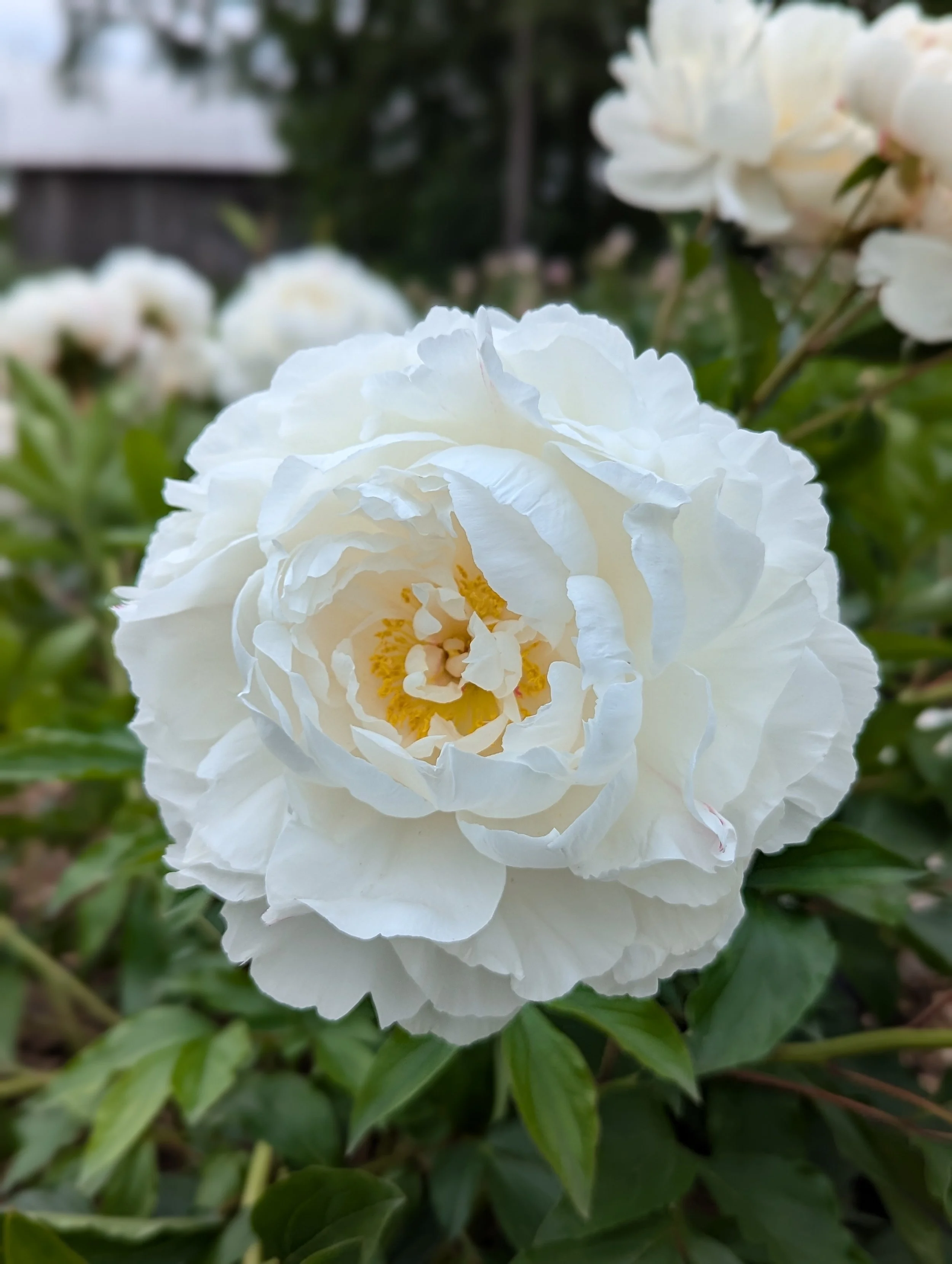

'Mary E. Nicholls' (Late-season): The newcomer that stole my heart completely. Elegant white petals kissed with the faintest blush of pink—subtle sophistication at its finest.


Blush
'Florence Nicholls' (Early/Mid-season): This color-shifter begins as soft blush pink, then performs the most graceful transition to nearly white as it opens. It's like watching magic in slow motion.


'Pillow Talk' (Mid-season): Don't let the soft name fool you—this variety is tough and durable. The massive blooms grow on sturdy, robust stems. The perfect blush pink Peony.


“Sarah Bernhardt” (Late-season): One of the most popular Peonies of all time. The delicate, blush blooms are simply swoon-worthy. She’s the grand finale of Peony season.


Pink
‘Dr. Alexander Fleming” (Mid/Late-season): This is one of my personal favorites, as well as one of the most productive Peonies on the farm. The elegant cool pink tones are perfect in bunches or mixed wth other spring blooms.


'Monsieur Jules Elie' (Early-season): An explosion of joy in your garden! These "bomb-type" blooms literally burst open to reveal their fluffy petals, like nature's own fireworks display.


Red/Magenta
'Kansas' (Early-season): The undisputed champion and MVP Peony of the farm. These are ridiculously productive plants with robust stems and petals tough enough to weather any storm. These blooms last longer than any other Peony I grow.


The Payoff: Blooms for Decades to Come
Yes, Peonies demand patience.
Yes, they require a leap of faith and three years of delayed gratification.
But when that first armload of blooms finally makes it to your kitchen counter, when your entire house fills with their perfume and friends show up unannounced just to see them… you'll understand why we’re so obsessed with Peonies!
Peony Season is an annual celebration, a reward for patience, a reminder that some of life's greatest pleasures are worth waiting for.
In a world of instant gratification, Peonies teach us the profound satisfaction of delayed gratification.
I trust that this blog post will help you choose which Peonies you want to grow in your garden! You have plenty of time to start researching Peony farms to purchase from, since it’s best to plant the bare roots in the fall.
Yes, the roots may “seem” expensive, but Peonies can be productive for decades. It’s not uncommon for them to be handed down from generation to generation. Think of each root as an investment in your future joy and delight!
Here are a couple of farms I can recommend:
Mountain Flower Farm in Vermont
Hollingsworth Peonies in Missouri
Ready for More?
If you’re serious about growing the garden of your dreams this year, register for my online course, “Backyard Cutting Garden 101”. You’ll find everything you need to plan, grow, harvest and arrange your stunning blooms. I can’t WAIT to help you grow! Click on the button below for all the details.

How to Eliminate Weeds in Your Garden
Tired of constant weeding? Transform the way you garden and set yourself free from weeds!
How to Eliminate Weeds in Your Garden
Every year about this time, I get desperate messages like the following:
”Help! I planted my garden 3 weeks ago, but now it’s a sea of green and I can’t tell what are weeds and what are plants! What do I do?”
Unfortunately, once the garden gets to this point, it’s really hard to reverse it. I’m sorry to say that there is not much to do other than hand weed relentlessly.
Like many areas in life, PREVENTION is key. A little bit of forethought and effort goes a loooooong way. Think of it as investing in your future self!
Eliminating weeds in your garden requires a new way of thinking that may seem foreign to you at first.
Here is the main idea I want you to remember:
BARE SOIL IS AN INVITATION FOR WEEDS
Yup, any time you leave soil bare, you are rolling out the welcome mat for weeds to invade and take over.
Let’s take a look at nature and the purpose of weeds.
Soil erosion is bad. We all know this. So does nature. To prevent soil erosion, nature came up a brilliant defense: Weeds.
Weeds are designed to grow quickly and completely cover areas to prevent soil erosion. They do their job incredibly well and honestly they deserve a standing ovation. Weeds DO have a purpose! And no, it’s not to make your life miserable ;)
Think about it. When was the last time you walked around nature and saw a giant bare spot of soil? Never? Yeah, that’s right. You’ve probably never encountered truly bare soil in nature. It generally doesn’t exist.
Everywhere you look, you’ll see something covering the soil, be it grasses, weeds, dead leaves, pine needles, etc.
Your job as a gardener: Mimic nature and COVER THE SOIL. If you don’t cover it, weeds will come and do the job for you.
COVER THE SOIL.
COVER THE SOIL.
COVER THE SOIL.
Got it? ;)
If you drive around a neighborhood, you’re likely to see houses with beautiful landscaping in the front yards. Do people plant their landscaping plants and leave bare soil exposed around them? NO!!!! They cover the soil with mulch… to prevent weeds.
YOU CAN DO THE SAME THING WITH YOUR GARDEN!
Yes, you should mulch your garden, just like you would mulch your landscaping.
Mulch does 3 things:
1. Prevents weeds. Mulch does the job of covering the soil, so weeds are not needed.
2. Retains moisture. Mulch helps hold in water and keeps the soil from drying out, so you can water less often and conserve resources.
3. Fertilizes the plants and improves soil structure. As the mulch slowly breaks down, it’s adds nutrients and organic matter to the soil. Your soil will get better and better each year!

So, what is “mulch”? Mulch has a very broad definition and basically refers to any organic (nature based) material that is used to cover the soil. Depending on where you live, you could use the following materials for mulch:
Straw
Grass Clippings (if you have a mower with a grass clippings attachment, be sure to collect these and use them. CAUTION: Only use clippings from lawns that are NOT treated with herbicides or other chemicals.)
Pine needles
Dried leaves (especially if you can run them through a shredder first)
Tree trimmings/chips from an arborist/tree trimming company (usually a mixture of chipped branches, limbs and leaves)
Shredded bark mulch from a landscape supply company (do NOT use treated or colored mulch around vegetable plants)
Cardboard or newspaper
Sawdust/wood shavings
Gravel or Pea Stone
Inorganic mulch can also be used. This usually refers to landscape plastics or fabrics that are used to suppress weeds. These are very helpful, but generally do not help to improve soil structure, like organic mulches do.
Inorganic mulch:
Landscape Fabric
Plastic Ground Cover
Tarps (yup, you could lay down a tarp and simply poke holes in it where you want to plant. Works best if you install soaker hoses UNDER the tarp before planting, since you won’t be able to water from above effectively)
On our farm, we use organic mulch and inorganic mulch.
For our flower/non-food crops, we generally use landscape fabric.
For food crops, we use tree trimmings/chips.
Our vegetable garden is comprised of several raised beds that are never roto-tilled. Instead, we simply add more mulch each year as needed.
After 8 years of gardening this way, our soil has become rich, productive and nearly weed-free. When we plant tomatoes, we generally throw a scoop a composted goat/chicken manure in the hole. This year, my husband and I realized that our existing garden soil is even better than the compost!
Because we have built up such rich soil and cover it with a thick layer of mulch, we generally only water the vegetable garden at planting time, then maybe once a month during the summer, only if there is drought. Generally, rain fall is sufficient. Even if we haven’t had rain in 2-3 weeks, the soil is still damp under the layer of mulch.

We keep a giant pile of tree trimmings/chips on the farm at all time, so we always have material on hand to cover the soil. You can sign up for Chip Drop online, or just do what we do… run out into the street and wave down any tree trimming trucks that drive by house. Ha! ;)
Here is our chip pile/heap, affectionately called “Mount Chipmore”.

In our flower garden, we mostly use landscape fabric with holes burned into it for proper plant spacing. The fabric is called DeWitt Sunbelt Ground Cover/Weed Barrier and it comes in several different sizes.
My husband bought pieces of sheet steel and made templates with different plant spacing:
6” x 4” (single stem sunflowers, cress, flax, stock, etc.)
9” x 9” (pretty much everything else…)
12” x 12” (cosmos, amaranth, etc.)
18” x 18” (branching sunflowers, dahlias, etc.)
We lay down the sections of fabric in our raised beds, pin them in place with landscape staples, then plant the seedlings/direct sow into the holes.
While we still have to do some weeding in the holes when the plants are tiny, eventually the flowers get so big they take over and weeds become a non-issue.
Below is a photo of what the flower garden looks like in the spring as we are preparing, amending the soil and covering beds with fabric….

… and here is what it looks like 2-3 months later. Lots of flowers with very few weeds.

So there you have it! Yes, eliminating weeds from your garden requires some up front work and dedication… but the results are worth it! Imagine having a garden you ENJOY being in, instead of feeling stressed out and upset every time you look at it.
Repeat after me: BARE SOIL IS AN INVITATION FOR WEEDS.
COVER THE SOIL.
Got it??? Good. Now get out there and cover your soil… and start creating the garden of your dreams!

Cut Flowers to Direct Sow NOW!
Last week was our Average Last Spring Frost Date on our farm - May 15.
On our farm, our last harsh “killing frost” ❄️usually occurs sometime between May 1 and May 31. On May 15, we have a 50% chance of still experiencing frost. It’s a bit of a gamble sometimes planting on May 15, but it works about half of the time!
We use the May 15 date as our signal to begin direct sowing our heat-loving, summer-blooming Annual cut flowers, such as:

Our custom Zinnia mixes for instant, easy Zinnia bouquets.
Succession Planting Annual Cut Flowers for Continuous Blooms
Most people sow their seeds around their Average Last Frost Date… and then think they are done planting for the season.
And this is okay if you don’t mind having a flush of blooms in mid-summer.
But if you want blooms all summer long, I highly encourage you to “Succession Plant” (you can read a comprehensive, in-depth report on how we Succession Plant in THIS BLOG POST).
Succession Planting is a planting method that involves staggering the seed sowing dates. Instead of planting everything all at once (which results in a “feast or famine” situation 😞), the planting season is lengthened… which results in a lengthened harvest season.
As a general rule, I recommend sowing heat-loving, summer-blooming Annuals a MINIMUM of 2-3 times, about 2-3 weeks apart.
Check out the graph below. As you can see, blooming tends to peak and then decline quickly.
By planting 4 successions of Zinnias, instead of just 1, we can ensure we have top-quality blooms to harvest for months, instead of just a few weeks.

How Many Successions Can You Sow?
The number of successions you can sow depends on two factors:
How many months of “frost-free” growing time are available where you live?
How many days does it take for the plant to reach maturity and bloom (Days to Maturity)?
On our farm, we have about 5 months of “frost-free” growing - May 15 through Oct 15. That’s roughly 150 days to grow heat-loving, summer-blooming Annual flowers (it’s a little depressing to calculate that only 40% of our days in Michigan don’t have snow or freezing weather! 🥶).
Many cut flower varieties take about 65-100 days to bloom.
To determine how many successions I can plant, I count BACKWARD from my Average First Fall Frost Date (October 15).
Ex. Zinnias take 65-90 days from germination to bloom. I can plant them anytime from May 15 through about June 30. If I plant them later than June 30, it’s likely they will NOT mature/bloom before frost arrives on Oct 15.
NOTE: Plants grow/mature FASTER when the weather is warm and when day length is longest around the Summer Solstice on June 20. They grow SLOWER when the weather is cool and as days shorten heading into the Autumn Equinox on Sept 22. Take this into consideration when sowing seeds!
List of Cut Flowers to Direct Sow RIGHT NOW!
Here’s a list of great candidates for Direct Sowing AFTER your Average Last Spring Frost Date:
These are heat-loving flowers, so I recommend waiting until your soil is warm before direct sowing.
There’s no advantage to sowing them earlier when the soil is cold. In fact, trying to sow them too early could delay or even prevent germination!
These seeds require consistent temperatures of 70°F or warmer to germinate properly.
Even though May 15 is technically “safe” for sowing these seeds most years, I find the seeds I sow in June (when it’s warmer and the days are longer) grow much FASTER and more vigorously than the seeds sown on my Average Last Spring Frost Date.
The Zinnias in the photo below 👇were direct sown on June 30… and they started blooming by August 15! Because they were planted around the Summer Solstice and experienced peak light levels, they only took about 45 days to mature. It was a great discovery and taught me that I can plant heat-loving, summer-blooming Annuals much later in the season than I expected!
These plants bloomed like crazy until they were killed by frost on October 17.

Featured flowers: “Rainbow Mix” Zinnias, “Salmon Pastel” Globe Amaranth, “Fercita” Amaranth
Tips for Direct Sowing Success
Here are a few tips for Direct Sowing:
After sowing the seeds, gently water the planting area. Watering “activates” the seeds and signals them to begin the germination process. Be sure to water GENTLY so you don’t wash away the seeds.
Make sure the soil stays moist the entire time while awaiting germination. If the soil dries out, the seeds might not germinate. You can keep the soil moist by:
Watering 1-3 times per day or as needed, depending on your weather conditions
Covering the sowing area to prevent the soil from drying out. I’ve used various materials with success, including burlap bags, feed sacks, frost cloth, pieces of 2x6 lumber, a light layer of straw, etc. The goal is to keep the soil from drying out. Check daily for germination. Once the seeds are germinated, you can remove the covering.
If squirrels, birds, or other critters eating your seeds is a problem, consider covering the planting area with frost cloth or old bedsheets until the seeds have germinated.
Mark where you planted the seeds. Your flower seeds will germinate… and so will weed seeds. It’s helpful to indicate where you planted the seeds so you can determine which seedlings are your flowers and which ones are weeds!
So what are you waiting for?
Now’s the time to direct sow your heat-loving, summer-blooming Annuals. And don’t forget to Succession Plant them so you can experience beautiful blooms for MONTHS, instead of just weeks!