How to Grow: Ageratum
How to Grow: Ageratum
Pronunciation: ah-jer-rah-tm
Ageratum is a wonderful addition to the cutting garden. While it never steals the show like other flowers, I like to think of it as a “supporting character”. It’s reliable, dependable and always shows up when you need it.
The blooms are cheery, adorable and delightful in bouquets. With multiple blooms per stem, they quickly add mass, texture and visual interest to your arrangements.

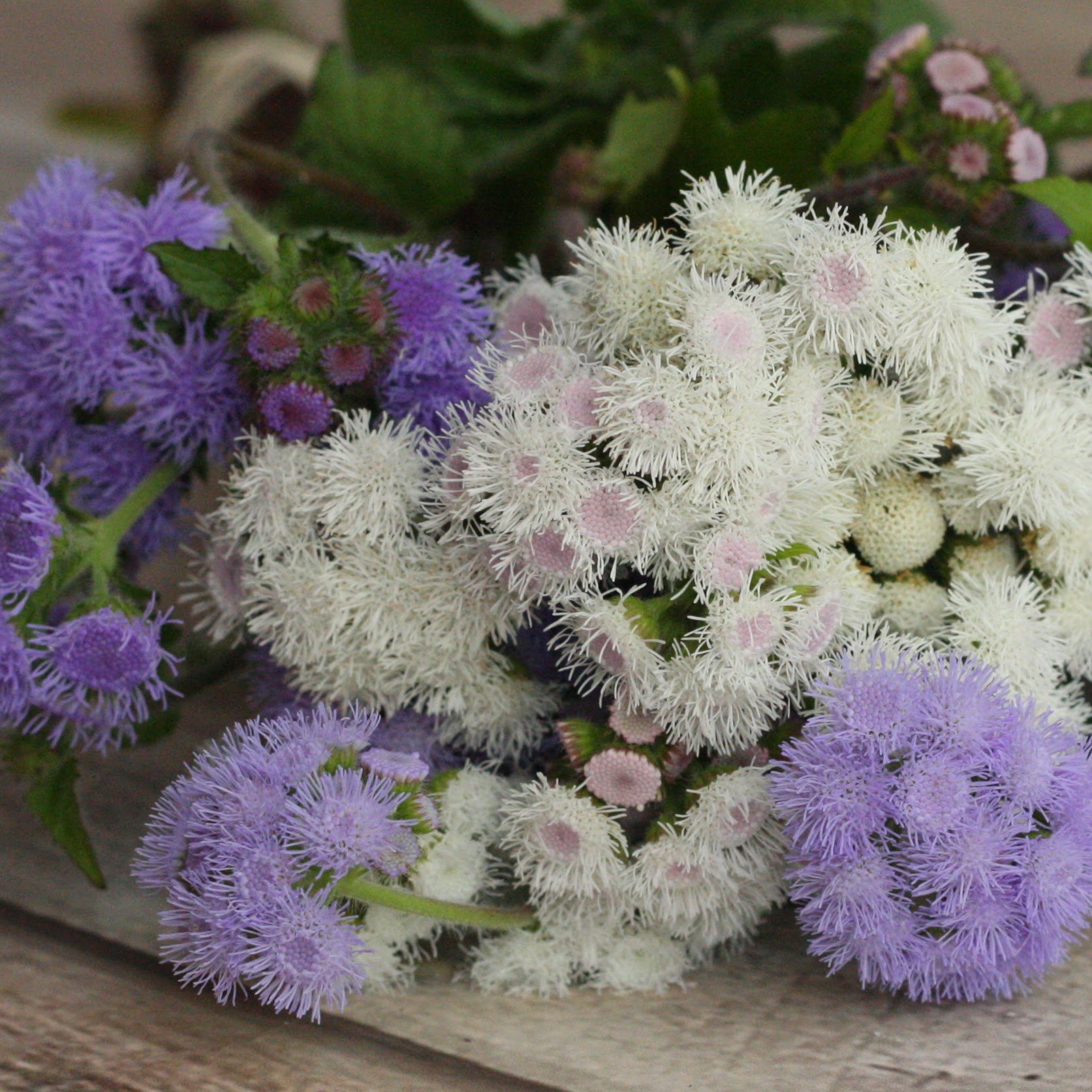
Ageratum "Timeless Mix"
Many varieties of Ageratum are bred as short “bedding plants” used in landscaping. You’ll want to avoid these varieties for the cutting garden and choose varieties bred for cut flower use instead (varieties that grow at least 24 inches tall).
A few years ago, I heard another flower farmer mention she grows Ageratum almost exclusively for its beautiful, prolific foliage.

Ageratum Foliage
In the photo below, you can see that we used Ageratum foliage as our primary foliage for these beautiful bouquets!

Ageratum foliage used as our primary foliage in these beautiful bouquets!
If you’ve ever grown a cutting garden, you know that finding good Annual type foliage sources is quite difficult! Lack of good foliage options seems to be a nearly universal problem for cut flower growers. Ageratum is a perfect solution to this problem. The more you harvest from the plants, the more they will grow.
Since Ageratum is a “dual-purpose” plant (flowers AND foliage), it earns a place of honor in every cutting garden.
Ageratum is sometimes called “Floss Flower”, which I assume refers to the fact that the flowers are thread-like and resemble embroidery floss… but I could be wrong. ;)
Let’s look at the Pros and Cons of growing Ageratum for cut flower use.
PROS
They are easy to grow from seed. In fact, Ageratum self-sows so well on my farm that I don’t even sow seeds in trays anymore. I simply go look for “volunteer” seedlings coming up each spring, dig them up and transplant them where I want them.
They are one of the best cut-and-come-again plants that will continue blooming for a long period of time if harvested regularly. The more you harvest, the more they will keep growing flowers and foliage.
They are very heat tolerant and perform well in hot climates.
They add wonderful texture and interest to bouquets.
They are easy to harvest and long-lasting in the vase.
They have little to no pest or disease issues. If you’re looking for a carefree, no-fuss flower, Ageratum fits the bill!
CONS
They come in a limited color palette (mostly cool colors such as white, purple, blue, violet and pink).
They will stop producing flowers if you stop harvesting them (which is true for most cut flowers).
They are not the most exciting flower. If your space is very limited, you may want to choose a flower with impact.
CHOOSING SEEDS
Here are a few of my favorite Ageratum to grow for cut flower use:
“Tall Blue Planet”
‘White Bouquet” (particularly useful as a white flower. White goes with everything!)
HOW TO SOW
Ageratum is a heat-loving, summer-blooming flower. It’s best to plant them outdoors after the threat of frost has passed.
Transplants or Direct Sow?
Ageratum can be started in seed trays and transplanted or direct sown in late spring. Transplanting is the preferred method, as the seeds are very tiny and difficult to direct sow.

Sow seeds in trays about 6-8 weeks before your Average Last Spring Frost Date. Keep them in a warm place while they are growing.
Transplant the seedlings outdoors after your Average Last Spring Frost Date.
Seeds are tiny and I recommend sowing them using the “toothpick method.” Pour the seeds into a container, lick the end of a toothpick and use the toothpick to remove seeds one at a time. Sow 1-2 seeds per cell. Barely over the seeds with a sprinkle of potting soil or vermiculite.
Like many Annuals, I recommend sowing 2-3 successions of Ageratum, 2-3 weeks apart to ensure you have a steady supply of blooms over the season.
PLANT SPACING
Grow Ageratum at 9-12 inch spacing for best results.

GROWING ON
Ageratum is quite carefree and easy to grow. Like most cut flowers, they appreciate consistent feeding and watering.
Plants should be netted or supported to prevent them from falling over.
Pinching is not required but can be useful as it causes the plants to branch more abundantly. I usually pinch half of the plants and leave the other plants as is. This helps to stagger the blooming time, so I don’t have all the plants in bloom at the same time.
STAGE OF HARVEST
Harvest when the flowers are ¾ of the way open, not in “bud” form. Be sure to cut low into the plant to encourage future growth.
If harvesting for foliage, cut stems before the flower buds form. Cut deep into the plant to encourage branching and more growth.

POST-HARVEST CARE
Ageratum does not require any special post-harvest care.
Like most cut flowers, always harvest in the cool of the day and allow the flowers to rehydrate in water in a cool location overnight before arranging.
QUESTIONS?
Ask them here and I’ll get back to you!
Ready for More?
If you’re serious about growing the garden of your dreams this year, register for my online course, “Backyard Cutting Garden 101”. You’ll find everything you need to plan, grow, harvest and arrange your stunning blooms. I can’t WAIT to help you grow! Click on the button below for all the details.

How to Grow: Amaranth
How to Grow: Amaranth
Pronunciation: am-ah-ranth
Amaranth is a beautiful and unique flower to add to your cutting garden. Their velvety flowers are elegant looking in the vase and add some real drama to your cut flower arrangements.
It’s also fun and easy to grow. Amaranth plants can tower in the garden and some even make great ornamental plants, if you decide you’d rather enjoy them in the garden rather than the vase.

“Coral Fountain” Amaranth
Another bonus of Amaranth is it makes a great dried flower. I dried Amaranth two seasons ago for fall decor arrangements and it still looks great!
You may have heard of Amaranth before or even seen it’s seeds in the grocery store! Yes, there are several different species of Amaranth and they can be used for food, foliage or flowers. Amaranth seeds are tiny and often cooked/prepared like quinoa (another “ancient grain” that is popular today).
Let’s look at the Pros and Cons of growing Amaranth for cut flower use.
PROS
They are easy to grow.
They are very unique and fun to look at.
The plants are productive for a long period of time.
They add elegance and drama to arrangements. No other flower has the same draping, trailing quality.
They have a good vase life of 7-10 days, with proper harvest and care.
CONS
They can shed their seeds on your table if harvested too late.
They can sometimes grow so large that they can be unwieldy and difficult to use in arrangements (more about how to prevent that later…).
CHOOSING SEEDS
There are 2 main types of Amaranth grown for cut flower use.
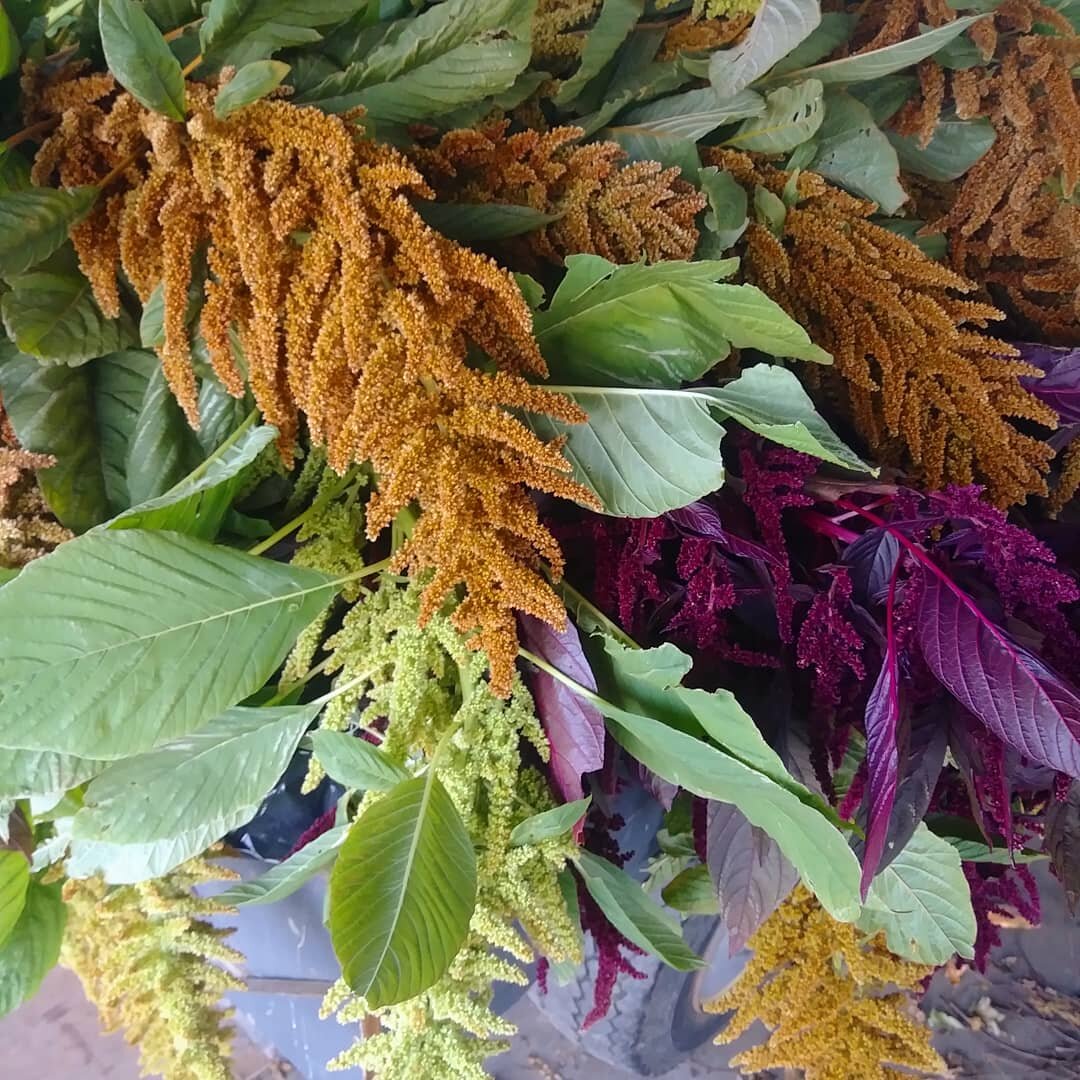
“Spike” type Amaranth has an upright growing habit and the plants produce “spikes” or “plumes” that add height and drama to arrangements.
“Trailing” type Amaranth has a draping growth habit and the plants produce “ropes” that hang and drape in arrangements.
Both types are useful and worth growing. Here are a few of my favorite Amaranth to grow for cut flower use:
“Love-Lies-Bleeding” (trailing)
“Green Cascade” (trailing)
“Red Spike” (spike)
“Hopi Red Dye” (spike)
HOW TO SOW
Amaranth loves heat. They do not like cold temperatures and can’t handle frost, so don’t plant them too early. Don’t worry - they grow quickly when the soil warms up. They will begin to bloom in mid/late July and bloom until the fall frost.
Transplants or Direct Sow?
Amaranth is versatile and can be transplanted or direct sown.
The seeds are tiny, so you may need to use the “toothpick method” for planting seeds. Pour the seeds into a small bowl, wet the toothpick with your tongue, then dip it in the seeds to pick up 1-2 seeds on the toothpick. Transfer seeds to your trays or desired planting spot.
Transplants should be started indoors about 4-6 weeks before the last spring frost. They love heat, so be sure to keep them warm while they are growing indoors.
Direct sowing is another option (my preferred method!), as the plants grow very quickly. Direct sow in warm soil, after the threat of frost is passed. Sprinkle a couple seeds in spots spaced about a foot apart. You can thin the plants later (pluck out the unneeded seedlings).

PLANT SPACING
Amaranth plants can get quite large, so they should be spaced at about 12-15” apart.
GROWING ON
It is wise to provide support or netting to keep the plants from falling over. If you are growing just a few plants, large tomato cages may be sufficient. If you are growing a block or row of them, netting or metal supports would be best (like our “cattle panel supports” featured below).

“Coral Fountain” Amaranth
For best results and more manageable blooms, it’s advisable to “pinch” the plants. If they are not pinched, they tend to grow very large (over 6 foot tall!) and have thick stems that are much too big to use in most floral arrangements (below, you will see an example of Amaranth plants I forgot to pinch! Whoops).
To pinch Amaranth, cut back the center bud/stem when plants are about knee high. This will signal the plant to produce multiple stems that are smaller and easier to use.
If flowers are harvested and spent blooms are “deadheaded” (removed and not allowed to go to seed), the plants will continue to send up blooms until frost arrives.
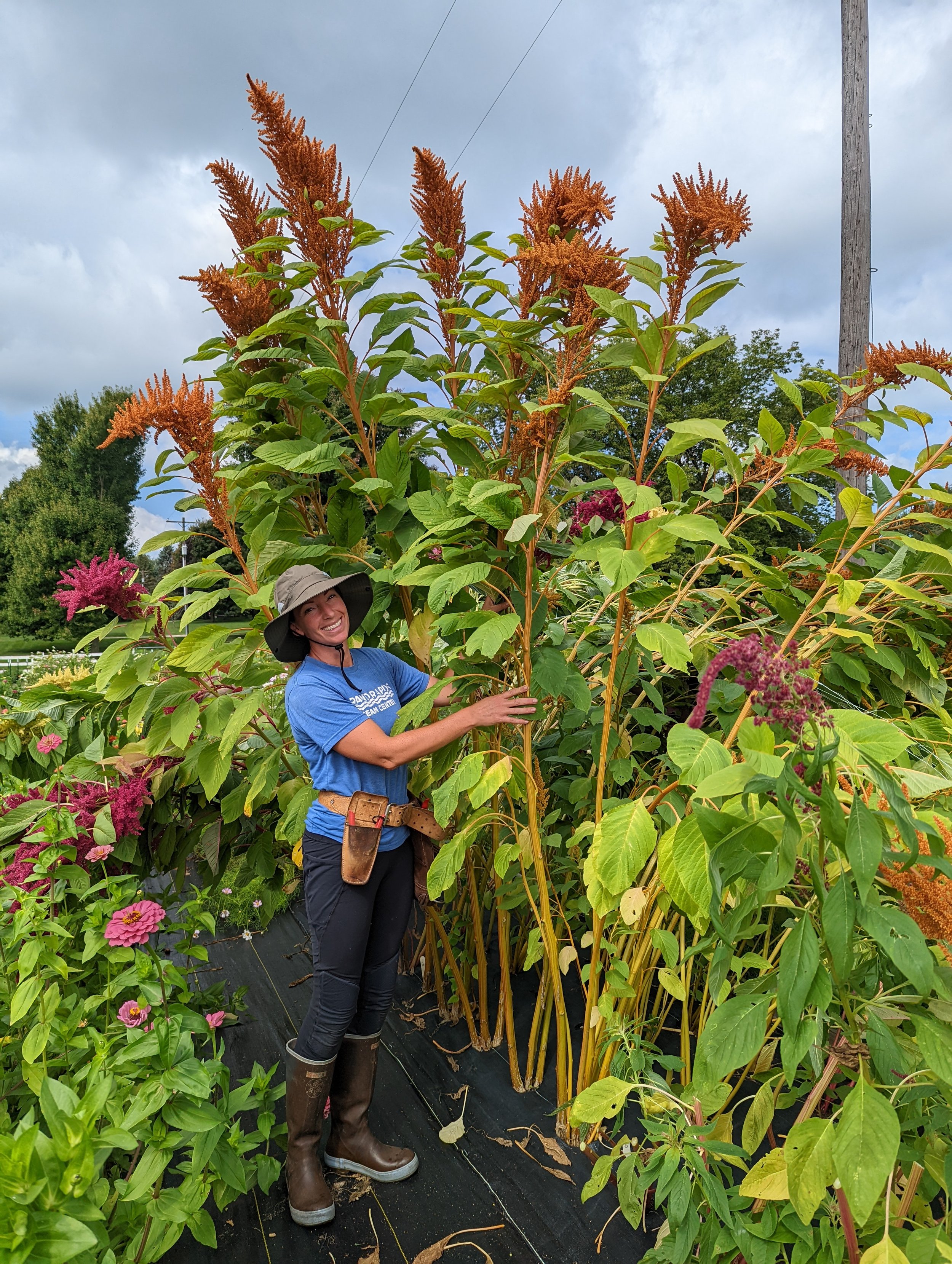
“Chinese Giant Orange” Amaranth
STAGE OF HARVEST
Amaranth can be harvested after the color forms on the spikes or tassels, when about ¾ of the tiny little flowers are open. The spikes or tassels will continue to grow in size as they mature and they have a long harvest window.
However, be sure to harvest before they are too mature or they will drop their seeds all over your table!

“Fercita” Amaranth
Amaranth can be used fresh in arrangements or you can dry it to be used as an “Everlasting” flower.
To dry, simply place them in a bucket in a warm, dry place out of direct sunlight, and let them drape naturally… or hang them upside down. They should dry in about 2 weeks.

POST HARVEST CARE
After harvesting, remove most of the leaves to help the stems re-hydrate more quickly. This also allows the flowers to be more visible.
Amaranth requires no other special care.
“Coral Fountain” Amaranth in a wedding arrangement
QUESTIONS?
Ask them here and I’ll get back to you!
Ready for More?
If you’re serious about growing the garden of your dreams this year, register for my online course, “Backyard Cutting Garden 101”. You’ll find everything you need to plan, grow, harvest and arrange your stunning blooms. I can’t WAIT to help you grow! Click on the button below for all the details.

How to Grow: Ammi (False Queen Anne's Lace)
The perfect filler for all your arrangements!
How to Grow: Ammi (False Queen Anne’s Lace)
Pronunciation: am-ee
One of the biggest “newbie” flower gardening mistakes I see is not growing enough “filler” type flowers for bouquets.
I know, I know… it’s easy to get starry eyed over all those big blooming “focal” flowers, like Sunflowers, Zinnias and Dahlias… but a bouquet made with only big focal flowers can easily look a tad gaudy and overpowering.
In order to have well balanced bouquets and arrangements with visual interest, it’s important to grow some flowers whose soul purpose is to complement and enhance the focal flowers.
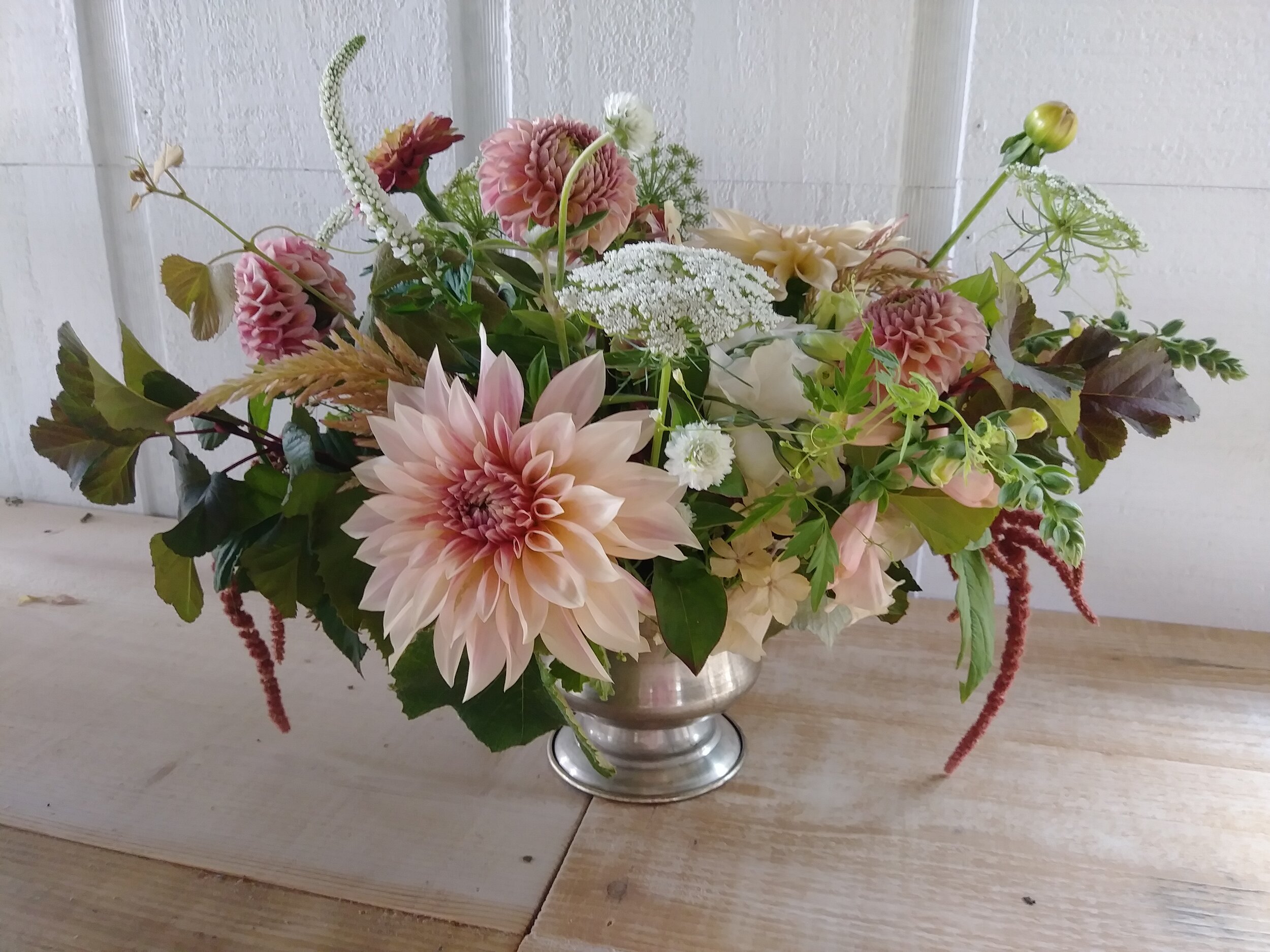
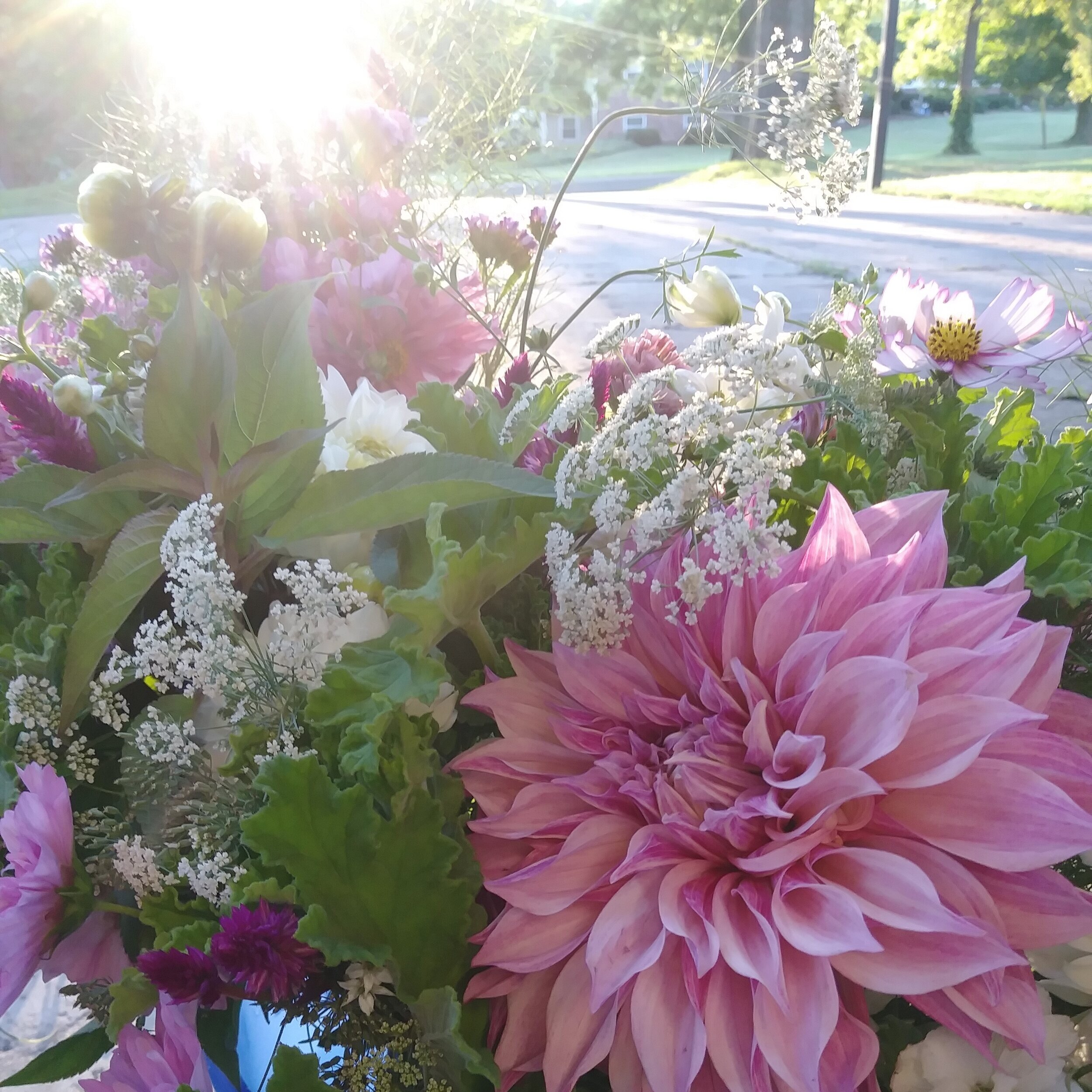
Ammi (False Queen Anne’s Lace) does this beautifully. It looks great with almost any type of flower and adds some much needed volume, texture and whimsy.

You may have noticed the wild Queen Anne’s Lace (Daucus carota) growing in meadows and roadsides. Another name for this plant is Wild Carrot, and yes, if you pull up the root, you’ll see and smell that it is indeed a white carrot!
Queen Anne’s Lace grows wild in our area. In fact, the field that is currently our U-Pick Flower Garden was an entire field of Queen Anne’s Lace when we moved to farm nearly a decade ago. It certainly was beautiful!

Gah! My kids were just babies. Now my son has a mustache and is taller than me… and my daughter is the same size as me. People, how does this happen?!? Excuse me while I have a moment…

For floral use, though, most people prefer to grow the more sophisticated and cultivated varieties of Ammi, which are related to wild Queen Anne’s Lace.
Let’s look at the Pros and Cons of growing Ammi for cut flower use.
PROS
They are fairly easy to grow.
They are versatile in bouquets and arrangements.
They attract pollinators.
They will reseed themselves, if you allow them to.
CONS
They are not the longest blooming flower. You’ll need to plant them a few times over the spring/summer to have a continual harvest.
They should be netted to keep them from falling over.
They have irritating sap that can cause contact dermatitis when harvested on a sunny day (more about this later!).
CHOOSING SEEDS
There are 3 main categories of Ammi that are used for floral work.
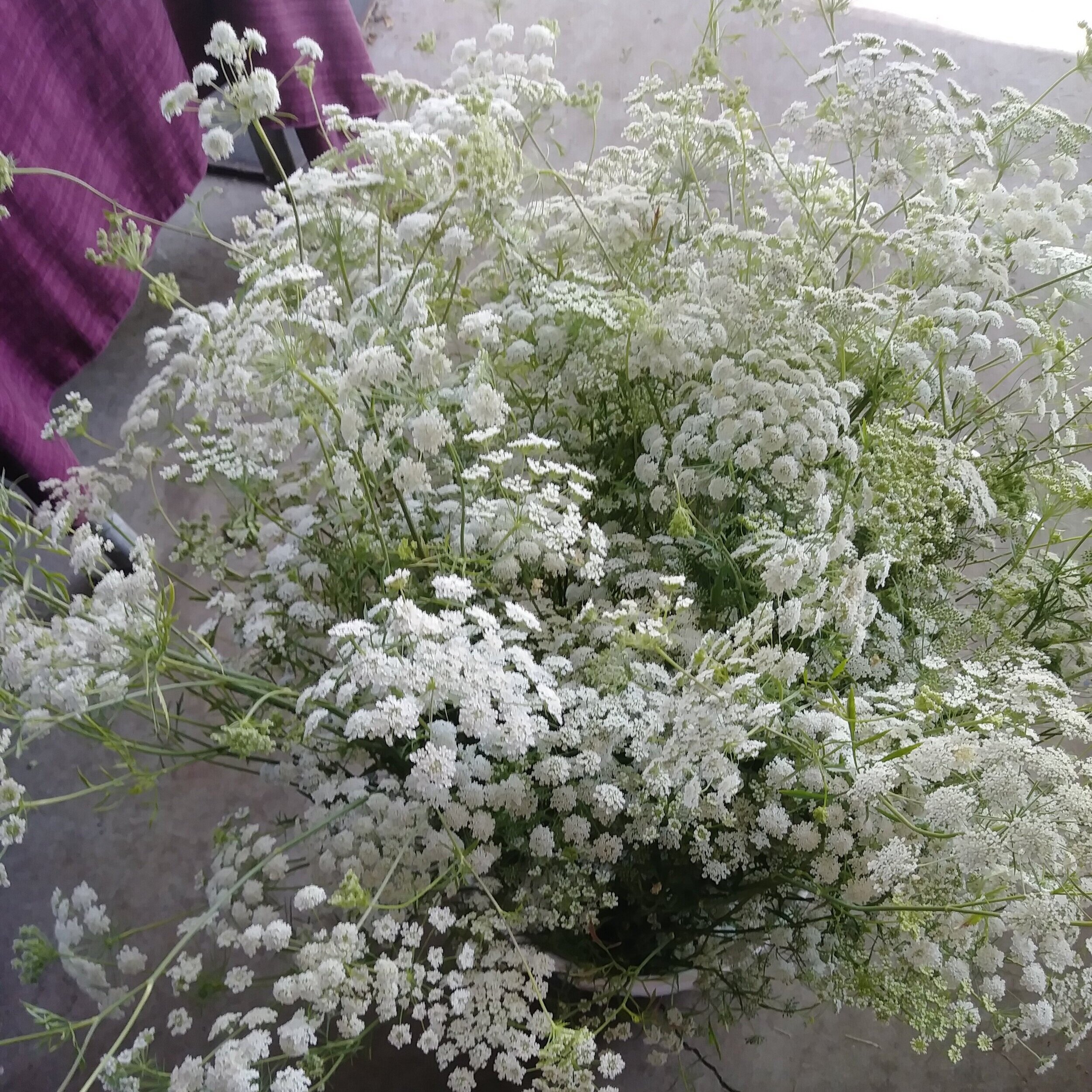
1. Ammi majus: This type most closely resembles wild Queen Anne’s Lace - light, airy and delicate. On our farm, this type does best in the spring/early summer.
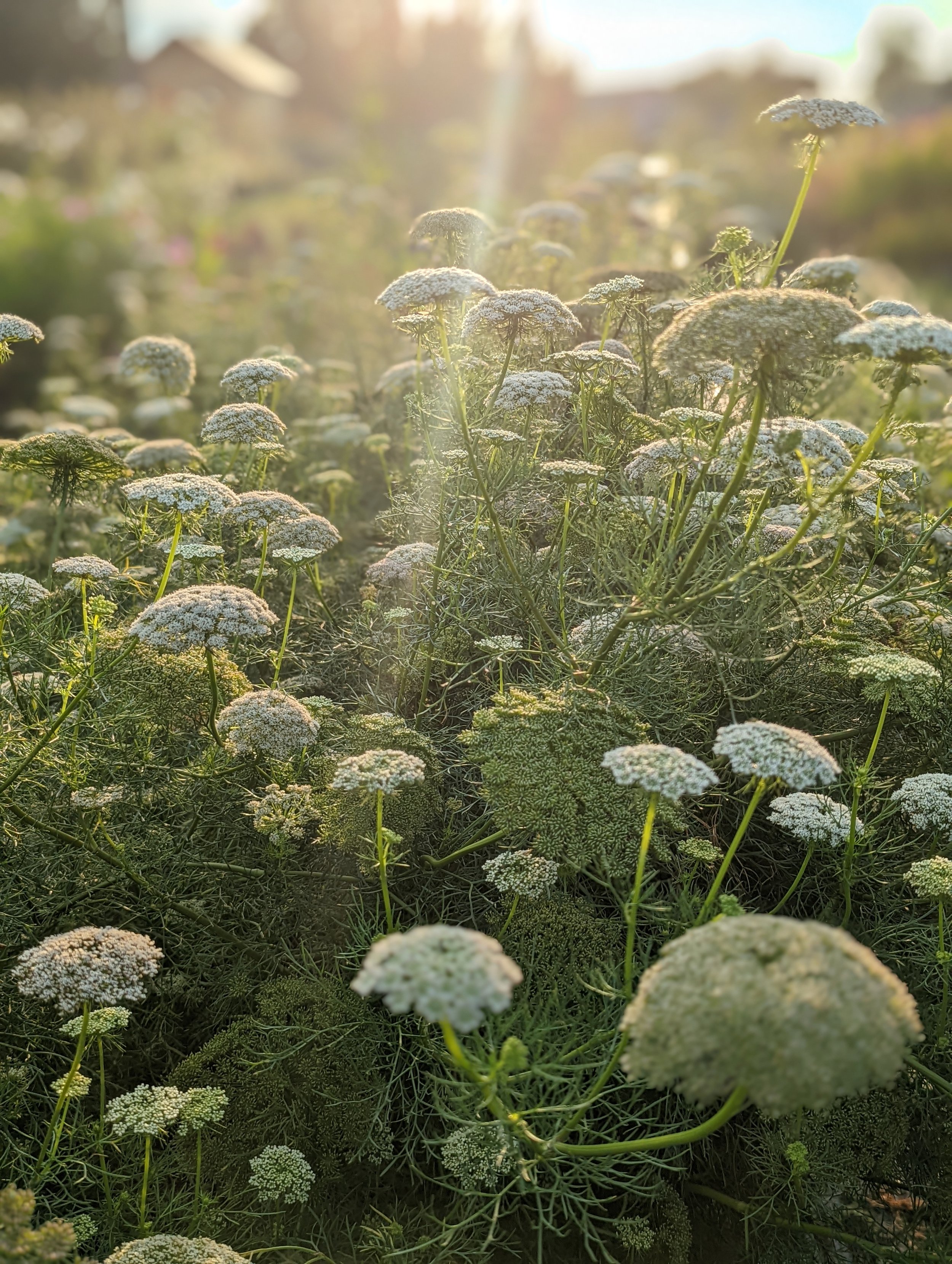
2. Ammi visnaga: This type is much more robust and fuller than Ammi majus. It also tends to be more green than white. This type is sturdy and adds lots of structure to bouquets. Unfortunately, it also has a distinct smell that some people don’t like. On our farm, this type blooms well even in the heat of summer and into fall.
3. Dara/Daucus carota: Technically not “Ammi”, you’ll often find this in seed catalogs under the Ammi category. This type is a unique variety of wild carrot. The blooms come in a range of pink, purple and white. I’ve seen all sorts of names for this flower (no one seems to know exactly what to call it!), so search for “Dara”, “Ammi dara”, “Daucus”, “Daucus carota”, “False Queen Anne’s Lace”, “Chocolate Queen Anne’s Lace”, “Ornamental Carrot”, “Chocolate Flower” and even “Chocolate Lace Flower”!

Here are a few of my favorite Ammi to grow for cut flower use:
“White Dill” (Ammi majus)
“Graceland” (Ammi majus)
“Green Mist” (Ammi visnaga)
“Dara” (Daucus carota)

HOW TO SOW
Ammi generally prefers cooler weather and really shines in the spring/early summer. While it can handle warm days, it wants cool nights.
The plants are quite cold hardy and can handle some frost.
If you live in a warm climate, sow the seeds in the fall and they will take off early next spring. If you live in a cold climate, sow the seeds as early as you can in the spring (when the soil has thawed).
Transplants or Direct Sow?
Ammi can be transplanted or direct sown.
Transplants should be sown indoors 4-6 weeks before you plant them out. Keep the seeds in the fridge or freezer for 2 weeks before sowing (this mimics winter weather).
Remember, they want cold nights, so if you are using heat mats for your seedlings, be sure to turn off the heat at night or remove the tray at night. They can be transplanted out BEFORE the threat of frost is over, since they are cold hardy.
If you don’t want to mess around with moving trays every day (I don’t!!!), then simply direct sow when you want them to grow as early in the spring as possible.
Ammi prefers to be direct sown, so this method is the simplest and easiest. You might as well save yourself some time and growing space, and simply direct sow the seeds!
If you want to try Winter Sowing, Ammi is a great candidate for this method.
Ammi is a “self-sowing” hardy annual, which means if you leave a few seed heads to mature on the plants, new plants will pop up the following spring. Bonus!
PLANT SPACING
Ammi can be grown at 3-12” spacing… so if you direct sowed and your plants are crowded, don’t fret.
I find Dara needs the least amount of spacing (grows very upright), Ammi majus needs about 6-9” spacing, and Ammi vignaga does better at 12” spacing (widely branching plants).
Netting is helpful, as plants will grow 36” or more. We use Hortonova trellis netting stretched tight over the bed with stakes.
Yup. It’s a real pain harvesting those stems in the netting… But it’s better than having the plants falling over! Hint: Pull the stem down through the netting, not up.

Update: Recently, we switched to using “cattle panel support” pictured below for growing Ammi and Dara… and it is a GAME CHANGER. You can learn how we make the “cattle panel supports” in this blog post.

GROWING ON
Ammi is not a particularly long lasting flower in the field. Don’t expect it to bloom all summer long.
In order to harvest Ammi longer, I like to plant 2 successions of Ammi majus (spring/early summer blooming) 2-3 weeks apart, followed by 2 successions of Ammi visnaga (summer/fall blooming) 2-3 weeks apart.
Dara seems to do better as a spring/early summer blooming plant, but occasionally I can get some to bloom into the fall.

STAGE OF HARVEST
Recognizing the correct stage of harvest for Ammi can be a little tricky.
Harvest too early, and they will droop over and never recover.
It’s better to err on the side of too mature than too early. Fortunately, even if you harvest them too mature, they still look beautiful with their seed pods.
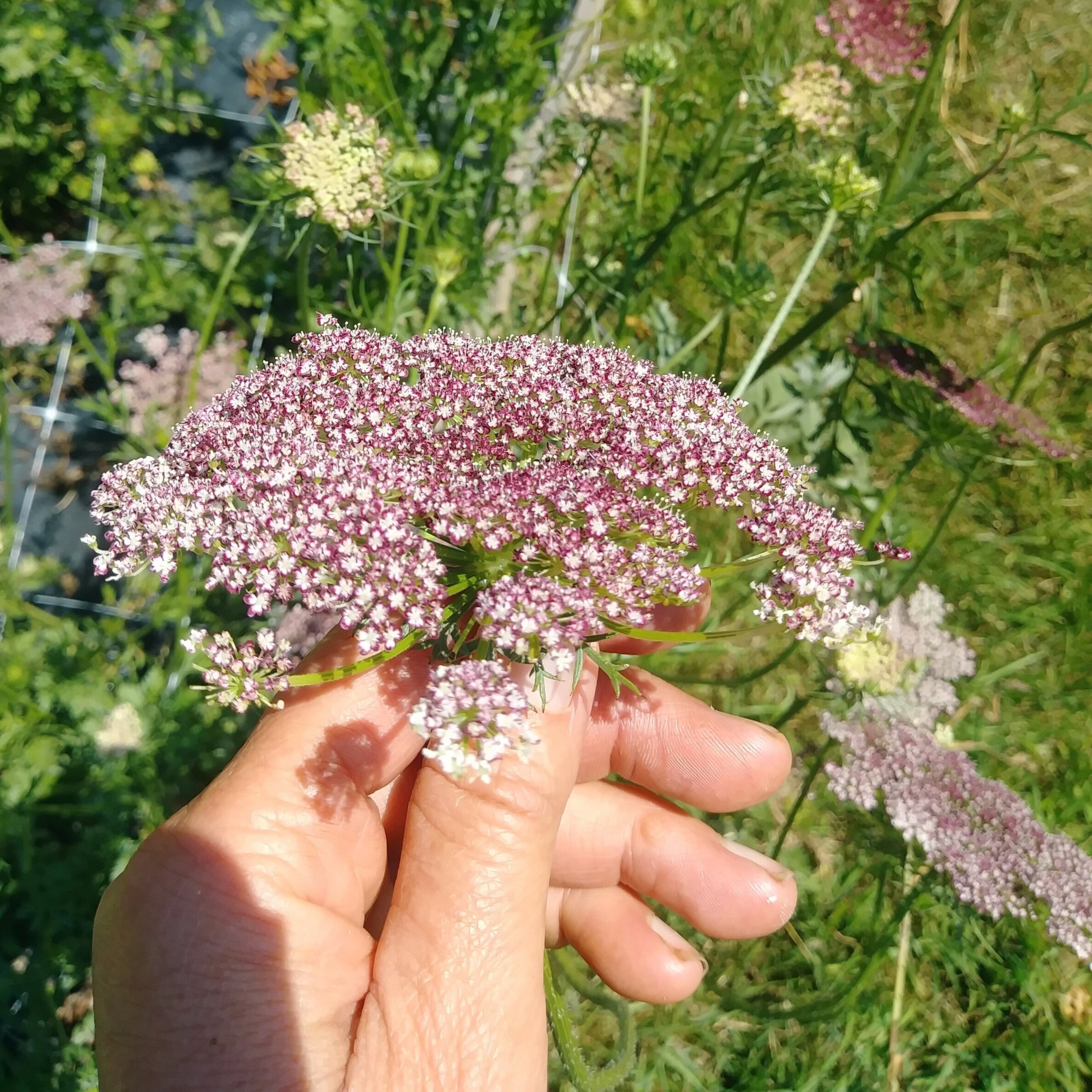
Take a look at the bloom. If it is flat or concave (sides higher than center), it is not ready.
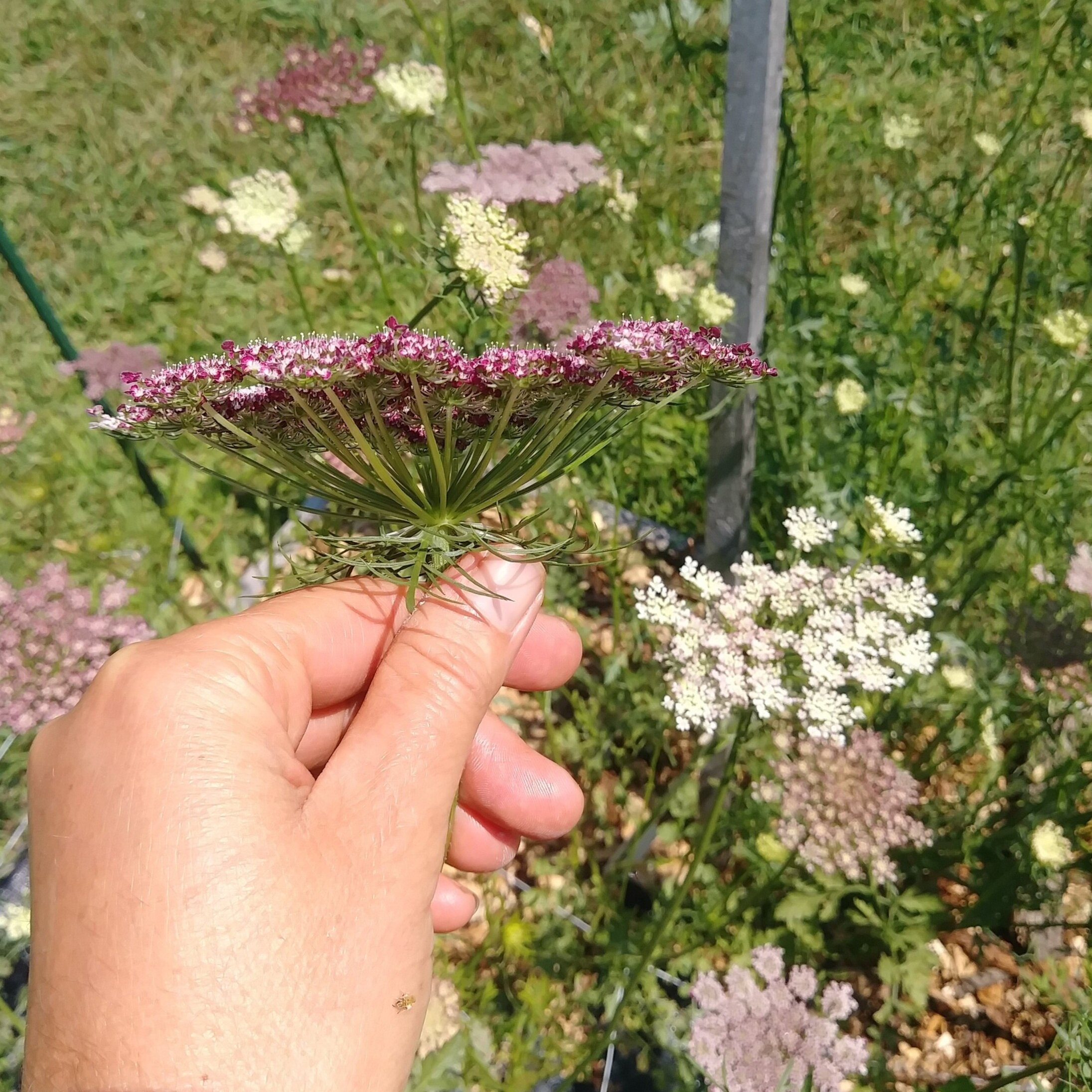
If the bloom is domed or convex (sides lower than center), then it’s ready!
SPECIAL NOTE:
When you cut a stem of Ammi, sap will come out of the cut end. Do NOT allow this sap to come into contact with your skin, especially on a sunny day. Ammi can cause contact dermatitis on some people, called Phytophotodermatitis, a reaction caused by contact with a plant sap/substance that reacts to sunlight.
When the sap gets on your skin and is exposed to the sun, it can cause burns and blisters. While usually not painful, it can cause scarring that lasts for months. Ask me how I know this.
Usually, I wear long pants, long sleeves and gloves when harvesting (AND harvest it before sunrise or after sunset), but on this one day, we had to harvest it 9am and it was 90+ degrees. I learned a hard lesson to always wear long pants/sleeves, even when it’s suffocating (and this is exactly why farm workers wear long pants/sleeves when harvesting carrots, celery and other plants).
The blisters were not painful, but I had scars/dark patches on my legs/forearms for about 3 months.

POST HARVEST CARE
Immediately upon harvest, allow the Ammi to rest in a bucket of water in a cool, dark place.
After resting overnight, stems should be ready for arranging!

QUESTIONS?
Ask them here and I’ll get back to you!
READY FOR MORE?
If you’re serious about growing the garden of your dreams this year, register for my online course, “Backyard Cutting Garden 101”. You’ll find everything you need to plan, grow, harvest and arrange your stunning blooms. I can’t WAIT to help you grow! Click on the button below for all the details.

Perfect Color Palettes For Stunning Bouquets
When I first started growing cut flowers, I chose a bunch of random flowers in random colors and randomly planted them.
As you can expect… my bouquets looked pretty, well, RANDOM.
Random (adjective)
Definition:
1.a: lacking a definite plan, purpose, or pattern
b: made, done, happening, or chosen without method or conscious decision
Yup, that sounds about right!
No plan, method, pattern or conscious decision.
Now, don’t get me wrong. I do appreciate qualities such as whimsy, spontaneity and “happy accidents” (thank you very much, Bob Ross).
But I quickly realized that while random-looking bouquets were fun to make, I wanted something a little more… professional-looking.
Something that looked like a bit of thought and intention went into it!
The human eye/brain loves order, rhythm and pattern. Without those elements, the design can look cluttered, chaotic and disorganized.
After years of growing, harvesting and crafting thousands of bouquets, I finally figured out how to create pleasing bouquets based on COLOR palettes.
It all starts with being intentional about what COLOR flowers you choose you grow !
I’m here today to help you PLAN AHEAD and choose the best seeds in your favorite color palettes.
Psst… choosing a color palette INTENTIONALLY is what makes your bouquets look more pleasing, appealing, and well… professional!
On our farm, we work with 3 broad color palettes to craft beautiful and coherent bouquet designs that are pleasing to the eye and easy to put together.
While there are ALWAYS going to be variations in each bouquet depending on what’s available (it changes day by day!), most of our bouquets fit into one of the 3 following color palettes.
Warm Sunset tones: Flowers in warm tones, like peach, coral, apricot, salmon, buttery yellow, bronze, strawberry lemonade, sunset, etc (plus white, because white goes with everything!).
Cool Romantic tones: Flowers in cool tones, like pink, lavender, violet, silvery rose, rose, wine, blue, magenta, etc (plus white, because white goes with everything!)
Bright Bold tones: Flowers in bright tones, like red, magenta, violet, carmine, yellow-orange, maroon, orange, yellow, lime green, etc (plus white, because white goes with everything!)
Want a printable guide to help you formulate your color palette strategy?
You’re in luck!
I put together a beautiful resource to help you explore and plan your color palettes.
It’s called “Perfect Color Palettes: Your guide to elevated homegrown bouquets”.
Inside your find:
Example photos of color palettes
Photos of individual flowers, according to their color palettes
A printable list of flowers that fit into each color palette:
Warm Sunset tones
Cool Romantic tones
Bright Bold tones
Get your copy of the guide by filling out the form below. 👇
The guide will be delivered to your inbox. If you don’t see it, be sure to check your promotions or spam folder!
Let’s look at some examples of color palettes so you can see how they work in real life….

Warm tones vs cool tones

Warm tones

Cool tones

Cool tones vs Bright tones

Warm tones vs Cool tones

Warm tones

Bright tones

Bright tones

Cool tones (with a few touches of bright! )
Once you have a color palette in mind, it’s so much easier to choose what seeds to grow.
You can be confident that when it’s time to harvest your blooms, your bouquets will look organized, sophisticated and visually appealing.
Side note: If you love random-looking bouquets, then you should 100% keep making them. You do you, friend!
Enjoy the Perfect Color Palettes Guide. All the flowers featured in the guide are available for purchase on our website.
You can buy seeds from all 3 palettes (there is some overlap!) or make your life super simple and stick to one palette.
Personally, I’m on Team “Warm Sunset Tones”! I can’t get enough! They blend so perfectly with my warm-toned Dahlias in September.
What’s YOUR favorite?

It’s Dahlia Evaluation Time on the Farm!
It’s Dahlia Evaluation Time on the Farm!
Right now is the PERFECT time to do a Dahlia Evaluation before they get hit by frost and the growing season abruptly ends. Dahlia Evaluation time means I’m inspecting each plant, looking to make sure:
It’s properly labeled.
It’s healthy and productive. Any plant that looks suspect or is not producing blooms true to form is immediately culled and destroyed.

MORNING WALKS IN THE DAHLIA FIELD
This time of year, most mornings are spent walking the Dahlia field. While it’s a beautiful way to start the day, it also has purpose. One of my best (and also exhausting) qualities is observation. I notice EVERYTHING. My eyes are evaluating every plant:
Is it healthy?
Is it productive?
Is it true to form?
Is it labeled correctly?
Is it experiencing disease or pest issues?
Most of these answers are cataloged in my brain, where I file away a decade's worth of observation, examination, and scrutiny. As I get older, I become more aware that these thoughts, observations, and awareness need to be recorded or they will be lost forever. So I’m starting to record them.
A UNIQUE PERSPECTIVE ON DAHLIAS
Each Dahlia variety is unique and has different characteristics and qualities. I think of them like people. Even though they are all the same species, the variations are astounding—just like humans. I even find myself talking to them like old friends. When they start blooming, it’s usually been 9-10 months since I’ve last beheld their beautiful faces. It’s so good to see them again, and I tell them how much I’ve missed them. Every morning is a new delight. I’m cherishing these quiet moments, knowing that my time with the Dahlias is limited.
We could have 6 weeks left before frost ❄️… or 2 weeks… or somewhere in between. So I soak it all up, into my body, into my bones… to get me through that 9-10 month absence from my dear friends.
EVALUATING FOR NEXT SEASON
As I make decisions about what to grow next year, I like to keep it simple, growing about 100 different Dahlia varieties each year. This means that if I’m adding 10 new varieties, I must say goodbye to 10 varieties as well.
We are a “Cut Flower Farm,” which means we are growing Dahlias for the purpose of cutting the stems for bunches or bouquets, NOT as a landscape plant. If the Dahlia is beautiful but too short for bouquets or the petals get too damaged in arrangements, then it’s not worth our time or effort to grow it (except in a few cases where we grow them just for fun).
At the end of each season, I take about 3-4 hours and walk the field with my clipboard, making observations and notes about each Dahlia, looking for things like:
Does it grow tall enough to be used as a cut flower? If not, does it have any other redeeming qualities?
What kind of growth habit does it have? Are the stems easy to harvest for cut flowers?
Did this variety have specific issues with disease or pests?
Did I like the color? Was it easy to use in bouquets and bunches?
Are the petals sturdy and able to hold up to handling during harvesting and bunching? If not, does it have any other redeeming qualities?
Is it a good tuber producer? Some Dahlias grow incredible blooms but have consistently poor-quality tubers that make reliable tuber storage difficult. I usually give these varieties three seasons, and if it doesn’t get easier, I will discontinue growing them.
FINAL THOUGHTS ON DAHLIA EVALUATION
If you haven’t done a Dahlia Evaluation yet… you’ve still got time! Grab a notebook, inspect your plants, and start making decisions for next season. Your “Future Self” will thank you!
We have our first chances of frost this week, so if you haven’t done your Dahlia evaluation and inspection, NOW is the time to do it! If we do get frost, I expect it to be very patchy. It won’t kill the plants. It usually takes temperatures below freezing to truly end the Dahlia growing season. We call this our first “Killing Frost” or “Frostmas.” Frostmas is a celebrated holiday on our farm that signals the completion of our growing season, but we never know exactly when the holiday will arrive! It’s usually around October 15, but some years Frostmas arrives weeks before or after that date.

Once the Dahlias are killed by frost, they become completely unrecognizable, so it’s important to do your inspection and evaluation while you can still see what they look like! I walk up and down the rows with my Dahlia Map, ID tags, a Sharpie, and a spade, inspecting every single PLANT that I grow:
Is it labeled correctly? If not, be sure to flag it.
Is it healthy? If not, remove it and dispose of it.
Are the flowers true to form? If not, remove it and dispose of it.
I’m also taking notes on my clipboard about each VARIETY that I grow:
Does it grow tall enough to be used as a cut flower?
Are the stems easy to harvest for cut flowers?
Did this variety have specific issues with disease or pests?
Was the color easy to use in bouquets and bunches?
Are the petals sturdy and able to hold up to handling during harvesting and bunching?

LOOKING AHEAD TO NEXT YEAR
Next year, we are going to divide our Dahlias into two groups and two separate fields:
Dahlias for Cutting/Production: The tried-and-true varieties that perform well as cut flowers in bunches and bouquets.
Garden Dahlias: The varieties that are best enjoyed in the garden. While they still CAN be used as cut flowers, these may be Dahlias with fragile blooms or short stems, which are otherwise better suited for garden decoration.
I'll be sure to share my evaluation this winter!
QUESTIONS?
Ask them here and I’ll get back to you!
Ready for More?
If you’re serious about growing the garden of your dreams this year, register for my online course, “Backyard Cutting Garden 101”. You’ll find everything you need to plan, grow, harvest and arrange your stunning blooms. I can’t WAIT to help you grow! Click on the button below for all the details.