How to Grow Statice
How to Grow Statice

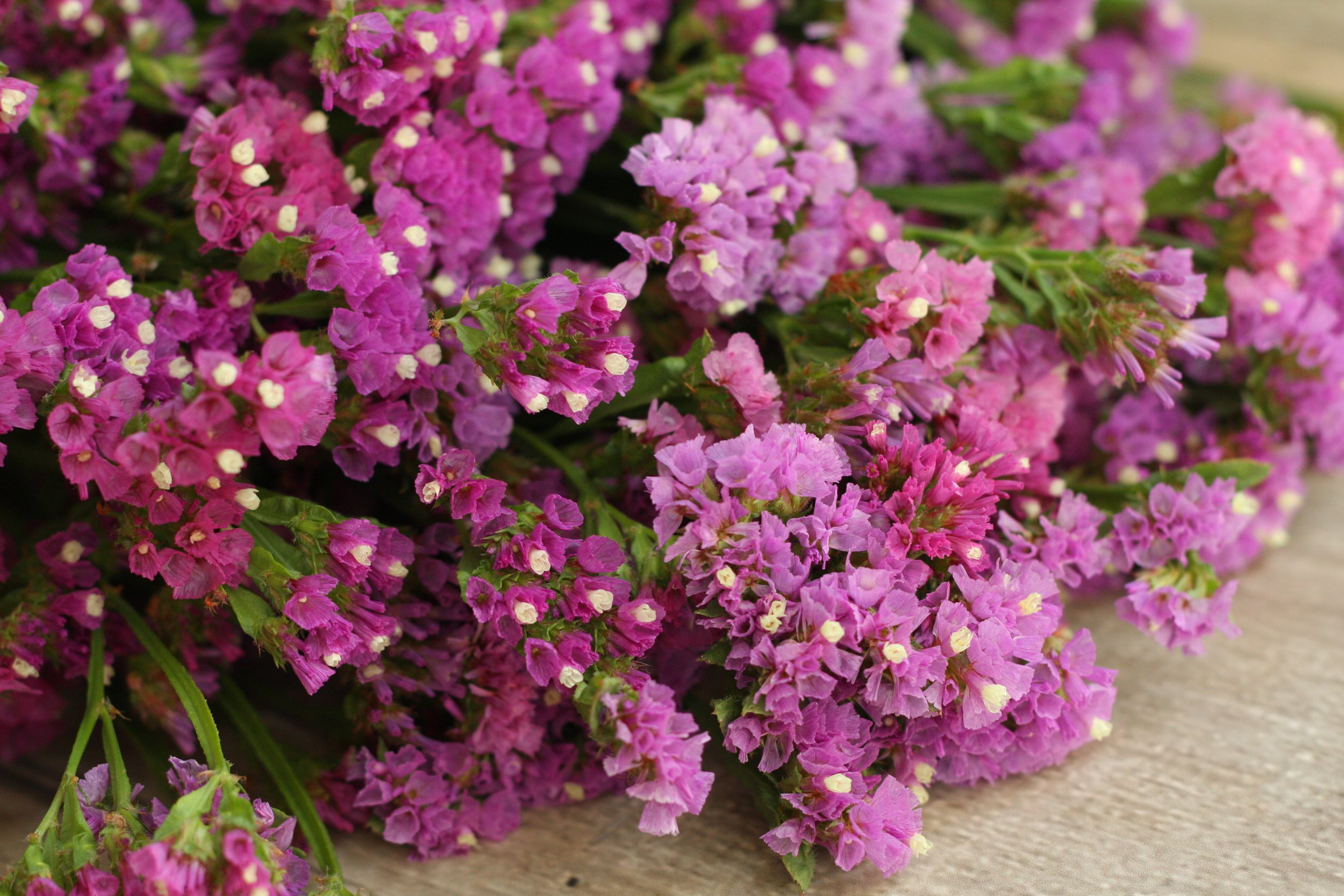
Rose Shades
On our farm, we consider Statice our bouquet-making MVP (most valuable player). During the growing season, we harvest bucket loads of it every single week and we use every single stem in our bouquets.
I find Statice to be one of the most useful “Filler” type flowers you can grow. The role of Filler flowers is to complement and enhance the “Focal” flowers (the big flashy flowers that get all the attention). Statice doesn’t mind playing a supporting role.
Statice also is a dual-purpose flower. Not only does it look great in fresh flower bouquets, but it also dried beautifully for dried flower arrangements. The papery-looking clusters will last for years.
I sure hope you try Statice and learn to love it as much as I do. We use it nearly every summer and fall bouquet we make on the farm!

QIS Apricot
Let’s look at the Pros and Cons of growing Statice for cut flower use.
PROS
They are very long-lasting in the vase. Once all the other flowers have died, Statice is still standing. You can pluck out the stems, hang them to dry and keep them for years as an “Everlasting Flower”.
They are a perfect filler flower to enhance and “fill out” a bouquet that is looking a bit sparse.
They are versatile and look good with almost any other flower.
They are easy to grow.
They are productive over a long period of time. While many sources say they are NOT “cut-and-come-again”, we find that plants will continue blooming for 2-3 months if harvested/deadheaded on a regular basis. This is likely climate-dependent and your experience may be different.
They come in a wide range of colors (although I do find some of the colors garish, so I stick to just a few super versatile colors).

Rose Shades
CONS
They can be susceptible to Aster Yellows disease. Botrytis (fungal infection) can also be a problem.
They do not like overhead watering. This, along with wet poorly draining soil, can cause them to rot.
They don’t produce a lot of stems at the same time (so you’ll need to plant a decent amount of them to harvest from).

QIS Apricot
CHOOSING SEEDS
When choosing seeds, decide if you want to grow a mix of colors or stick with just a few colors. It’s really about personal preference.
Personally, I dislike most of the colors in the mixes and I now only grow 3 different varieties:
A white variety (goes with EVERYTHING),
an apricot variety (goes with all our warm-toned bouquets),
and a rose pink/violet variety (goes with all our cool-toned bouquets).
The following Statice series are a great choice for cut flower use:
“QIS” series (wide variety of colors)
“Seeker” series (wide variety of colors)
Here are the 3 Statice varieties I grow:
“Seeker White”

Seeker Rose in Everlasting Bouquets
HOW TO SOW
Statice is a summer-blooming Annual flower. However, it does like a cool start to establish, so try to get the plants out into the garden before the heat of summer
Transplants or Direct Sow?
Direct sowing is not recommended. Instead, start seeds in trays about 6 weeks before your Average Last Spring Frost Date. Transplant outdoors into well-composted beds after your Average Last Spring Frost Date.
Plants have a tap root, so take care to nestle them in the ground carefully when transplanting.
We usually plant 3-4 successions of Statice, about 2-3 weeks apart to make sure we have an abundant supply of Statice in bloom from June - October.

Statice seedlings a few weeks after transplanting

Statice about a month after transplanting
PLANT SPACING
9-12 inch spacing is recommended.
GROWING ON
Once the seedlings are well established, reduce the amount of watering, if possible.
Overwatering and overhead watering (sprinkler, hose, etc) can cause the plants to rot. Watering with drip irrigation or soaker hoses is best.
Netting or support is not necessary for Statice.
Pinching is not required. Most plants that have a “rosette” type growth habit (low-growing leaves radiating from the center of the plant, like Foxglove and Statice) do not require pinching.

QIS Apricot, ready for warm bouquet making
STAGE OF HARVEST
Harvest when most of the papery blooms on the stem are open, but before they begin to turn brown and look “tired”.

QIS Apricot in warm bouquets, Seeker Rose in cool bouquets
POST-HARVEST CARE
Like most cut flowers, always harvest in the cool of the day and allow the flowers to rehydrate in water in a cool location overnight before arranging.
Statice requires no other special care.
For dried flower use, hang small bundles of Statice upside down in a warm, dry location out of direct sun for about 2 weeks until they are fully dry. Dried flowers will last for years if kept out of direct sunlight.
QUESTIONS?
Ask them here and I’ll get back to you!
Ready for more?
If you’re serious about growing the garden of your dreams this year, register for my online course, “Backyard Cutting Garden 101”. You’ll find everything you need to plan, grow, harvest and arrange your stunning blooms. I can’t WAIT to help you grow! Click on the button below for all the details.

How to Grow Stock
How to Grow Stock
How to Grow: Stock (Matthiola incana)
Once you smell the intoxicating aroma of Stock, you’ll know EXACTLY why they are loved and adored! The smell is hard to describe… sweet… peppery… clove-like… However you choose to describe it, it's memorable and delightful!
It’s hard to believe that this beautiful flower is actually in the Brassica family, related to broccoli, cabbage, kale, and cauliflower.
Stock can be a bit tricky to grow, as it generally grows best in cold temperatures… and let’s face it, most growers are not thinking about planting flowers in late winter/early spring when they need to go in the ground. If planted too late in the season as temperatures are rising, the plants will fail to thrive.
Thankfully, there has been a recent introduction of a variety called “Anytime” Stock that has much more heat tolerance and can be planted later in the season.

Stock "Anytime Mix"
It’s important to note that most Stock seeds will produce about 50% “Double” flowers and 50% “Single” flowers. Some growers will start 2x as many seedlings as they need and rogue out/eliminate the single flowering seedlings (there are very slight differences at the cotyledon stage. It requires years of experience to be able to tell the difference). Others just grow all of the seedlings and simply discard the stems with singles.
On our farm, we just grow them all and tuck the singles into bouquets. While they don’t look as pretty as the doubles, they still have a lovely scent.
PROS
They have a wonderful strong scent. Very few cut flowers have a scent, so this makes Stock especially valuable in bouquets.
They are beautiful in mixed bouquets or in vase by themselves.
They have a good vase life of 7-10 days
They are easy to grow IF you start them at the right time (very early in the season).
They are the perfect spring bouquet flower!
CONS
They are a one-and-done plant. They will not rebloom.
They need to be grown and planted early in the season, which can be hard for some people.
They do not tolerate heat. Once it gets warm, the plants decline rapidly (except the “Anytime Stock”, which has better tolerance).
Some plants will produce single flowers, which are not as desirable as the double flowers.

Stock Anytime Mix
CHOOSING SEEDS
The following Stock series are a great choice for cut flower use:
Cheerful
Iron
Katz
StoX
Here are a few of my favorite Stock to grow for cut flower use:
“Anytime Mix” (bred to have better heat tolerance, which allows a wider range of planting time. Ideal for home growers)
“Iron Mix”
“Iron Rose Pink”
“Iron Pink”
“Iron White”
“Stox Champagne”
“StoX Rose”…
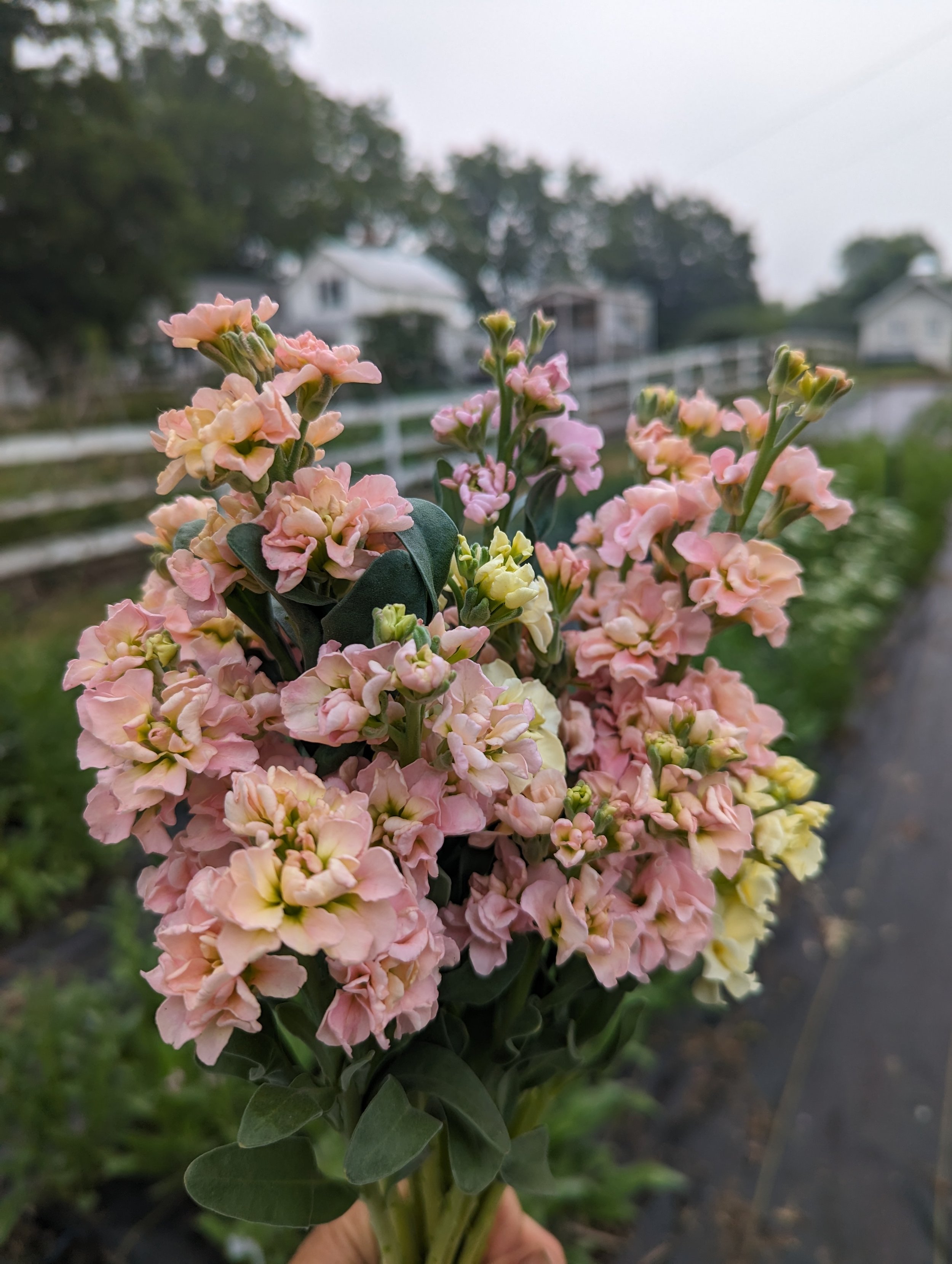
Stock "StoX Champagne"

Stock "Iron Mix"
HOW TO SOW
Stock is easy to start from seed. The trick is to remember to start the seeds early enough in the season!
Transplants or Direct Sow?
Start seeds as transplants about 8-10 weeks before your Average Last Spring Frost. Do not direct sow.
Sow 2 seeds per cell. Stock doesn’t mind growing with a buddy. Germination should take about 10-14 days.
Plant out the seedlings when they are about 4-6 weeks old. It should be cool (about a month before your Average Last Spring Frost), as they require about 2-3 weeks of temperatures between 40-55F to promote flowering. They are frost tolerant, but if it gets well below freezing the plants may need to be covered with a sheet at night.
Since Stock is a one-and-done plant, you may want to plant 2-3 successions about 2 weeks apart. However, remember that planting them too late in the season will often fail because of excessive heat.
If you have a long, cool spring, you may be able to squeeze in 3 successions. But if your weather goes from freezing to broiling (like ours does in Michigan!), you may only get one planting.

Stock seedlings ready for transplant
PLANT SPACING
Stock can (and should!) be spaced close together. We plant 2 seedings in the same planting hole, every 6 inches. This year, I’m going to try 4 inches because even at 6 inches, there is wasted space.

Stock "Iron Mix"
GROWING ON
Stock likes to grow in well-composted, fertile growing beds. Fertilizing is minimal since it’s a one-and-done plant.
Netting or support can be helpful but not completely necessary.
Pinching is NOT recommended for Stock, unless you are growing a variety that is listed as “branching” or “spray-type”, such as “Quartet”.

Stock "Iron Mix"
STAGE OF HARVEST
Harvest the stems when about ⅓ of the blooms are open. The other blooms will open up slowly in the vase. Strip the leaves from the stem to make sure there are no leaves in the bucket or vase that could rot (remember that they are related to broccoli and cabbage… and you know what rotting broccoli and cabbage smell like!)

Stock "Anytime Mix" (Unheated hoophouse grown on the left, field grown on the right)
POST-HARVEST CARE
Besides frequent water changes, Stock requires no other special post-harvest care.

Stock "Anytime Mix" blooming in August!
QUESTIONS?
Ask them here and I’ll get back to you!
Ready for more?
If you’re serious about growing the garden of your dreams this year, register for my online course, “Backyard Cutting Garden 101”. You’ll find everything you need to plan, grow, harvest and arrange your stunning blooms. I can’t WAIT to help you grow! Click on the button below for all the details.

Winter Solstice
On December 21, we celebrate the power of light over darkness… and prepare our hearts for the miracle of Christmas.
Winter Solstice
December 21 marks the Winter Solstice… and the First Official Day of Winter.
In case you are unfamiliar with the term Winter Solstice, it is the time of year with the shortest amount of daylight and the longest night of the year - 9 hours of sun and 15 hours of darkness (except those of us in Michigan know the days feel even shorter than that because the sun rarely shines in Michigan in the winter!).
It’s opposite is the Summer Solstice (the First Official Day of Summer), which occurs on June 21, exactly 6 months apart. On this day, we observe the longest amount of daylight and the shortest night of the year - 15 hours of sun and 9 hours of darkness.

Before I became a farmer, these 2 dates held no significance for me. Sure, I knew the days were longer in the summer and shorter in the winter, but I never paid close attention to the patterns.
Now… my life and livelihood revolve around these days. My year is planned according to daylight hours and the changing of the seasons.
Once I started to pay attention I was surprised to discover that lots of living things are daylight length sensitive…
Plants. Did you know that plants need a certain amount of light/darkness on order in bloom? Poinsettias, for example, need short days/long nights… hence their popularity during the winter.
Animals. Did you know birds only lay eggs when the daylight hours are long enough? Hence the reason chickens don’t lay eggs (or slow down) in the winter. It’s really starting to cramp my style because I want to make lots of Grandma Hamm’s Peanut Butter Cookies!
People. Did you know that SAD (Seasonal Affective Disorder), a type of depression that afflicts many people in northern climates in the winter, is related to lack of light? Yup. I’m one of them.
Many people feel a sense of melancholy, discomfort, restlessness… or maybe even fear during the dark days of the winter.
Gayle Boss, a Grand Rapids, MI based author, describes this haunting feeling powerfully in her Advent book, “All Creation Waits: The Advent Mystery of New Beginnings”.
![20171103_093141[1].jpg](https://images.squarespace-cdn.com/content/v1/582b872529687fd6acb7423d/1544632180242-QP2TIB6ISI1GYD3YBOPA/20171103_093141%5B1%5D.jpg)
According to Boss, those feeling stem back to the days of the early agricultural peoples. In the not so distant past, nearly everyone was intimately connected to the earth and it’s rhythms. Completely and totally dependent on the growing season and the harvest.
After the big fall harvest, it was time to relax and celebrate… but as the days became shorter and the darkness more prevalent, that ancient fear of darkness and death began to creep.
“In December the dark and cold deepen, and our rational minds dismiss it as nothing. We know that on December 21, the winter solstice, the sun will begin it’s return to our sky. But our animal bodies react with dis-ease. We feel, The light - life- is going. Those particularly afflicted know themselves as SAD - Seasonal Affective Disorder - suffers. Some of us cope by seizing distractions the marketplace gleefully offers: shopping, parties and more shopping....
...for us also, as for our ancestors, the dark end of the year brings unrest. It is an end. It comes without our asking and makes plain how little of life’s course we control. The uncertainty, we don’t know how to mark. And so it marks us. We feel weighted, gloomy even, and we feel guilty because voices everywhere in myriad ways sing our “It’s the Most Wonderful Time of the Year.””

I have felt this “dis-ease” that Gayle talks about, the guilt of feeling quiet, inward and reserved when the rest of the world seems to be pressing outward - embracing loud music, glitter, and non-stop parties.
I’ve learned to accept my dis-ease and make space to lean into it.
All through Advent, I have a ritual of turning on lights in our windows at dusk, while saying a short prayer “Come, oh come, Immanuel. Push back the darkness.”
It’s a small assurance to me that the days WILL get longer, that He will come to push back the darkness, figuratively… and one day, literally.
But… this IS the season of celebration, after all! As we inch closer to Christmas, my heart begins to lighten.
On the Winter Solstice, December 21, I like to fill my house with people I love and all things warm, cozy and comforting, as we celebrate the day when the darkness no longer reigns… the day that we start moving toward the light.
During our Winter Solstice party, we illuminate the house with only candles and Christmas lights. We serve heavy, warm comfort foods. We feast, we drink, we share warmth, we share light, we share laughs, we share hope for the future.

It’s our way of celebrating that the darkness no longer has power over the light. That even when the darkness seems to be overwhelming, we trust that brighter days are coming.
What a powerful way to prepare our hearts for the Celebration of the Birth of Immanuel, “God with Us”. The solstice fills us with hope, excitement and anticipation.
On the Winter Solstice, we will fill our home with light, love and laughter. We celebrate the power of light over darkness. We rejoice in hope, even when the darkness presses in all around us.
“The people walking in darkness have seen a great light;
on those living in the land of deep darkness a light has dawned.”
- Isaiah 9:2

P.S. If you don’t have a copy of Gayle’s book, I highly recommend it. Each day is a short reading to prepare for Advent. It’s written for adults, but appropriate for children and families too. In fact, the book is based on Advent reading Gayle wrote for her own children.
I think you’ll love it as much as I do.
![20181205_122107[1].jpg](https://images.squarespace-cdn.com/content/v1/582b872529687fd6acb7423d/1544632147946-HBYM8RBLF507QW5O0GNK/20181205_122107%5B1%5D.jpg)

How to Grow: Strawflowers
Strawflowers are excellent in fresh or dried arrangements!
How to Grow: Strawflowers
Strawflowers are having a bit of a revival these days and I’m happy to see that!
I’ll admit, when I started growing flowers and thought of Strawflowers, I could only think of the harsh, gaudy dried flower arrangements I saw growing up in the 80’s. Blech.
Thankfully, plant breeders are now cultivating Strawflowers in soft, elegant tones and shades. They are so beautiful and unique that they even have a place now as a wedding flower.
Strawflowers are considered an “Everlasting Flower” and once they are dried, you can use them for years. I decorate my house all winter with dried Strawflowers…. And they are excellent as a “wearable” flower, for flower crowns, corsages or boutonnieres.
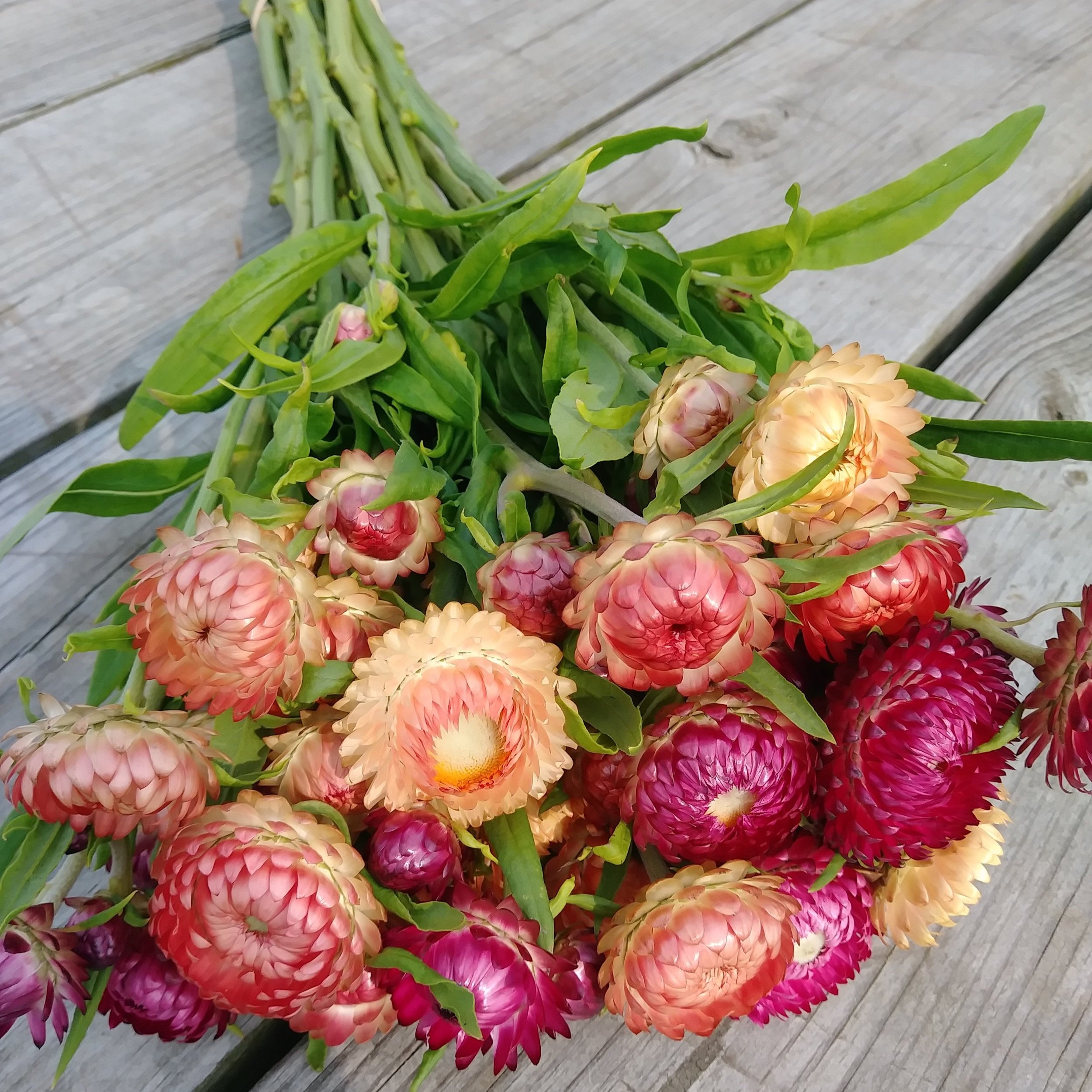
“Apricot” Strawflower
Let’s look at the Pros and Cons of growing Strawflowers for cut flower use.
PROS
They come in a multitude of colors and sizes.
They are easy to grow and actually thrive in poorer soils.
The plants are productive for a long period of time.
They have a long vase life of over 7 days.
They are an “Everlasting Flower”.
CONS
They are susceptible to Aster Yellows, a disease spread by leaf hoppers.
They can be tricky to germinate. Fresh seed from a reputable source is essential.
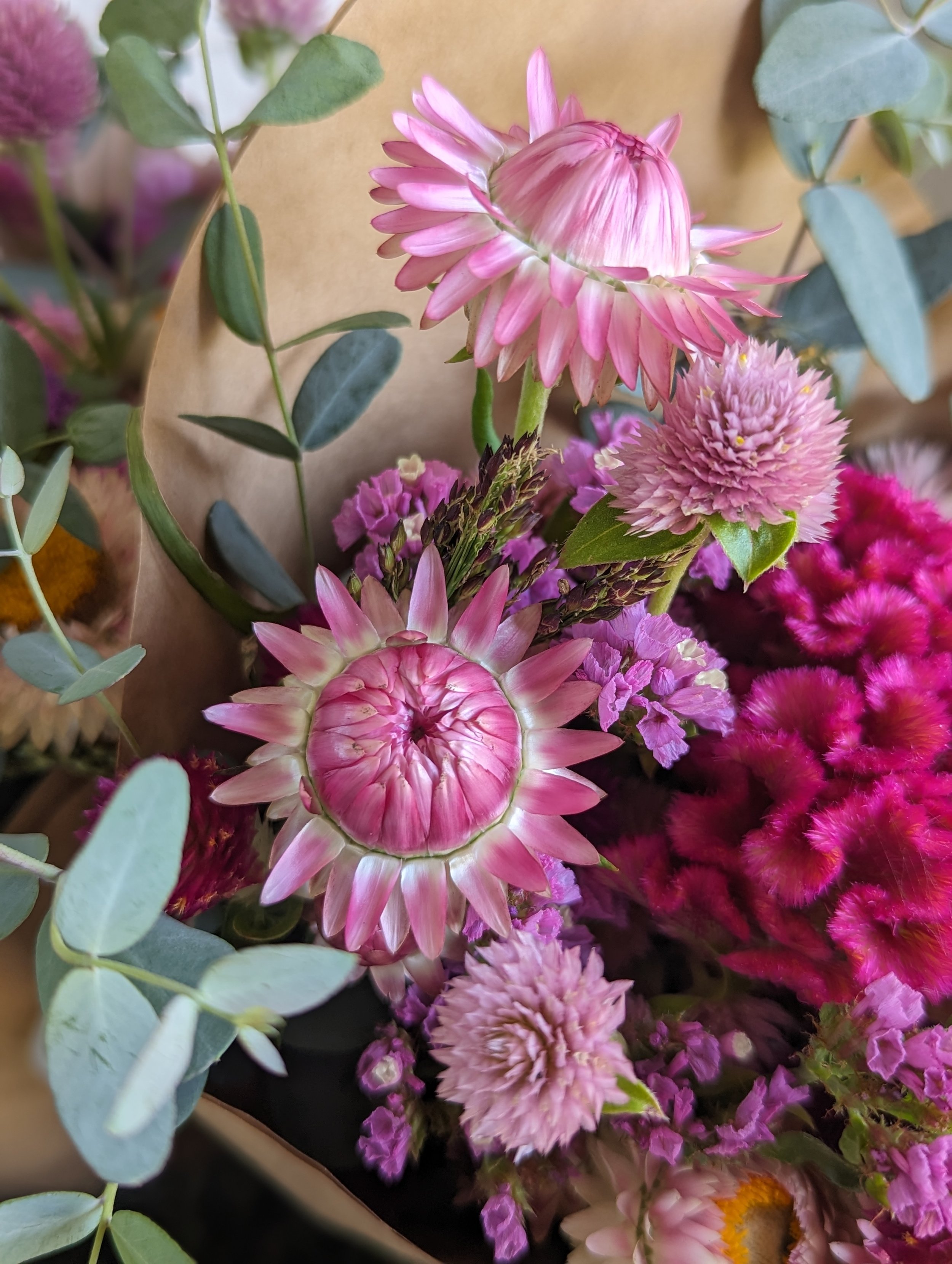
“Bright Rose” Strawflower
CHOOSING SEEDS
Strawflowers come in a variety of colors, so it really comes down to personal preference.
Personally, I prefer the pastel shades, as they are easier to incorporate into bouquets and arrangements, but the brighter colors have their place too.
Here are a few of my favorite Strawflowers to grow for cut flower use:
“Vintage White”

“Apricot” Strawflower
HOW TO SOW
Strawflowers are slightly cold hardy (they will survive a few light frosts in the fall), but we generally wait until after the last spring frost to put out the transplants. They are not fussy about soil conditions and in fact seem to prefer "poor" soil.
Transplants or Direct Sow?
For people with shorter growing seasons (like us in Michigan), transplants are recommended. Start the seeds indoors about 3-5 weeks before your last spring frost and transplant outside after the last frost.
Strawflowers can be direct sown in climates with a long growing season. Direct sow after the last spring frost.

PLANT SPACING
Plants should be spaced at 9-12”. The plants can grow up to 4 feet tall, so netting may be required if you live in a windy area.
Strawflowers are quite unsightly looking plants, so they might not be a plant you want to grow in a prominent spot.
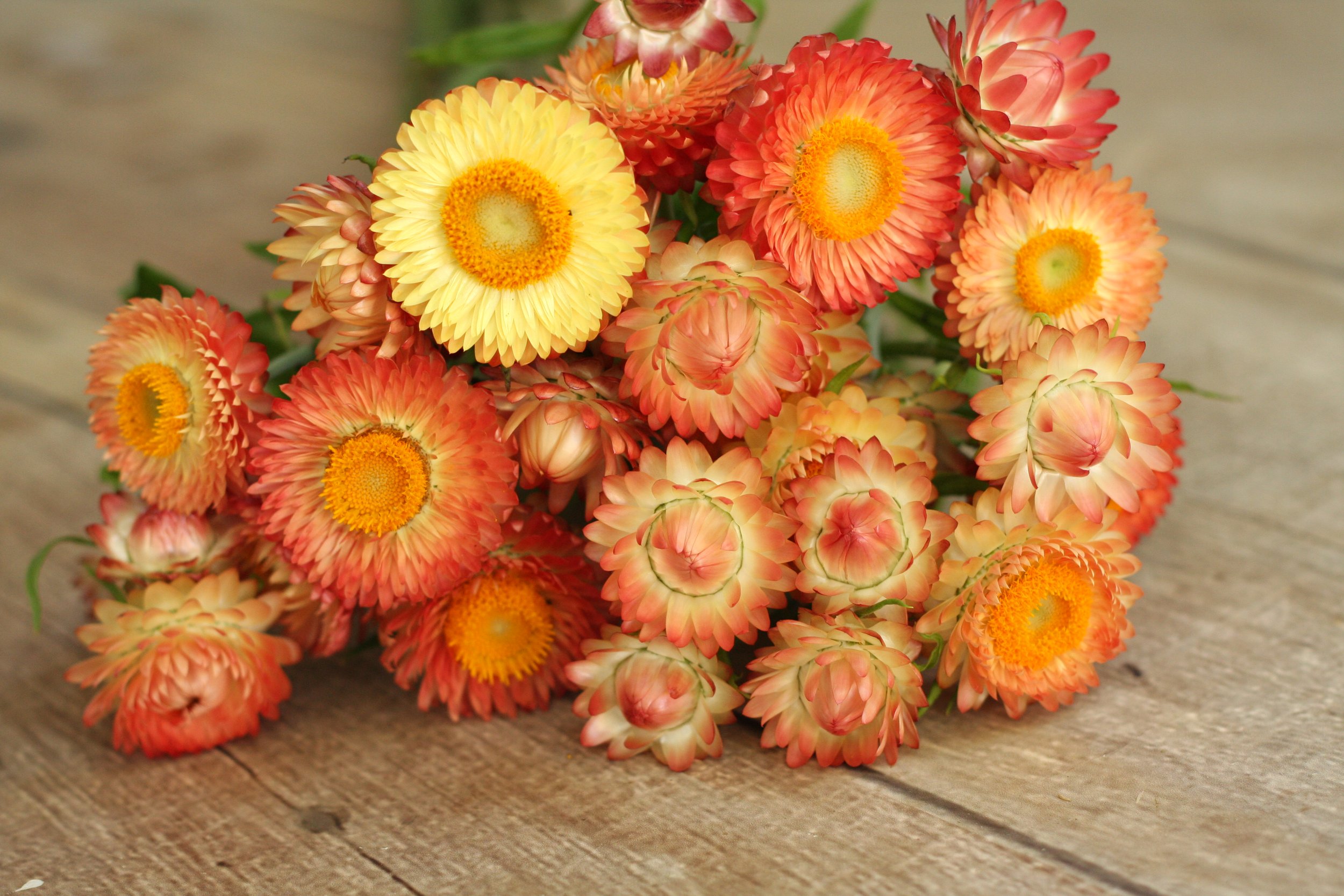
“Apricot” Strawflower
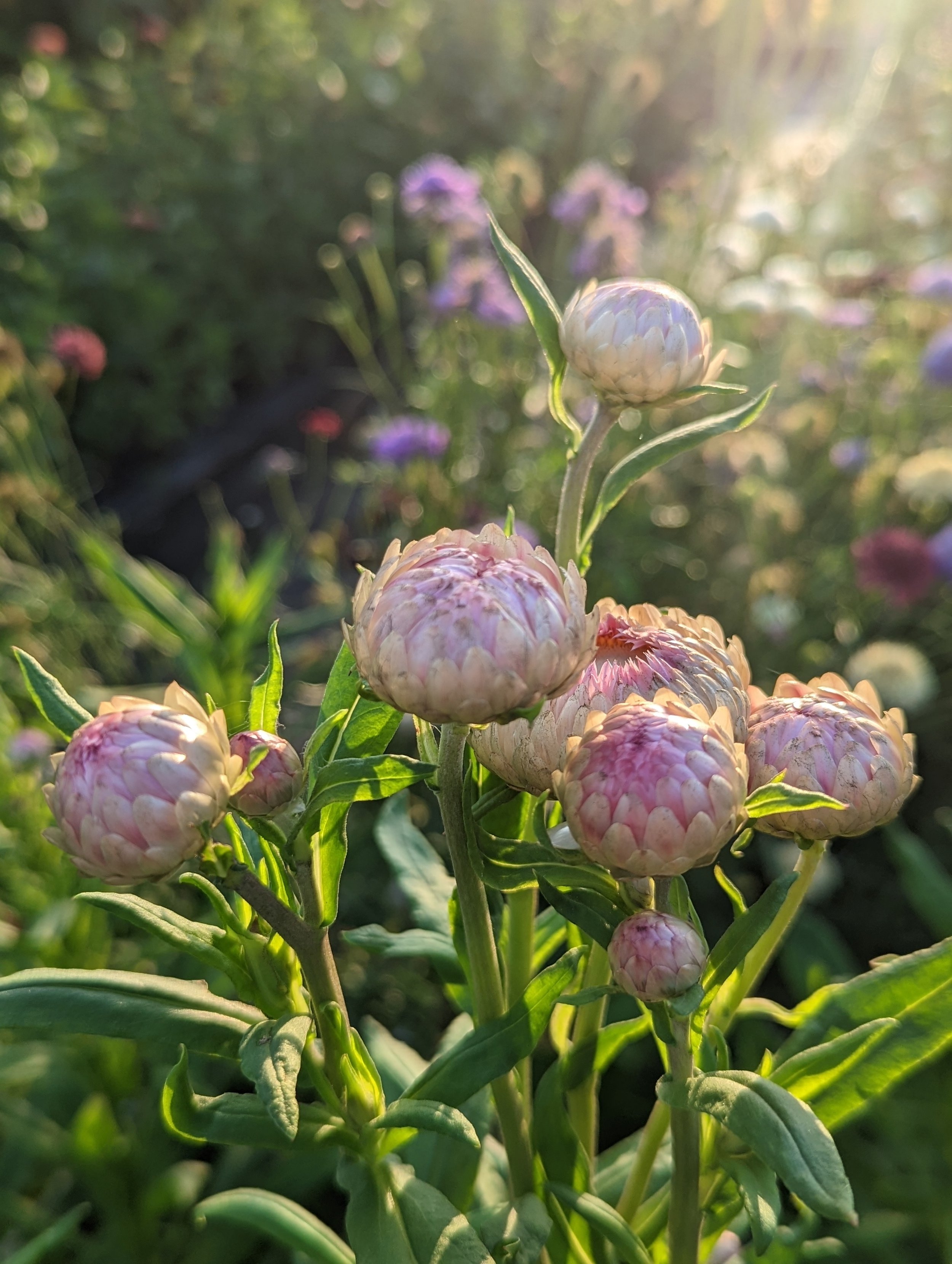
“Silvery Rose” Strawflower
GROWING ON
Like all direct sown or transplanted seedlings, be sure the plants have consistent watering when they are small and getting established.
By the time the plants are large enough to bloom, they are quite self reliant. Deep watering once a week should be sufficient (water until soil is saturated as far down as you can stick your finger in the soil).
Pinch the plants when they are about a foot tall. This causes the plant to branch out and produce way more blooms.
If flowers are harvested and spent blooms are “deadheaded” (removed), the plants will continue to send up blooms until frost or cold weather arrives.
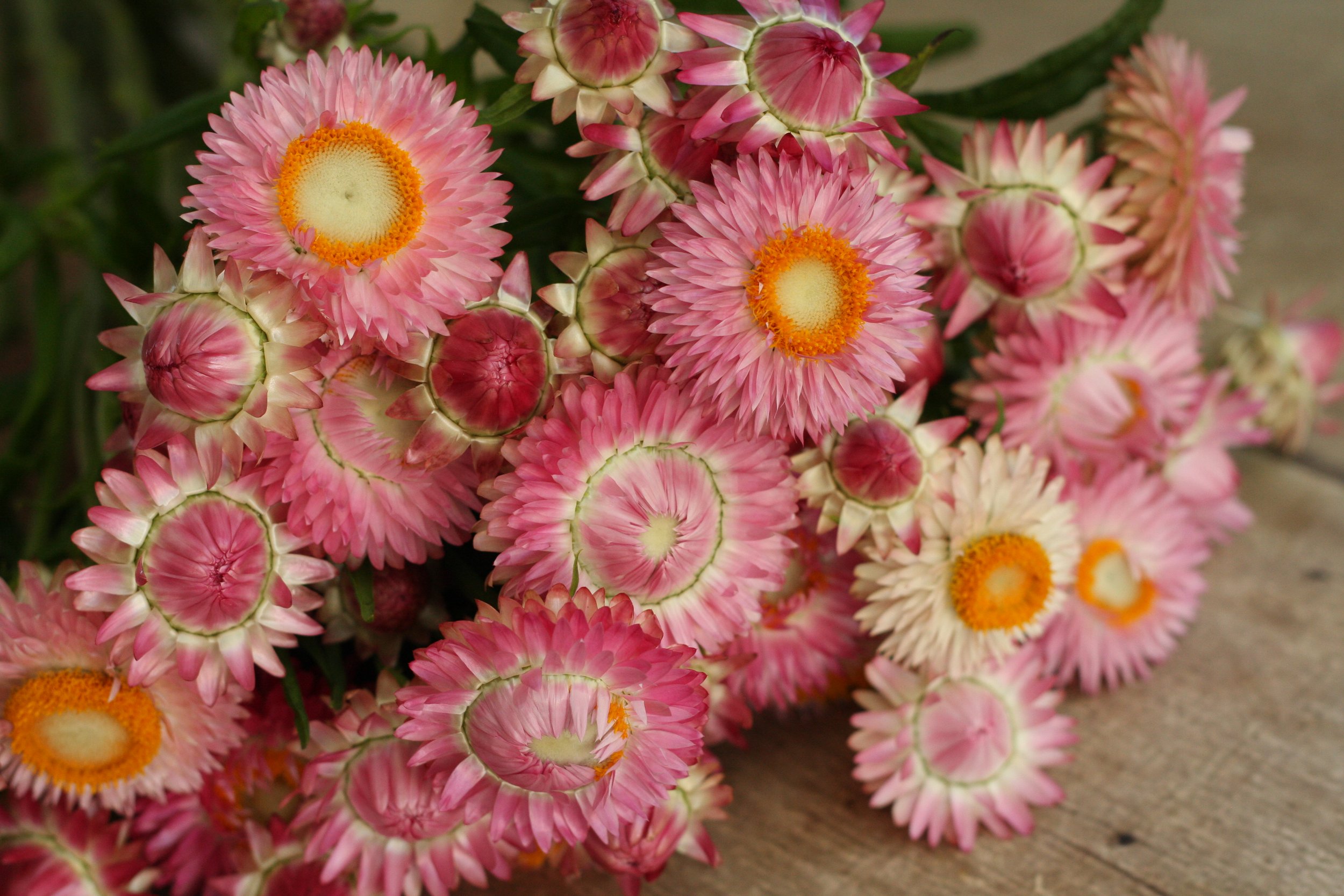
“Bright Rose” Strawflower
STAGE OF HARVEST
Knowing the correct stage of harvest for Strawflowers can be tricky. If harvested too early, they will flop over and not recover.
As with Zinnias, it can be helpful to perform the “Wiggle Test” with Strawflowers. Grasp the stem about 8” below the bloom and wiggle. If the bloom flops around, it’s not ready yet. Wait until the stem stiffens up more.
You can also gauge the stage of harvest by looking at the bloom. You want to harvest when the bloom is still mostly closed, as it will continue opening up after being cut. In the photo below, you can see the 2 blooms on the right were harvested too late and “blew open”. The others were harvested at the correct stage.
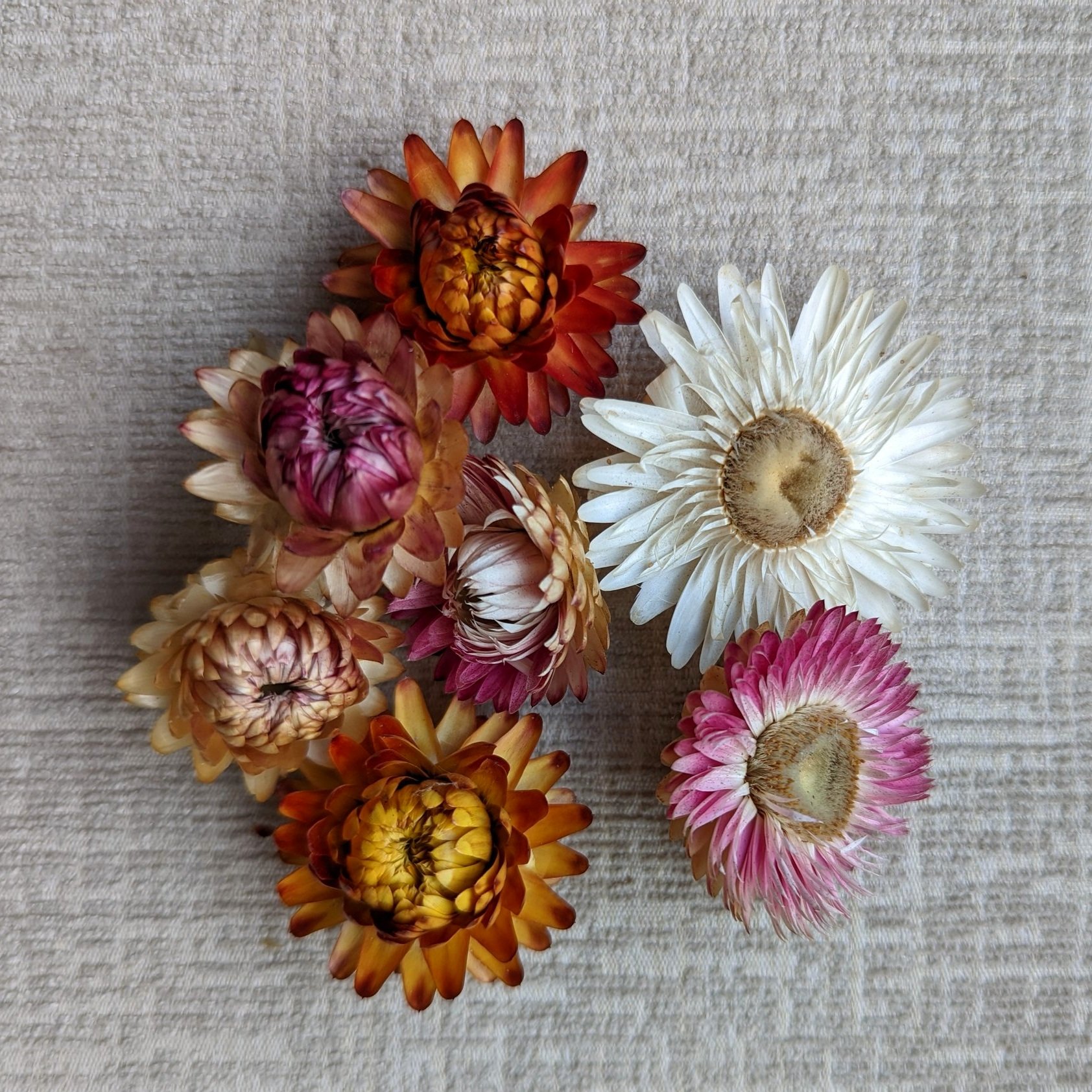
Note that the blooms close up at night and open again as the sun rises. While I always encourage harvesting early in the day, you may actually need to wait a few hours after sunrise to allow the flowers to open up a bit so you can get a better idea of what stage they are at.
As with all cut flowers, be sure to cut deeply into the plant between 2 sets of leaves, cutting stems at least 18” long. Deep cuts signal the plants to produce MORE flowers to replace the one you just cut.

POST HARVEST CARE
After harvest, allow stems to condition for a few hours in a cool, dark place in fresh water.
If you want to dry the blooms, you can hang them upside down in a warm, dry place out of direct sun. The stems may become fragile and break, but the blooms are quite study.
Some people prefer to dry the blooms on floral wire instead. To do this, simply pop the bloom off the stem, take a length of floral wire and stick it though the bottom of the bloom. Or you can simply allow the blooms to dry in a basket or bowl.

QUESTIONS?
Questions or comments? Leave them below and I’ll get back to you!
READY FOR MORE?
If you’re serious about growing the garden of your dreams this year, register for my online course, “Backyard Cutting Garden 101”. You’ll find everything you need to plan, grow, harvest and arrange your stunning blooms. I can’t WAIT to help you grow! Click on the button below for all the details.

How to Grow: Sunflowers
Everybody loves Sunflowers!
How to Grow: Sunflowers
Sunflowers. Does anything shout “Summer!!!!” more than bright, sunny sunflowers?!?
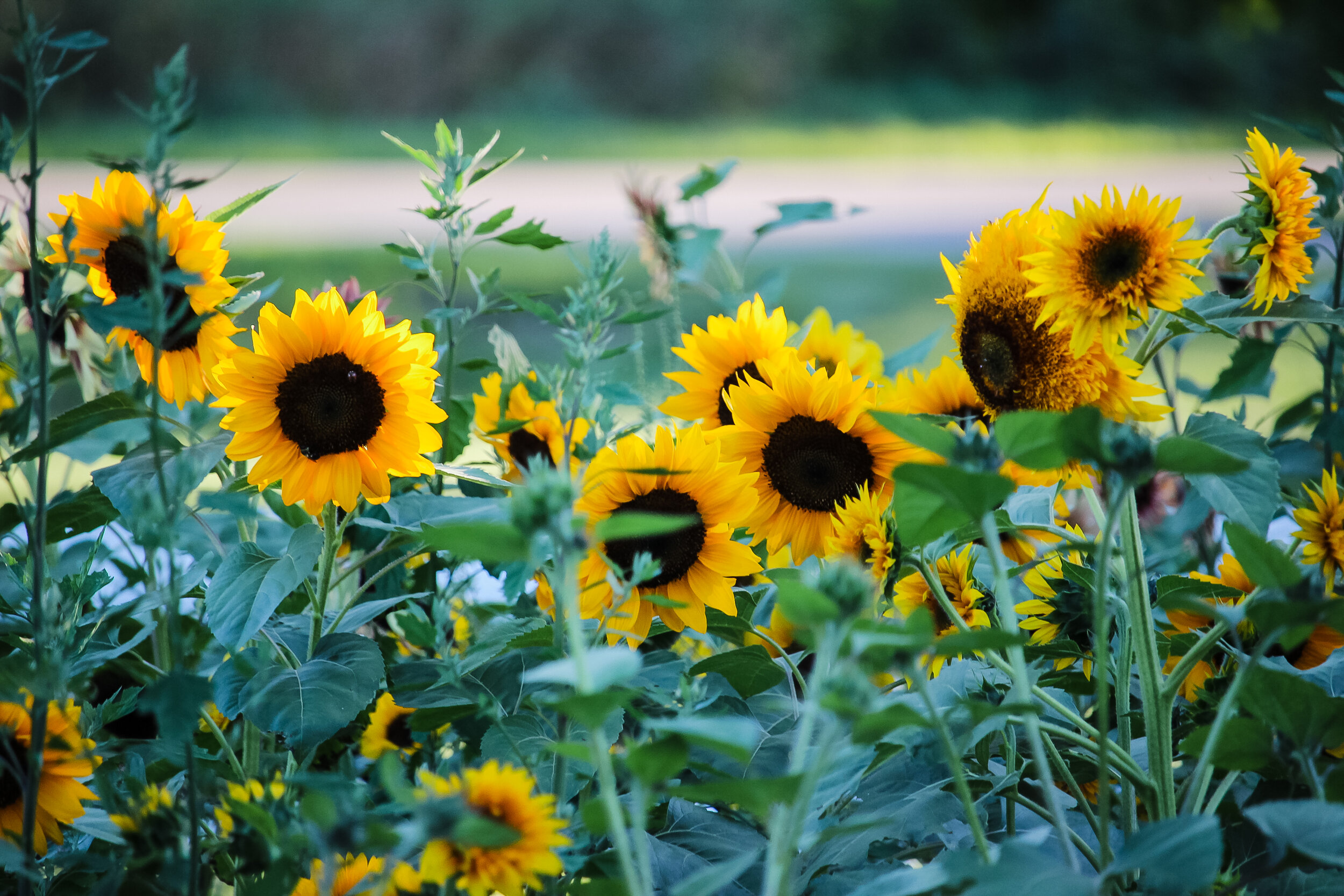
They are eternally cheerful and loved by many…. Including our animal friends. Birds and bees adore sunflowers as a source of pollen and seeds. Be sure to plant a few extra just for them!
Years ago, I planted several different types of sunflowers in my vegetable garden to attract pollinators. The next spring, I noticed sunflowers sprouting all over the garden. How about that! The birds had sowed the seeds for me! I let them grow and watched all the beautiful flowers grow, and feed the birds… and this cycle continues today.

I grow lots of sunflowers to harvest for cut flower use, but I always leave all the ones in my vegetable garden for the birds and the bees ;)
Let’s look at the Pros and Cons of growing Sunflowers for cut flower use.
PROS
They come in a multitude of colors and sizes, from 2 foot tall dwarf varieties to 12 foot tall Mammoth varieties.
They are easy to grow, perhaps the easiest of all flowers.
They provide pollen for pollinators (honeybees, bumblebees, butterflies, etc.)... unless you purchase “pollenless” varieties.
They are bright and cheerful in bouquets.
They have a good vase life of 5 -7 days, with proper harvest and care.
CONS
They are a “once and done” type plant, meaning once they bloom, they are finished and will not bloom again.
They tend to muck up the vase water quickly.
They transition from “not quite ready” to harvest to “too late!” very quickly… sometimes in just hours.
They don’t last long in the vase if you allow the flowers to be pollinated.

CHOOSING SEEDS
There are so many different Sunflowers to choose from. It can feel very overwhelming, so let’s break it down a bit.
It’s important to know:
1. Not all Sunflower varieties make good cut flowers. When you see photos of HUGE sunflower fields, those are usually sunflowers grown for bird seed or sunflower oil. These do not make good cut flowers.
You want to look for “Ornamental” sunflowers. This is the kind you will find in most gardening seed catalogs. Some types are better than others for cut flower use.
2. Ornamental Sunflowers can be divided into 2 main categories:
Single Stem: This type produces one flower on one stem.
Once the bloom as been harvested, it will not send up another bloom.
Some are available as “pollenless”. This is helpful for people with allergies.
They grow extremely fast, some varieties going from seed to bloom in 55 days!
Because they are a “once and done” type flower, you will need to plant new seeds every 10-14 days May - August if you want blooms all summer into fall.
Branching: This type will send out multiple blooms. The blooms will mature over a few weeks, extending the bloom time of the plant.
Most Sunflowers grown for garden or decorative use are Branching varieties.
The stems are often too short to make a good cut flower (unless you “pinch” the plants very early in their growth… I’ll show you how to do it under the “Growing On” section)
Even though they produce multiple blooms, you will still need to plant new seeds about every 2-3 weeks May-August if you want blooms all summer.
Here are a few of my favorite Sunflowers to grow for cut flower use:
“ProCut Orange” (single stem)
“ProCut Plum” (single stem)
“ProCut Brilliance” (single stem)
“Vincent’s Choice” (single stem)
“Cherry Rose” (branching)
“Autumn Beauty” (branching)
“Soraya” (branching)
“Starburst Panache” (branching)
“Starburst Lemon Aura” (branching)
“Strawberry Blonde” (branching)

“Ruby Eclipse” Sunflower
HOW TO SOW
Sunflowers are heat-loving, summer-blooming flowers.
Here in Michigan, our last spring frost is about May 15, so we wait until that date to sow our first round of seeds. Depending on the variety and the soil temperature, we can expect to see blooms in 50-90 days - from late June to mid-July.
Transplants or Direct Sow?
Sunflowers are very forgiving and can be transplanted or direct sown.
If you have problems with birds, squirrels or chipmunks, you may want to start the seeds indoors as transplants to prevent the seeds from being gobbled up! Don’t worry - the seeds grow FAST and will be ready to transplant out in less than 2 weeks. Do not leave them in the seed trays for much longer than that.
You can also direct sow the seeds. It really couldn’t be easier. Poke a hole with your finger, drop in 2 seeds (in case one doesn’t germinate), cover the hole and you’re done. Thin to one plant per hole if they both germinate.
PLANT SPACING
For Single Stem Sunflowers: Plants should be spaced 4-9” apart. I usually do 6” spacing. The closer the plants are spaced, the smaller the blooms will be, which is more desirable for bouquets. Plants spaced farther apart will produce larger blooms.
For Branching Sunflowers: Plants should be placed 12”-24” apart. I usually do 18” spacing.
GROWING ON
Sunflowers are quite tolerant of most soil types and will thrive without much fuss.
For Branching Sunflowers ONLY: Branching sunflowers are capable of producing multiple long-stemmed blooms per plant IF THEY ARE PINCHED.
Plants that are not pinched usually produce many blooms, but the stems are so short and thick, it renders them unusable for cut flower use.
In contrast, pinched plants can produce 6-10 long-stemmed blooms that are perfect for cut flower use. 10 blooms from 1 seed! That is an incredible ROI (Return on Investment)!

Pinching MUST take place early in their growth, when the plants are about 8”-12” tall (less than knee high). Pinching alters the growth habit of the plant, causing all the stems to originate from one point on the plant.
To pinch, simply locate the central bud on the plant (it will be tiny, less than the size of a pea) and dig it out with your thumbnail. That’s it!
DO NOT PINCH SINGLE STEM SUNFLOWERS.

STAGE OF HARVEST
We’ve all oooh and aaahed over those gorgeous photos of sunflower fields…. But did you know sunflowers grown for cut flower use actually need to be harvested BEFORE they open?
Yup. That’s right. BEFORE they open up, BEFORE you can see their pretty faces.
If you miss harvesting them at the ideal stage, you can still harvest as long as the petals are pointing forward, not back (knowing they won’t last as long in the vase as blooms cut at the ideal stage). Once they are pointing back, you might as well leave them for the bees and the birds.
As you can see in the photo below, these Sunflower blooms all blew open faster than we could harvest! We got a day of rain… and then they all opened up in the span of a few hours. While some were too far gone to harvest (and now worthless to me), they sure looked nice in the field!

Pictured below is a bloom that I would consider too far gone to harvest (especially because it has insect damage). I left this one for the birds!

The one pictured below is at the ideal stage of harvest. For the longest vase life, you want to harvest the stem when you notice a few petals starting to lift off the face.

Cut the stems about 24” deep and strip off nearly all the foliage (you can allow a few leaves to remain at the top, if desired).
When Sunflowers are cut at this stage, you will get a much longer vase life. The flower will open fully over the next day or 2.
POST HARVEST CARE
If you are displaying the Sunflowers immediately, no special treatment is needed, besides allowing them to rest in a cool, dark area for a few hours.
However, if you want to store them for later (because they all tend to be ready at once!), you can place them in a cooler or refrigerator for about a week. This will delay opening. Once removed from cold storage, the blooms will open up naturally.

Sunflower are a somewhat “dirty flower”. They tend to make the water get gross. Dirty water breeds bacteria, the enemy of cut flowers. Bacteria significantly reduces vase life.
To combat this, it’s important to change the water at least once a day or use commercial flower food (easily found on Amazon - I like “Floralife”).
QUESTIONS?
Questions or comments? Leave them below and I’ll get back to you!
Ready for more?
If you’re serious about growing the garden of your dreams this year, register for my online course, “Backyard Cutting Garden 101”. You’ll find everything you need to plan, grow, harvest and arrange your stunning blooms. I can’t WAIT to help you grow! Click on the button below for all the details.